

India's e-commerce industry continues to grow rapidly.
A joint report by Flipkart and Bain & Company reported 25% e-commerce growth in Q1 2026.
This e-commerce growth means that brands are getting more orders. And with more orders, more exchanges and returns also come.
That is why return management is not a need; it is an essential part of every e-commerce business.
Because how a company deals with returns and their management directly impacts their profitability, customer satisfaction, and retention.
With online return rates reaching 30-40% in India and global e-commerce returns hitting $816 billion in 2023, every e-commerce brand needs to choose the best among the types of return management methods.
So, let us have a look at different "Types of Return Management Methods in Ecommerce Explained".
What is Return Management?
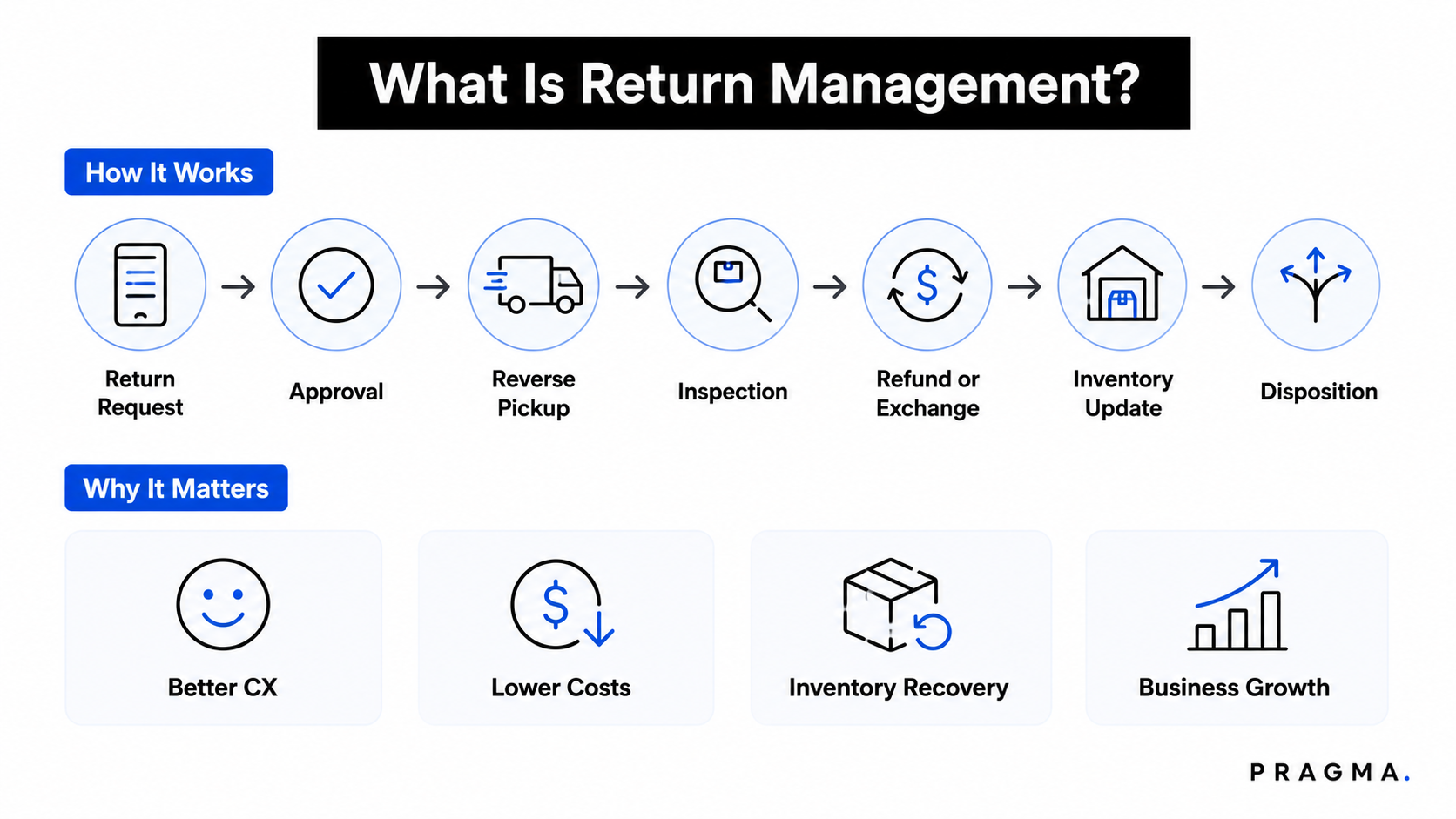
Return management is the process of handling products that customers send back after purchase.
The process includes:
- Return request creation
- Return approval
- Reverse pickup scheduling
- Product inspection
- Refund or exchange processing
- Inventory updates
- Product disposition decisions
Each stage affects costs and customer satisfaction. With the help of modern return management systems, D2C brands can automate these stages.
Pragma Return Management System processes returns 75% more than manual processes and provides a hassle-free experience for both consumers and businesses.
Why Return Management Matters in E-commerce?
Here is why returns management is essential for every e-commerce brand in India:
High E-commerce Return Rates
The e-commerce return rates in India in 2026 sit around 19% to 21% overall, while different industries show different return rates depending on the category.
The clothing and fashion industry sees a 25-40% of return rate due to size and fit issues being the most common reason, and electronics items show an average of 10-15% returns from defects.
Also, India has more than 60% of orders placed as COD, where the customer has no prior commitment to take the product and generally returns it when not needed or a change of mind.
Due to this much difference and volume of returns in different industries, it becomes essential for e-commerce brands to adopt the right among various types of returns management methods.
Returns Impact Profitability
Many brands calculate only refund amounts. The actual cost is much larger.
A return often includes:
- Marketing acquisition cost
- Forward shipping cost
- Reverse shipping cost
- Warehouse handling cost
- Product quality inspection cost
- Customer support cost
Blue Dart recently highlighted that reverse logistics has become a strategic area for margin protection across India's e-commerce ecosystem. It consumes 8-10% of total e-commerce revenue in India.
Those brands that are operating with thin contribution margins, unmanaged returns quickly become a profitability issue.
Customer Experience Depends on Returns
Customer satisfaction greatly depends on the post-purchase experience given to them.
As customers remember:
- How easy the return process was
- How quickly were refunds processed
- How smoothly the exchanges were completed
- Whether communication remained transparent
Also, some reports state that:
- 92% of consumers return to brands with easy return processes
- 81% switch to competitors after bad return experiences
- 62% of Indian online shoppers check return policies before purchasing
When such a percentage of revenue through buyers is focused on return processes, return policies, and experiences they got, having good return management becomes important for every Indian e-commerce brand.
Returns Affect Inventory and Operations
Every returned product is considered inventory in transit.
The longer products stay in reverse logistics networks, the lower their resale value becomes.
Blue Dart notes that faster validation, grading, repackaging, and redeployment directly reduce value erosion.
For fast-moving D2C categories, delayed return processing creates:
- Inventory inaccuracies
- Stock availability issues
- Delayed cash recovery
- Working capital pressure
To avoid such circumstances, companies must choose the best type of return management methods that are appropriate according to their industry.
Types of Return Management Methods
There are different types of return management methods that can be used by e-commerce companies. The important thing is which method is to be chosen when.
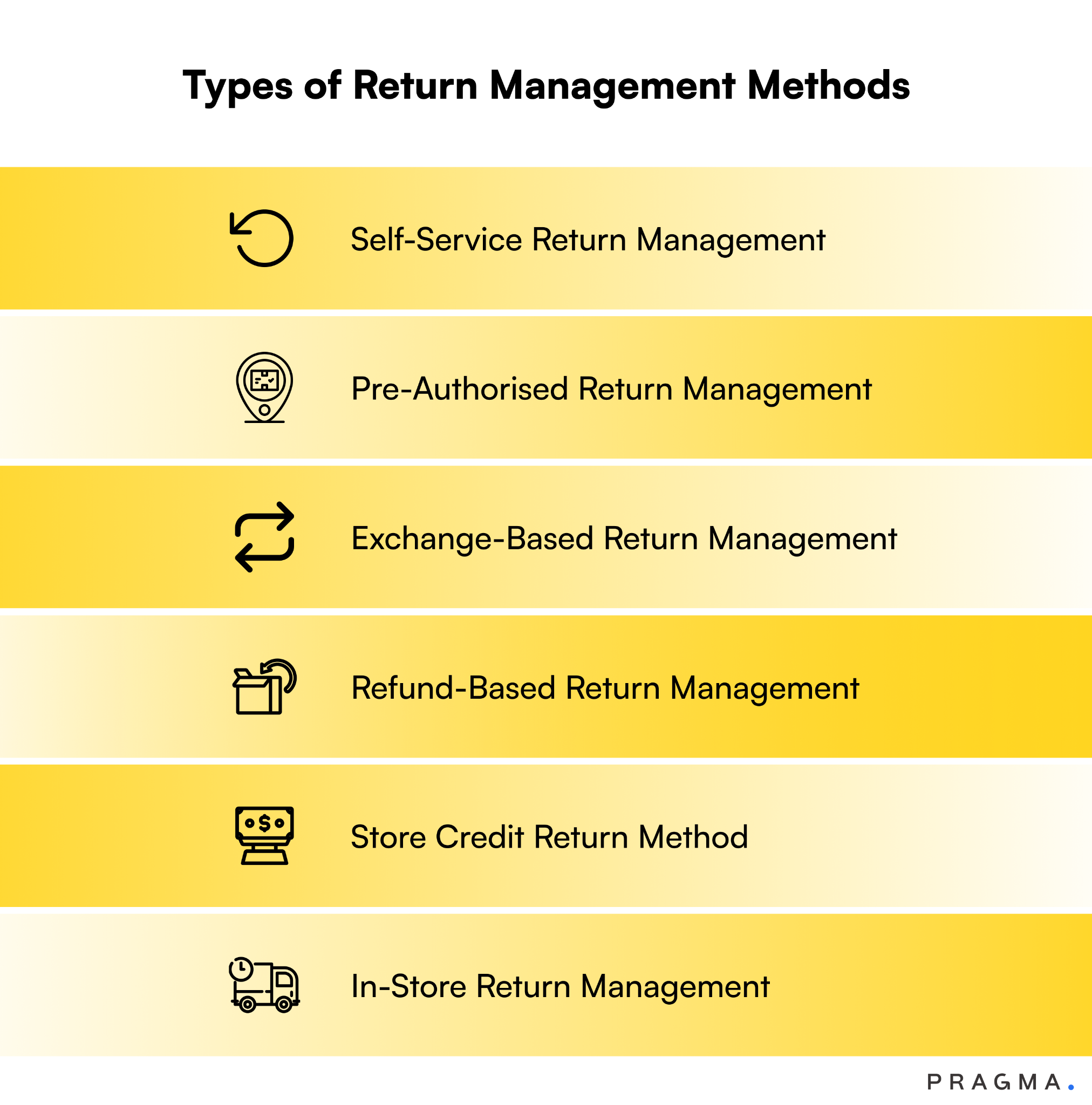
Because having only a single type of return management method is not enough. Today, customers expect different solutions, like some want a refund, but some seem good with store credits.
Therefore, every e-commerce brand should choose what suits them from these types of return management methods:
Self-Service Return Management
This is a type of return management method where customers initiate returns through a return portal without contacting customer support. This method reduces customer service workload by 60-80%.
The system allows customers to:
- Select return reasons
- Request exchanges
- Schedule pickups
- Track return status
This method provides the following benefits:
- Lower support workload
- Faster return initiation
- Better customer experience
- Standardised workflows
Pragma Return Management System helps brands automate post-purchase workflows and reduce manual intervention during return initiation.
It provides customers with branded return pages where they can easily initiate returns, and all those pages are built as per the brand's guidelines and custom domain names.
Pre-Authorised Return Management
Pre-authorised is a type of return management method where returns require approval before customers ship products back.
This method provides control over return eligibility and helps prevent fraud while maintaining customer service quality.
It is mostly used with electronics, high-value products, luxury goods, and customised products.
The approval process involves verification steps:
- Order validation and purchase verification
- Return policy compliance checking
- Product eligibility confirmation
- Customer history analysis
- Fraud risk assessment
- Return reason evaluation
Processing time affects customer satisfaction. Manual approval takes 24-48 hours. Automated systems approve eligible returns instantly while flagging complex cases for human review.
Pragma Return Management System automates pre-authorisation through configurable rules engines. The system checks return eligibility based on purchase date, product category, customer history, and return reason.
Exchange-Based Return Management
Exchange-based return management is one of those types of return management methods where customers are provided with a new item of a similar product in a different size or colour.
Nowadays, shopping places like Myntra are also providing exchanges with another item, where customers can take another product and adjust the amount if underpaid or overpaid.
This exchange-based return management includes:
- Size exchanges in apparel
- Colour or style variations
- Product upgrades
- Defective item replacements
Many D2C fashion brands prioritise exchanges because acquiring a new customer often costs more than retaining an existing one. And this type of return management can help in revenue retention, lower refund volume, and better customer satisfaction.
With the Pragma Return Management System, customers are allowed to get both return and exchange options.
Refund-Based Return Management
In this type of return management method, customers get refunds for their orders.
Here, the customer is given the money to their source of payment method.
Refund processing involves multiple steps:
- Return authorisation and approval
- Product receipt and inspection
- Refund calculation and processing
- Payment gateway communication
- Financial reconciliation
- Customer notification
Pragma's return management system integrates with major payment gateways and accounting systems. The platform processes refunds automatically upon return approval or product receipt.
Store Credit Return Method
In this return method, customers receive store credit instead of a cash refund.
This provides the following benefits:
- Revenue preservation
- Higher repeat purchase probability
- Reduced cash outflow
Many D2C brands encourage store credit by offering additional value compared to refunds.
In-Store Return Management
Omnichannel brands accept online returns at physical locations. This method provides convenience for customers while reducing shipping costs and enabling immediate exchanges or refunds.
This way of return management provides the following benefits:
- Reduced reverse logistics costs
- Faster processing
- Better customer convenience
- Cross-selling opportunities
- Customer relationship building
Back-End Return Processing Methods
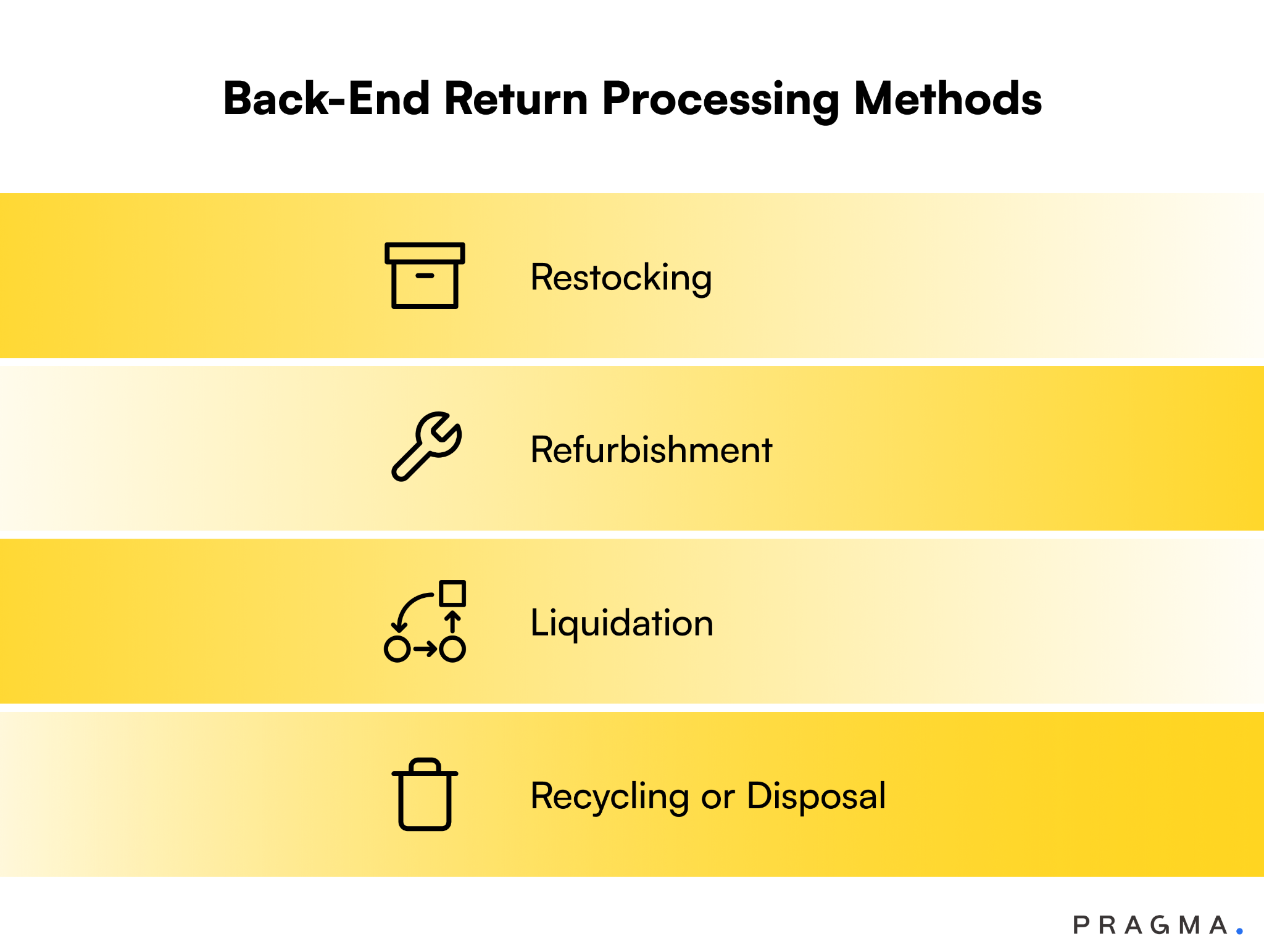
Back-end return processing decides what happens after a product comes back from a customer.
Here are different ways in which the product is handled after coming back to the warehouse:
Restocking
When the condition of the product is intact, it goes back into sellable inventory.
The warehouse places the item back into active stock.
This method protects revenue. It reduces loss. It improves inventory utilisation. Fast restocking improves availability for high-demand SKUs.
Refurbishment
The returned product goes through repair, cleaning, testing, or repackaging before resale.
This applies to electronics, appliances, accessories, and premium goods. Small defects get fixed. Packaging gets replaced. Product moves back into secondary inventory.
Refurbishment improves recovery value. It reduces write-offs and extends the product lifecycle.
Liquidation
Returned product moves to discount channels when full resale value recovery fails.
Brands sell through outlet stores, B2B bulk buyers, or clearance marketplaces. Pricing drops below the original selling price.
This method helps recover working capital quickly.
Recycling or Disposal
Product moves out of inventory when resale or refurbishment is not possible.
Damaged goods, hygiene-affected items, expired stock, and unusable returns enter this stage.
Recycling supports material recovery. Disposal removes dead stock from warehouse systems.
How E-commerce Brands Choose the Right Return Management Method?
E-commerce brands should not pick return methods randomly.
As each decision links directly to cost, speed, fraud exposure, and repeat purchase behaviour.
Here is how brands should choose the right one among different types of return management methods:
Product Category
Product category decides the types of return management methods.
Fashion in India sees 25% to 40% return rates, in which fit and size issues dominate. This pushes brands toward exchange-based return management. Exchanges reduce refund loss and keep revenue inside the system.
Electronics sit at 8% to 15% return rates. Defect-driven returns require pre-authorised return management. Brands verify the issue before pickup to avoid fraud and unnecessary reverse logistics costs.
Beauty products stay under 10% return rate. Hygiene rules push refund-restricted or store credit return methods instead of open returns.
So, this is how, on the basis of the category of the products, brands can choose the type of return management method.
Return Volume
Return volume decides system type.
D2C brands that have a low volume of returns often run manual return management with basic refund workflows.
Whereas high-volume brands handling thousands of returns per day shift to self-service return management with automation for approvals, pickup creation, and status tracking.
Large-scale operations also move toward automated exchange-first flows to reduce refund pressure and warehouse congestion. This is where the Pragma return management system can help.
Customer Expectations
Customer expectations decide the return experience model. Over 90% of shoppers check the return policy before purchase.
In India:
- COD buyers expect fast pickup and instant visibility.
- Fashion buyers expect self-service return management with exchange-first options.
- Electronics buyers expect pre-authorised return management with validation steps.
- Premium buyers expect fast refund-based return management with real-time updates.
This is how the return method aligns with the trust level, not only the product type.
Operational Costs
Each return includes:
- Forward shipping cost
- Reverse pickup cost
- Warehouse inspection cost
- Restocking cost
- Refund processing cost
- Support cost
When the total cost per return increases, brands shift away from refund-based return management toward exchange-based or store credit return management.
Exchange-based flows reduce cash outflow. Store credit improves retention and reduces refund leakage. Refund-only models increase working capital pressure.
Fraud Risk
Fraud risk decides the approval method.
- High fraud categories require pre-authorised return management. Brands verify claims before pickup to avoid empty box returns and product swapping.
- Medium-risk categories use hybrid models with self-service initiation plus backend approval.
- Low-risk categories allow instant self-service return management to maintain speed and customer experience.
Higher fraud exposure leads to stricter approval layers, whereas lower fraud exposure allows faster automation.
What are The Common Challenges in Return Management?
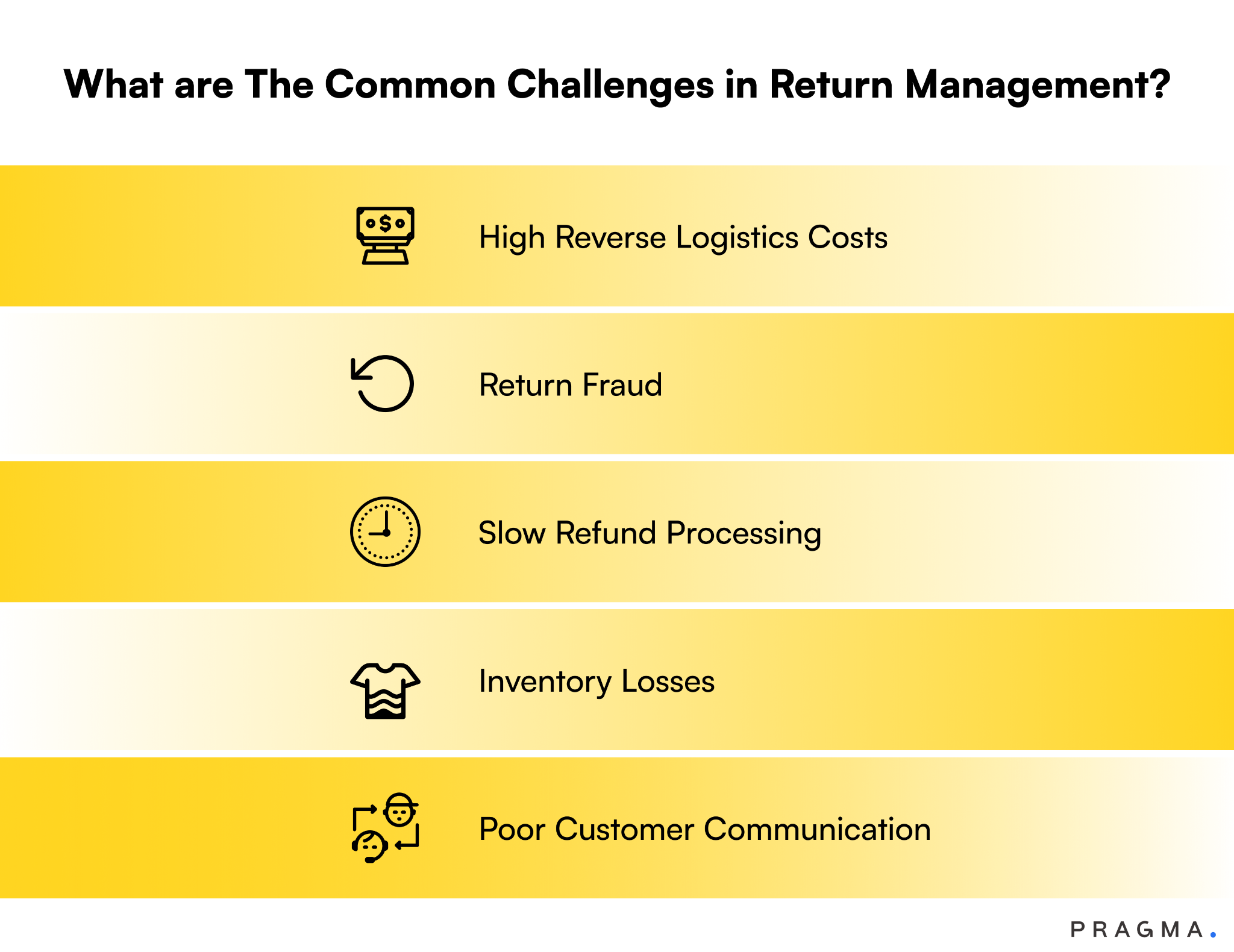
Here are some common challenges that e-commerce brands face during return management:
High Reverse Logistics Costs
Reverse logistics costs continue to rise as e-commerce expands across India.
India's reverse logistics market is expected to grow significantly over the coming years, driven by e-commerce growth and increasing product returns. (IMARC Group)
Shipping returned products costs more than forward logistics due to individual package handling.
To have a check on this, Pragma Return Management System integrates with multiple logistics partners to optimise return routing. The system selects the most cost-effective carrier based on location, product type, and service requirements.
Return Fraud
Return fraud costs retailers billions annually.
Common fraud types include returning stolen merchandise, used items claimed as defective, or receipt fraud.
To prevent such returns, brands need stronger verification processes and better return data visibility.
Here are some prevention strategies that e-commerce brands can use:
- Return policy restrictions
- Customer identification requirements
- Product condition verification
- Return frequency limits
- Value thresholds for approval
- Staff training programs
Slow Refund Processing
Not every time do brands fast-track the processing of returns. Processing delays occur during the inspection, approval, and payment processing stages.
And a delay in this frustrates customers and generates support inquiries, which become difficult to handle manually.
Automation reduces processing time from days to hours.
Automated systems such as Pragma Return Management System eliminate manual touchpoints while maintaining quality standards.
Inventory Losses
Returned products don't always return to a sellable condition.
Damage during shipping, customer use, or storage issues creates inventory write-offs that reduce profitability.
But this can be minimised if brands make use of these prevention strategies:
- Improved packaging design
- Faster processing times
- Better storage conditions
- Quality control procedures
- Insurance coverage
Poor Customer Communication
Customers expect proactive updates about their returns from initiation to the completion of refunds.
Lack of visibility often leads to:
- WISMO tickets
- Support calls
- Negative reviews
That is why automation is a necessity here. Automated communication systems provide proactive updates at each processing stage. Customers receive branded notifications via email, SMS, and mobile apps.
With Pragma WhatsApp Business Suite, customers can get notifications about their order status, returns, and refunds automatically without any hassle.
5 Best Practices for E-commerce Return Management
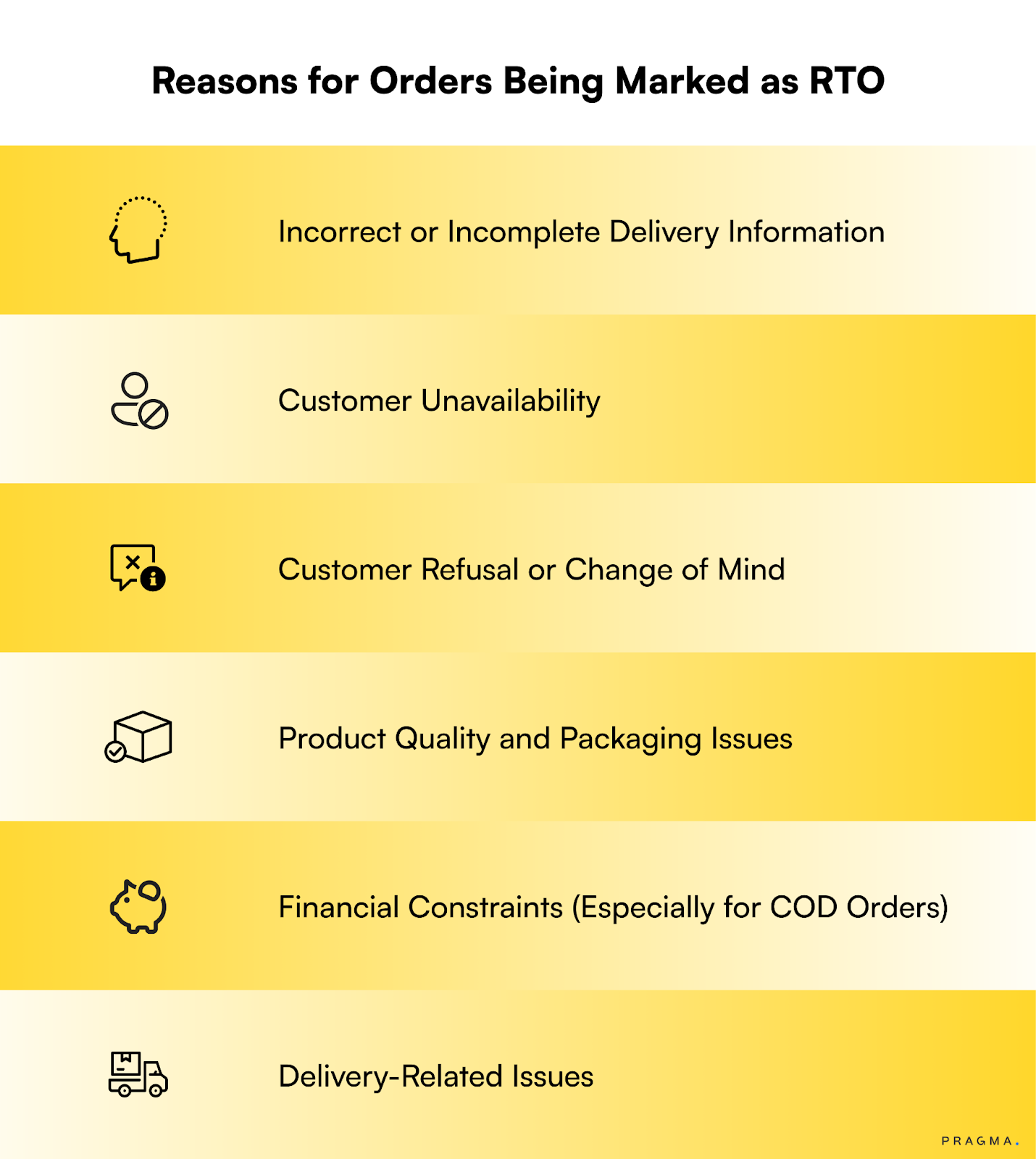
Looking into the market, we have gathered five best practices for effective return management that every Indian D2C brand should implement to make their returns easy and effective:
Offer Self-Service Returns
86% of shoppers want easy return processes.
Self-service portals reduce support costs while improving customer experience.
Brands should implement branded return portals that match their website design. Provide clear instructions and multiple return options.
All these are supported with Pragma RMS, where dedicated return pages can be made as per the brand's guidelines to initiate easy returns.
Encourage Exchanges Over Refunds
Exchanges retain revenue while satisfying customer needs.
Brands should offer incentives like free shipping or bonus credits for exchanges.
Also, they have to ensure that exchange processes are also as simple as refunds. So, this is how they can retain their revenues, too, along with a satisfying solution to the customers.
Use Automation for Faster Processing
Automated systems process returns faster and more consistently than manual methods.
Automation reduces errors and improves customer satisfaction.
Pragma RMS automates return approvals, label generation, and refund processing. The system integrates with your existing e-commerce platform and payment systems.
Provide Real-Time Tracking
Customers want visibility into return status. E-commerce brands should provide tracking information from pickup through refund completion.
Send proactive updates at each processing stage. Include estimated completion times and next steps.
This way, they can reduce their customer care queries and provide satisfaction to their customers regarding their returns and refunds.
Analyse Return Data
Return data reveals product issues, customer preferences, and operational inefficiencies. Regular analysis helps improve products and processes.
Leading D2C brands track:
- Return reasons
- Product-level return rates
- Courier performance
- PIN code trends
- Customer behaviour patterns
This data analysis helps brands reduce future return volumes.
How Technology Improves Return Management?
As technology has entered every industry today, similarly, it is being helpful in return management too. Here's how it helps:
AI-Based Return Prediction
Now, machine learning models identify high-risk orders before shipment.
Research shows predictive models help e-commerce companies reduce return-related losses by identifying return probability before purchase.
Brands can analyse:
- Product history
- Customer behaviour
- Category trends
- Location risk
This way, they can reduce their losses. Pragma RTO Suite also works on this principle, where it flags high-risk orders before shipping and prevents future RTOs.
Automated Return Portals
Modern return portals handle the complete return process without human intervention.
Customers can initiate returns, generate labels, and track status automatically, which reduces manual effort across teams.
Pragma return management system provides customers with branded return portals where they can easily initiate returns, upload media, and provide return reasons.
WhatsApp Return Updates
WhatsApp has become a key post-purchase communication channel in India.
Brands use automated notifications for:
- Return approvals
- Pickup status
- Exchange updates
- Refund confirmations
Integrated Reverse Logistics Systems
Many brands operate across multiple couriers, warehouses, and communication channels.
Pragma RMS helps centralise operational data across:
- Courier systems
- Return workflows
- Customer communication
- Order intelligence
- Performance analytics
It completely controls the flow of packages based on a rule-based reverse shipment generation mechanism.
Examples of Return Management Solutions
Have a look at the leading return management solutions for Indian D2C brands:
Pragma
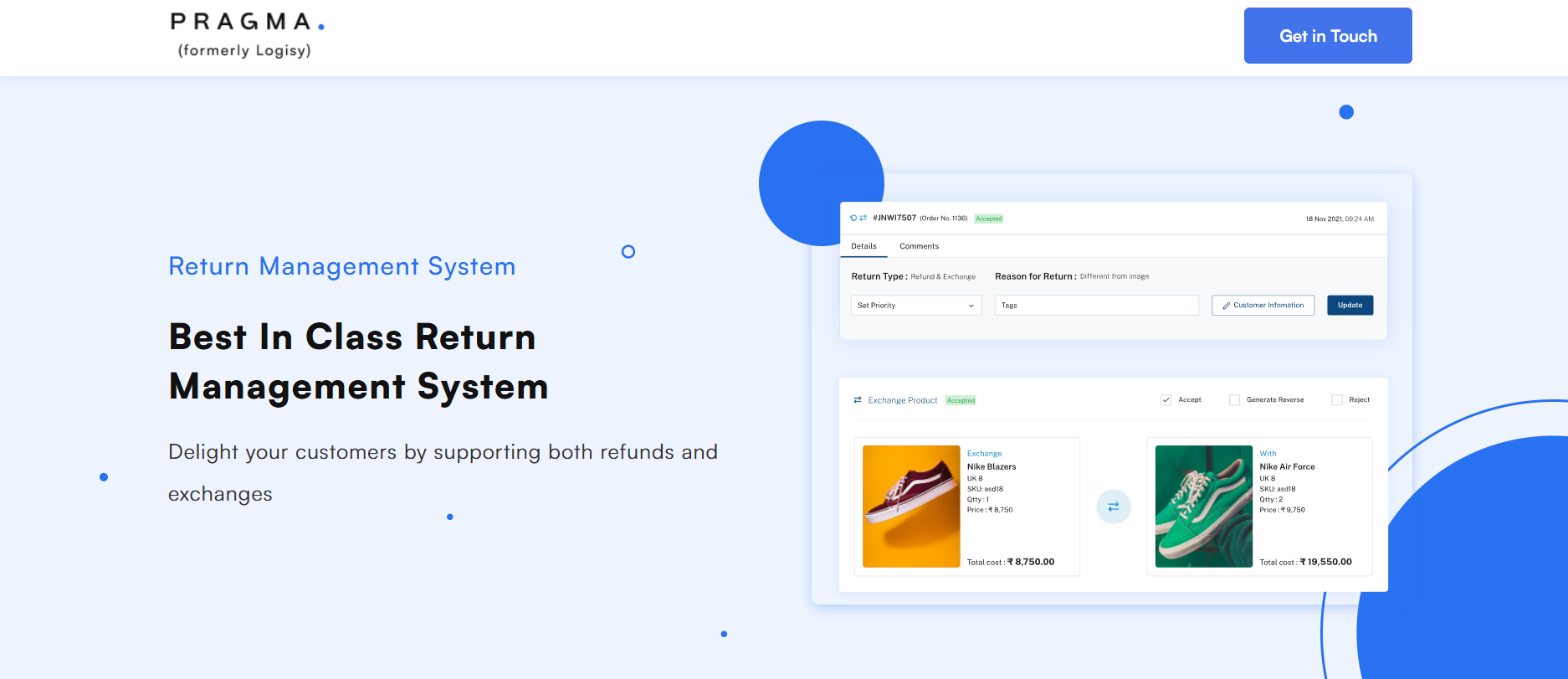
Pragma offers comprehensive return management for D2C brands. The system provides self-service portals, automated processing, and real-time tracking.
Key Features
- Self-service return initiation for customers
- Branded return portals made per the brand’s guidelines
- Rule-based return approval system
- Instant exchange option to retain sales
- Automated refund and store credit processing
- Return reason capture for analytics
- Courier pickup scheduling and tracking
- NDR (non-delivery/return) lifecycle handling
- Smart return eligibility checks (window, condition, SKU rules)
- Warehouse integration for faster reverse flow
- Return insights dashboard for product and courier optimisation
Loop
Loop specialises in Shopify return management. The platform focuses on exchanges and store credit to retain revenue.
Key Features
- Self-service returns portal for customers
- Easy product exchanges instead of refunds
- Automated refund and return approvals
- Smart return rules for brands
- Real-time return tracking and analytics
Narvar
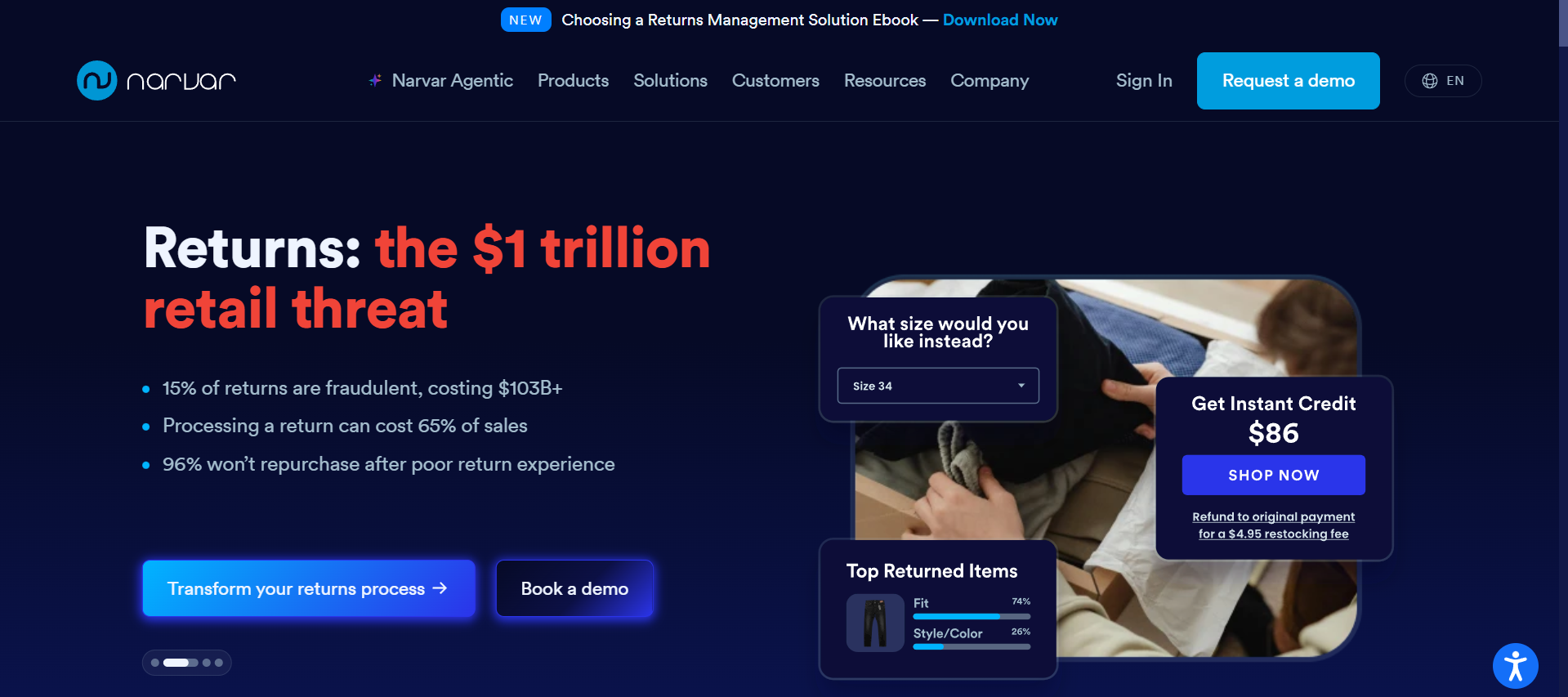
Narvar provides post-purchase experience management, including returns. The platform serves large enterprise retailers.
Key Features
- Post-purchase experience management
- Return tracking and notifications
- Enterprise-grade customer communication
- Order visibility across channels
- Branded return journeys
AfterShip
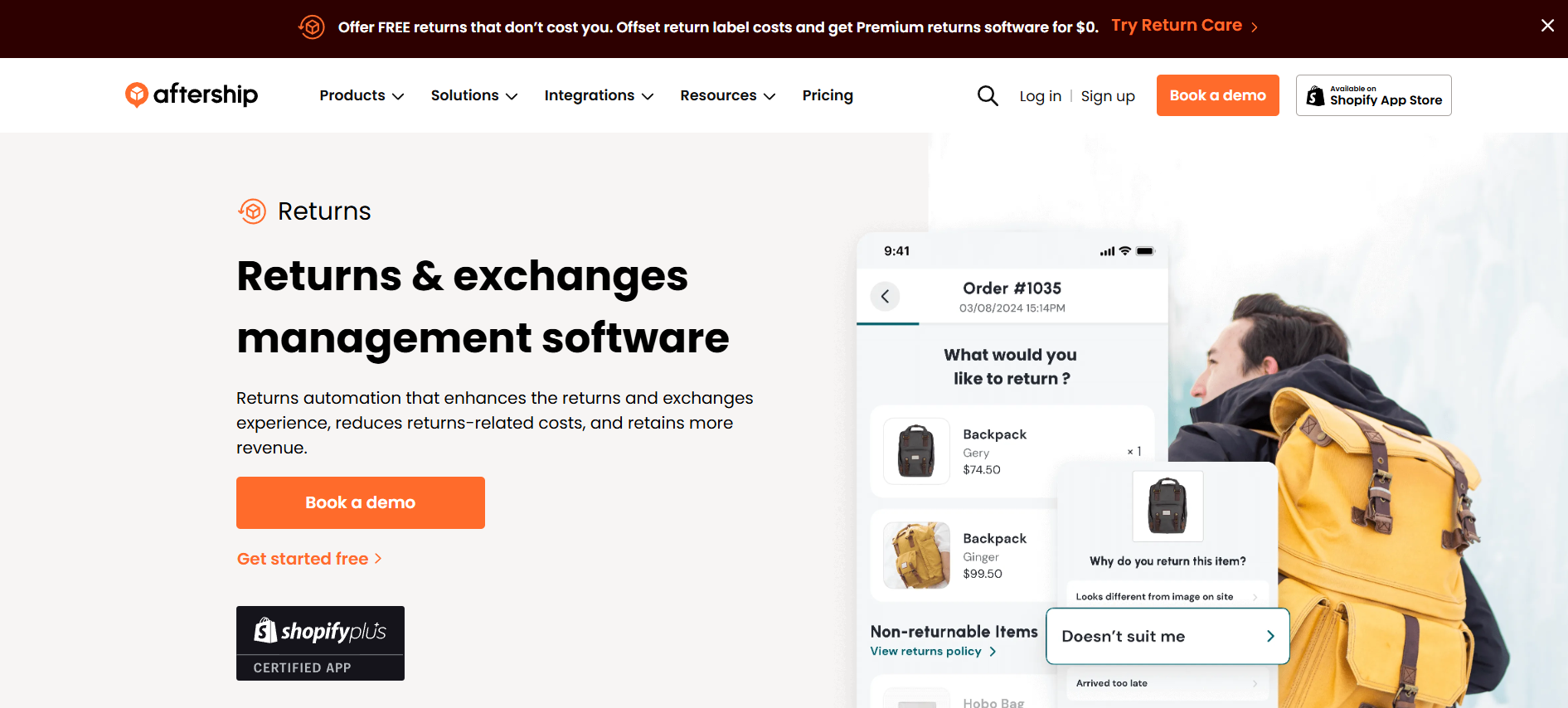
AfterShip offers return management as part of its shipping and tracking platform. The solution includes fraud detection and analytics.
Key Features
- Shipment tracking and returns automation
- Multi-carrier integration
- Return portal for customers
- Real-time delivery updates
- Analytics for logistics performance
Happy Returns
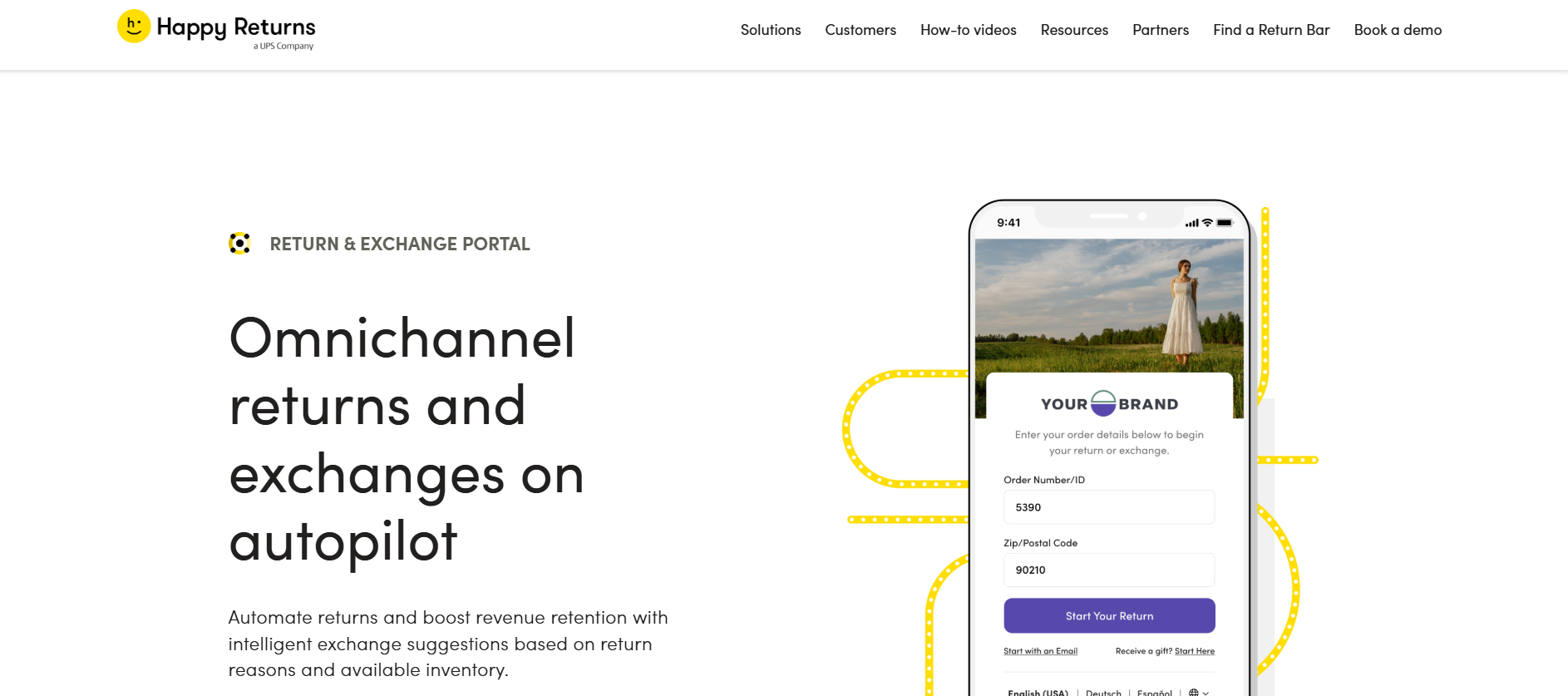
Happy Returns, owned by UPS, provides return bar locations and reverse logistics services primarily in the US market.
Key Features
- Box-free return processing
- In-store return drop points
- Faster reverse logistics flow
- Instant product inspection support
- Reduced shipping and packaging costs
parcelLab
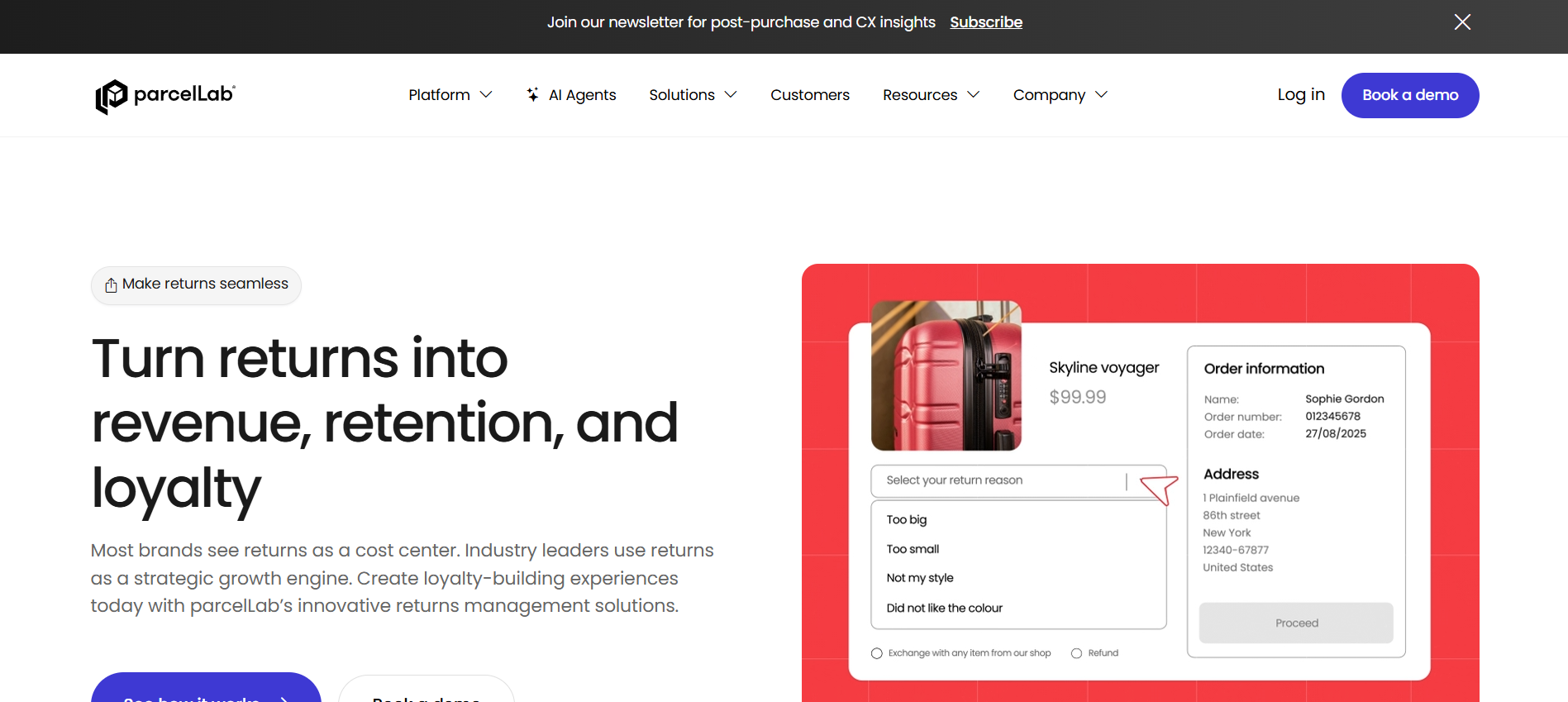
ParcelLab focuses on post-purchase communication and return tracking. The platform provides branded customer experiences.
Key Features
- Post-purchase communication platform
- Branded tracking pages
- Return and refund automation
- Customer notification workflows
What is The Future of Return Management in E-commerce?
The future of return management is all about making returns faster and easier for both brands and customers.
Many e-commerce brands are using automation to approve returns, schedule pickups, process refunds, and send updates automatically.
Brands are also encouraging customers to choose exchanges or store credit instead of refunds to reduce losses.
Technology helps brands track returns, manage inventory, and keep customers informed throughout the process.
A recent Blue Dart report highlighted that reverse logistics is becoming more important for e-commerce brands because it affects costs, inventory, and customer satisfaction.
Final Thoughts
So, to conclude, here we will say that returns are no longer a back-office process.
They directly influence profitability, customer retention, inventory recovery, and operational efficiency.
Brands handling thousands of monthly orders need visibility across return requests, reverse logistics, exchanges, refunds, inventory recovery, and customer communication.
Pragma helps e-commerce operations teams centralise these workflows, identify issues, and make faster decisions with proper data analysis.

FAQs (Frequently Asked Questions On Types of Return Management Methods in E-commerce Explained)
1. What are the different types of return management methods in eCommerce?
The most common return management methods include refunds, exchanges, store credit, instant exchanges, returnless refunds, and repair or replacement programmes, depending on the product category and business model.
2. Which return management method is best for eCommerce businesses?
The best return management method depends on the product type, margins, customer expectations, and operational capabilities. Many eCommerce brands use a combination of refunds, exchanges, and store credits to balance customer satisfaction and profitability.
3. What is the difference between refunds, exchanges, and store credit?
Refunds return money to the customer, exchanges replace the product with another item or variant, and store credit allows customers to use the value of the return for future purchases.
4. What is a returnless refund in eCommerce?
A returnless refund allows customers to receive a refund without returning the product. It is typically used for low-value items where reverse logistics costs exceed the product value.
5. How do exchanges help reduce return-related losses?
Exchanges help reduce losses by retaining revenue within the business, lowering refund volumes, and improving customer retention while still resolving customer issues.
6. What is the role of reverse logistics in return management?
Reverse logistics manages the movement of products from customers back to warehouses or sellers, making it a critical component of efficient return management operations.
7. How can eCommerce brands optimise their return management process?
Brands can optimise return management by automating workflows, simplifying return requests, improving communication, analysing return reasons, and streamlining reverse logistics operations.
8. What are the common challenges in return management for eCommerce brands?
Common challenges include high reverse logistics costs, fraudulent returns, delayed processing, inventory reconciliation issues, poor visibility, and customer dissatisfaction.
9. What tools help manage returns in eCommerce?
Tools include return management systems, reverse logistics platforms, customer communication tools, warehouse management systems, and analytics solutions that automate and track return operations.
10. Why is return management important for D2C brands in India?
Return management is important because it directly impacts profitability, customer experience, inventory efficiency, and long-term customer retention, especially in categories with high return volumes.
Talk to our experts for a customised solution that can maximise your sales funnel
Book a demo

.webp)
.png)