

RTO spikes rarely begin at the doorstep. By the time deliveries start failing in bulk, the underlying issues have usually been in motion for days, sometimes weeks. For D2C brands in India, these failures are often misdiagnosed as last-mile problems, when the earliest warning signs actually surface much earlier in the order lifecycle. The first mile, where orders are confirmed, packed, and handed off, quietly determines whether a shipment ever had a realistic chance of success.
First-mile signals that reliably precede RTO spikes (what to instrument) shifts the focus upstream. It examines the operational, behavioural, and system-level indicators that consistently show up before RTO rates climb.
Rather than reacting to courier NDRs or delayed scans, the intent is to help teams recognise risk while intervention is still possible. By instrumenting the right first-mile signals, brands can move from post-failure analysis to early prevention, reducing avoidable RTOs without adding friction to everyday operations.
Why do RTO spikes almost always originate in the first mile?
Failures surface late, but risk accumulates early
Most teams start investigating RTOs once courier NDRs pile up. By then, the window for meaningful intervention has already closed.
In reality, RTOs are rarely random last-mile failures; they are the final outcome of weak signals that appeared during order confirmation, address capture, fulfilment readiness, and early customer engagement.
The first mile is where intent, accuracy, and feasibility intersect. If any of these break down, the probability of delivery success drops sharply, even if the courier executes perfectly. Brands that instrument first-mile signals consistently see RTO spikes coming several days in advance, giving them time to intervene selectively instead of firefighting at scale.
Which order confirmation signals indicate weak delivery intent?
Not all “placed” orders are equally real
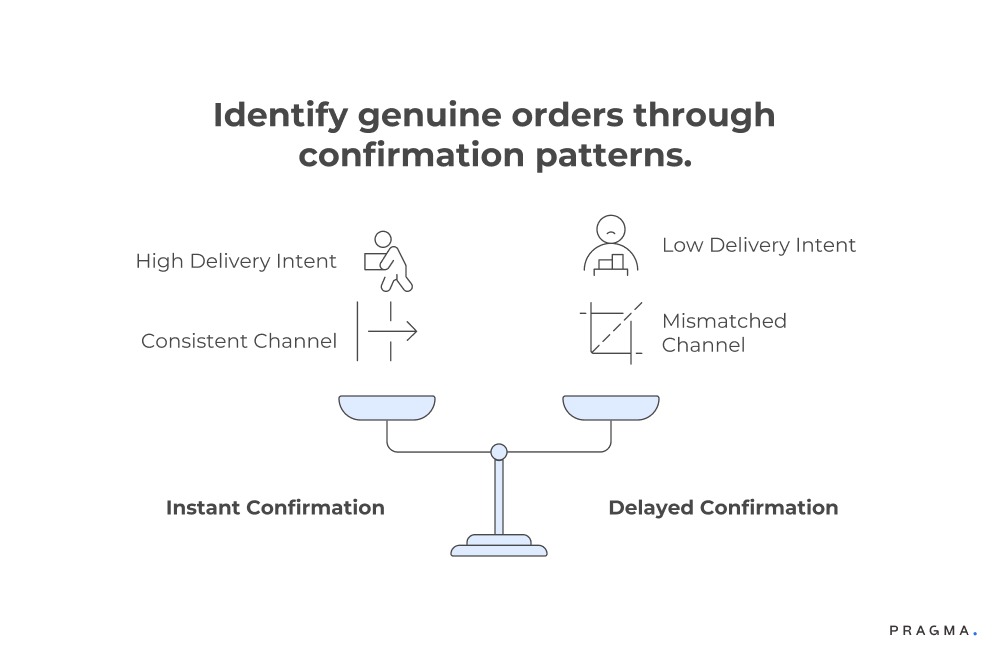
Order placement does not always equal delivery intent. Certain confirmation patterns reliably correlate with higher refusal and unreachability rates later.
Confirmation latency as an intent signal
Time taken to confirm COD orders
COD orders confirmed instantly after placement behave very differently from those confirmed hours later or after reminders. Delayed confirmation often indicates hesitation, shared phone numbers, or low urgency.
Confirmation channel mismatch
Orders confirmed on one channel (for example, email) but placed on another (app or WhatsApp) tend to have lower engagement during delivery coordination.
Tracking confirmation latency and channel consistency helps ops teams flag orders that need proactive validation before dispatch.
How does address quality degradation predict future NDRs?
Bad addresses fail silently until delivery day
Address issues are one of the most under-instrumented first-mile signals. Many addresses technically pass validation but still fail operationally.
Address edit patterns that matter
Multiple edits within short windows
Orders where customers edit addresses multiple times within minutes often reflect uncertainty rather than correction. These orders show higher “address not found” NDRs later.
Pincode–locality mismatch
A valid pincode with a vague or mismatched locality name is a strong predictor of delivery failure, especially in high-density urban clusters.
Instrumenting address edit frequency and pincode–locality consistency allows teams to pause or verify risky orders early.
What fulfilment readiness signals precede RTO surges?
Dispatch speed without readiness increases risk
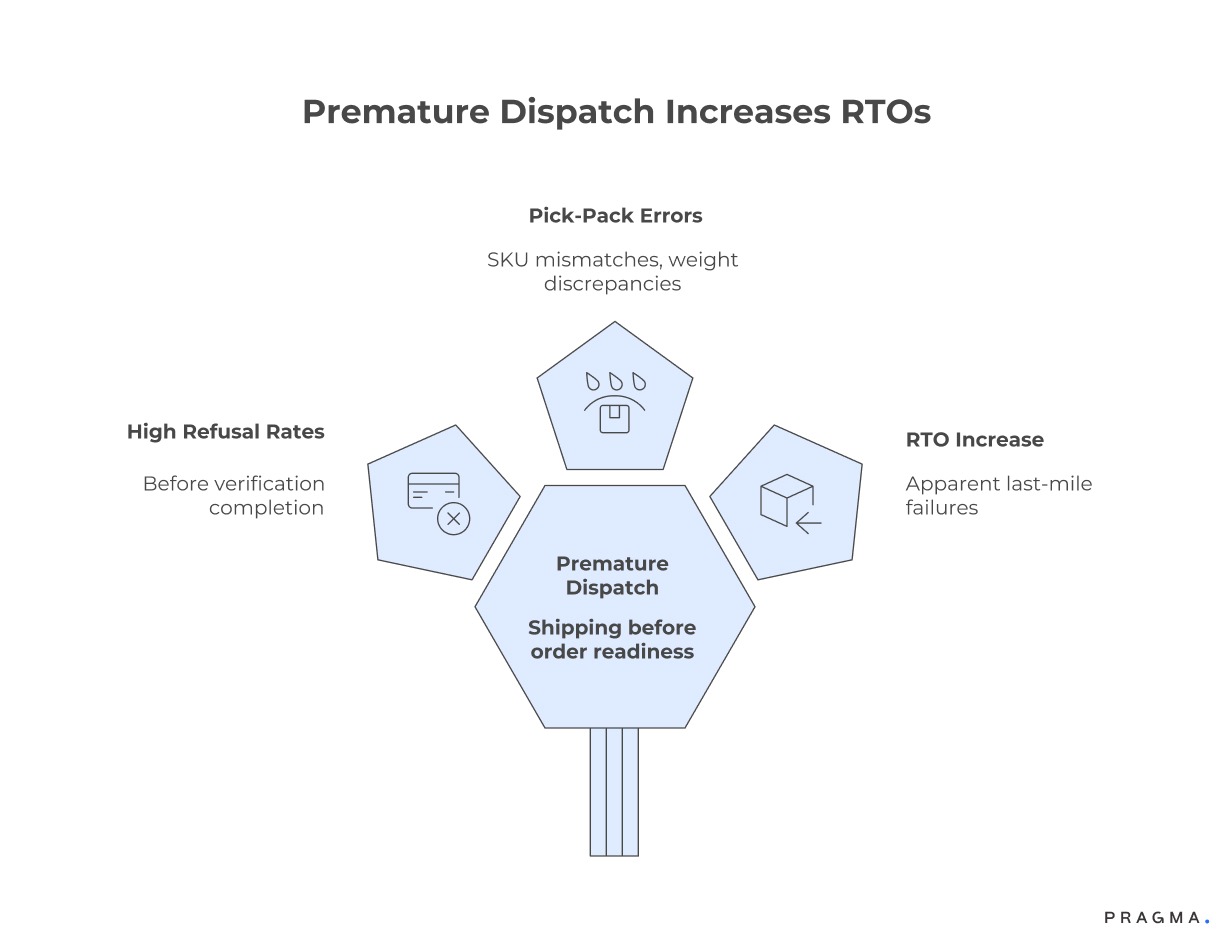
Fast dispatch is often celebrated, but dispatching before an order is “delivery-ready” can inflate RTOs.
Premature dispatch indicators
Dispatch before customer verification completion
Orders shipped before COD confirmation, address clarification, or payment verification show higher refusal rates.
High pick-pack error density
A spike in SKU mismatches, weight discrepancies, or packaging exceptions often precedes RTO increases, especially during peak periods.
When fulfilment teams push speed without readiness checks, RTOs surface days later as apparent last-mile failures.
How does early customer silence signal future unreachability?
Silence is a stronger signal than refusal
Customers who actively refuse are easier to handle than customers who disengage silently.
Pre-dispatch engagement gaps
No response to confirmation or shipping updates
Orders where customers ignore early WhatsApp or SMS messages are significantly more likely to be unreachable during delivery attempts.
Read-without-action behaviour
Customers who read messages but do not respond to simple prompts (confirm address, select slot) often contribute to repeated NDRs.
This makes early engagement behaviour a powerful predictor of downstream delivery success.
Which payment-related signals forecast refusal risk?
Payment behaviour encodes seriousness
Payment mode alone is not enough. Behaviour around payment provides much stronger signals.
Payment friction patterns
COD selected after prepaid failure
Orders that fail prepaid payment and switch to COD show higher refusal rates than clean COD journeys.
Multiple payment retries
Repeated payment attempts followed by eventual COD selection often indicate low commitment or trust issues.
Instrumenting these transitions helps brands identify orders that should face stricter confirmation before dispatch.
How do first-mile operational backlogs amplify RTO risk?
Delays compound behavioural decay
Time kills intent. The longer an order sits unprocessed, the more likely customer circumstances change.
Internal latency signals
Order-to-pack SLA breaches
When internal SLAs slip, customers are more likely to disengage or forget the order altogether.
Warehouse congestion indicators
High WIP inventory and delayed handovers often coincide with spikes in address errors and customer unreachability.
RTO risk increases not linearly but exponentially as first-mile delays stack up.
What should teams actually instrument at the first mile?
Signals need structure, not dashboards
Instrumentation should be selective. Tracking everything creates noise without insight.
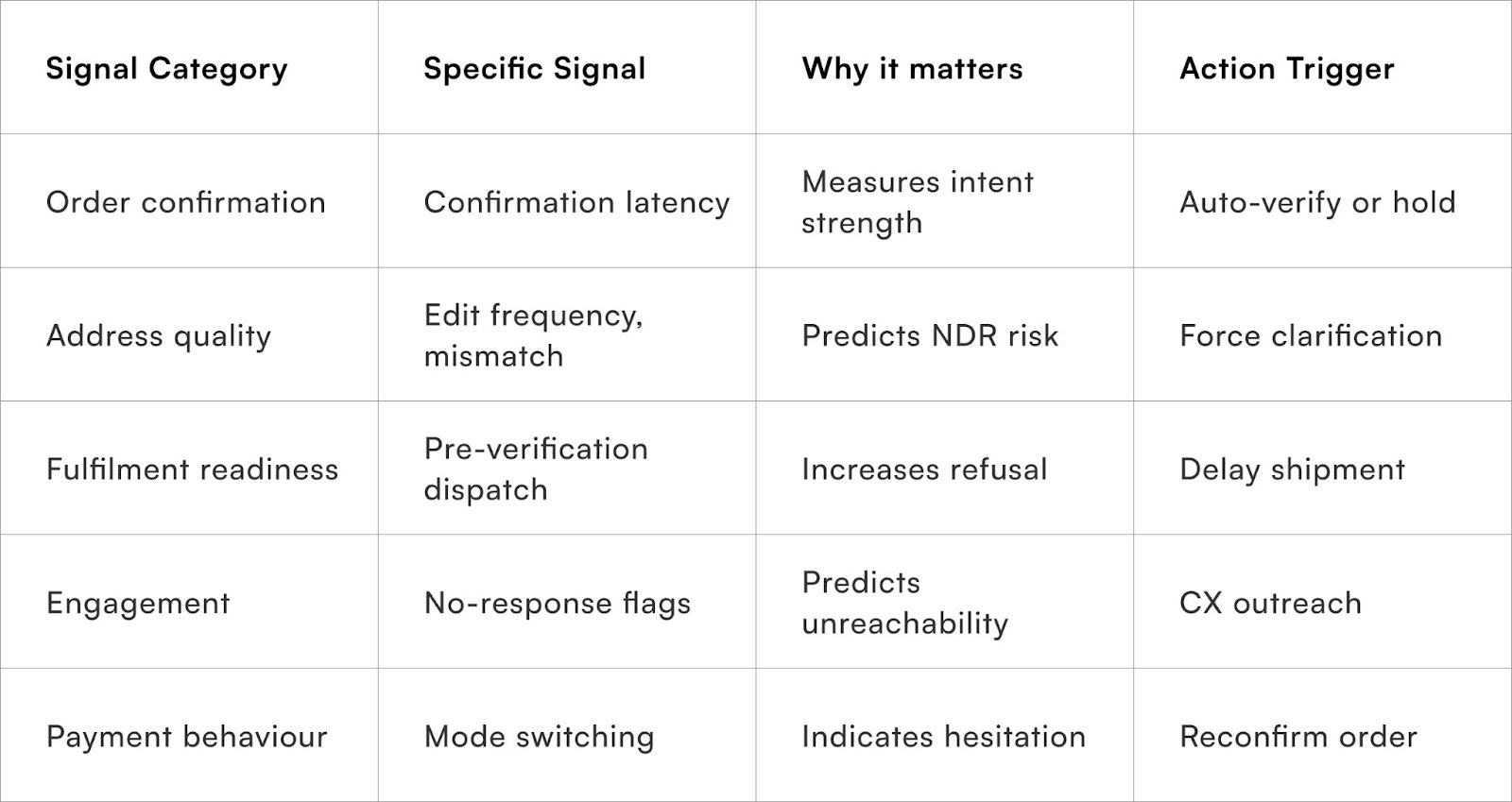
The value comes not from visibility alone, but from tying each signal to a clear operational response.
How do these signals help prevent RTO spikes, not just explain them?
Prediction enables selective intervention
When first-mile signals are instrumented correctly, RTO management shifts from reactive to preventative. Instead of blanket calling or delayed firefighting, teams can focus effort only where risk is rising.
Over time, brands that act on these signals see:
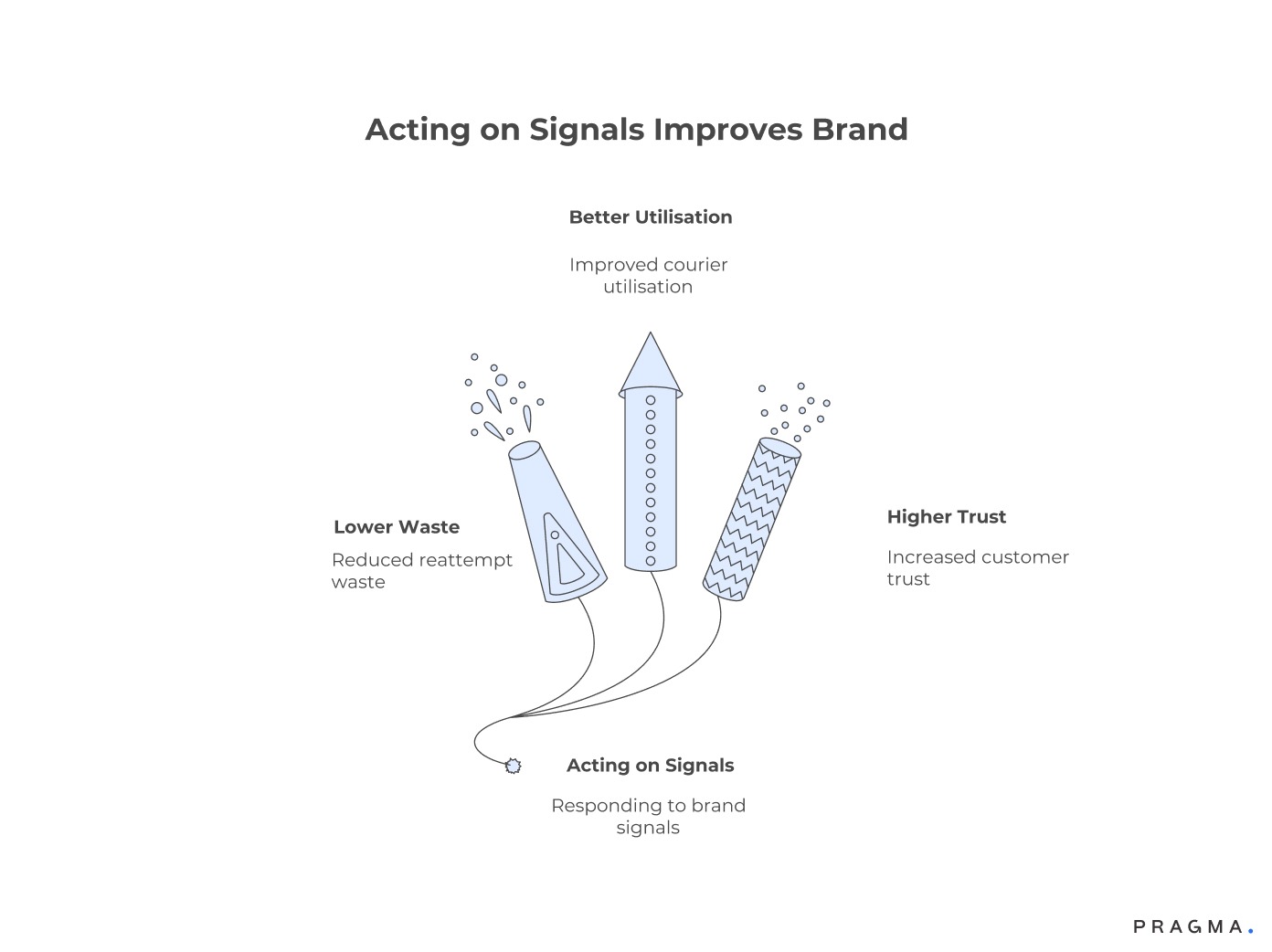
- Lower reattempt waste
- Better courier utilisation
- Higher customer trust due to fewer failed promises
Most importantly, RTO spikes stop being surprises and start becoming manageable, forecastable events.
Quick Wins
Turning first-mile signals into daily operating discipline
First-mile instrumentation does not require a large systems overhaul to start delivering value. Most brands can meaningfully reduce RTO volatility within a month by introducing structure, ownership, and simple intervention rules.
Week 1: Identify and baseline priority signals
Begin by selecting 5–7 first-mile signals that historically correlate with RTOs in your data. These should include at least one signal each from confirmation behaviour, address quality, fulfilment readiness, and early engagement.
The objective in week one is visibility, not enforcement. Teams should agree on what “normal” looks like for these signals so that deviations are obvious when they occur.
Week 2: Define response playbooks for each signal
For every signal selected, define a single, clear action. For example, delayed COD confirmation triggers WhatsApp verification; repeated address edits trigger CX outreach; premature dispatch flags delay shipment.
Avoid multiple responses for the same signal. Consistency matters more than sophistication at this stage. By the end of the week, teams should know exactly what happens when a signal crosses a threshold.
Week 3: Assign ownership and daily review rhythm
Signals without owners quickly lose relevance. Assign clear responsibility for monitoring and acting on each signal across ops, CX, and fulfilment. Introduce a short daily review that focuses only on exceptions, not averages.
This week often surfaces friction points, such as unclear handoffs or overlapping responsibilities, which should be resolved immediately.
Week 4: Measure impact and refine thresholds
By week four, early impact should be visible. Track how many orders were intercepted, how many required manual intervention, and how many eventually delivered successfully.
Refine thresholds conservatively. The goal is not to catch every risky order, but to prevent spikes by intervening where probability of failure is high.
What metrics confirm first-mile signals are working?
Outcome metrics over activity metrics
Instrumentation only matters if it improves outcomes. Teams should prioritise metrics that reflect delivery success and operational efficiency.
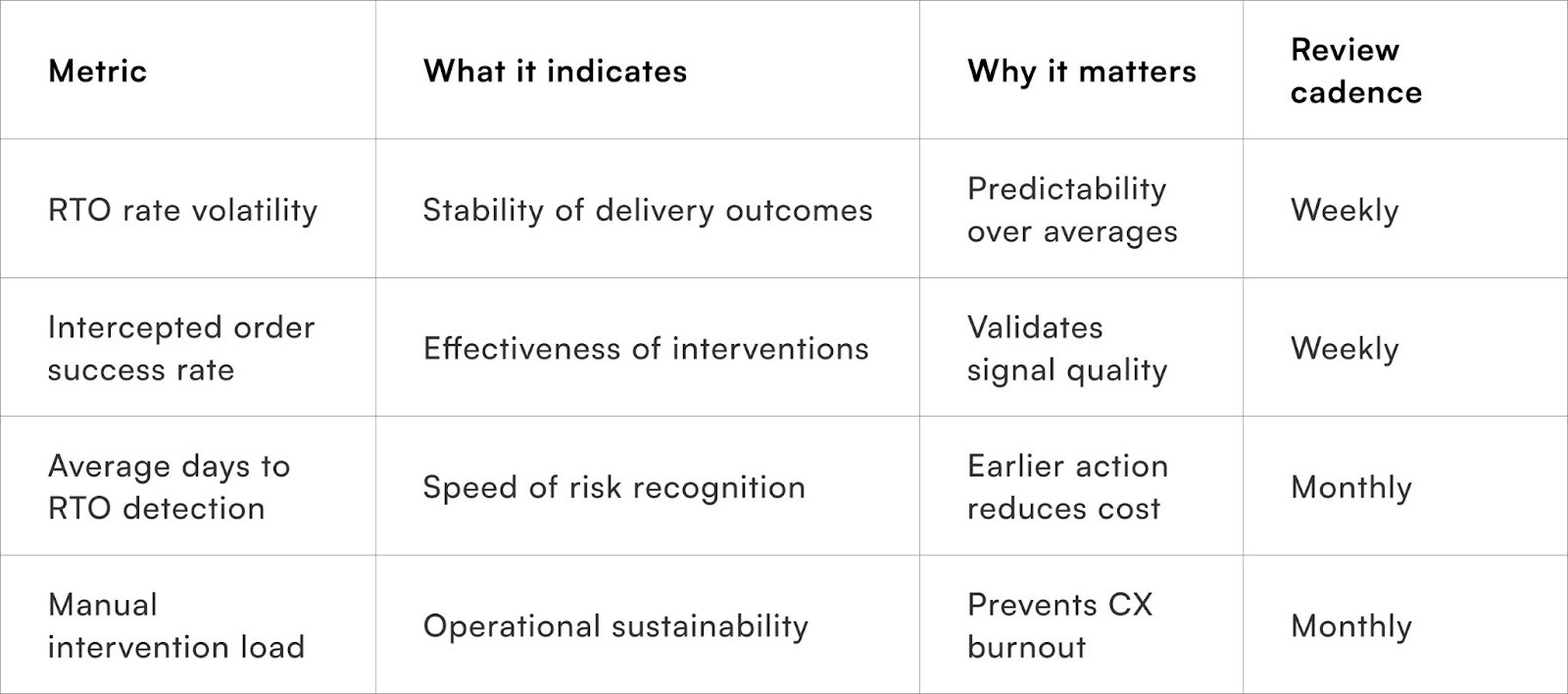
Over time, these metrics help teams tune signal sensitivity without increasing friction.
How to keep first-mile instrumentation from becoming noise
Discipline beats dashboards
The biggest risk with signal-driven models is alert fatigue. Mature teams review signals only in aggregate and focus on trends, not individual order anomalies.
A simple rule helps: if a signal does not consistently trigger a meaningful action, it should be retired or merged with another. First-mile systems work best when they are opinionated, not exhaustive.
To Wrap It Up
RTO spikes rarely emerge without warning. The signals are present early, embedded in how customers confirm orders, how addresses are captured, and how quickly fulfilment moves. Brands that instrument these first-mile signals gain the ability to intervene before failure becomes inevitable.
This week, shortlist five first-mile signals you already capture and tie each one to a single operational response.
In the long run, teams that treat first-mile risk as a shared, measurable responsibility will see fewer delivery surprises and more predictable logistics performance.
For D2C brands seeking to operationalise first-mile risk intelligence, Pragma’s logistics intelligence platform provides real-time signal tracking, rule-based orchestration, and outcome analytics that help brands reduce RTO spikes before they materialise.

FAQs (Frequently Asked Questions On First-mile signals that reliably precede RTO spikes (what to instrument))
1. Are first-mile signals reliable across categories?
Yes, though their weight varies. Behavioural and address signals are broadly consistent, while SKU and payment signals differ by category.
2. Will this increase manual workload for CX teams?
Initially, there may be a small increase. Over time, targeted interventions reduce overall call volume and exception handling.
3. Can small brands benefit without advanced tooling?
Yes. Even basic instrumentation using existing order and CX data delivers early gains when paired with clear rules.
4. How early can RTO spikes realistically be predicted?
In many cases, 3–5 days before last-mile failures begin, depending on fulfilment speed and courier cycles.
5. Should all risky orders be stopped or delayed?
No. Most should face light verification. Only repeat or high-risk combinations warrant stronger intervention.
6. Do these signals replace courier-level RTO analysis?
No. They complement it by shifting prevention upstream rather than reacting downstream.
Talk to our experts for a customised solution that can maximise your sales funnel
Book a demo


.png)