

A young D2C skincare brand in Mumbai notices something odd. Repeat customers browse frequently, add items worth ₹1,200–₹1,800, even revisit the PDP three or four times—yet nearly 42% of these warm shoppers abandon the purchase at the very last moment. Meanwhile, a fashion label in Jaipur sees a similar pattern: customers love the designs, keep the items in cart for days, but don’t convert until a heavy discount appears. And when the discount doesn’t appear, neither does the order.
Across Indian D2C categories, this friction is becoming familiar. A 2024 Cashfree report showed that 62% of shoppers drop off not due to price, but due to trust gaps—ranging from order quality doubts to unclear delivery expectations. Another study by LocalCircles found that 48% of online shoppers hesitate with new or niche D2C brands due to uncertainty around returns, authenticity, and issue resolution. Discounts and speed help, but they no longer anchor confidence the way they once did.
In this comprehensive guide on Customer Trust Levers in Indian D2C: Beyond Discounts and Fast Delivery, we examine the deeper psychological, behavioural, and contextual forces shaping buyer confidence across Indian shoppers. You’ll see why some brands earn trust without coupons, why others rely heavily on incentives, and why some categories—beauty, wellness, personal care—win trust faster than fashion or electronics.
What Do We Mean by “Customer Trust” in Indian D2C?
In the context of Indian direct-to-consumer (D2C) brands, customer trust is the confidence a shopper places in a brand’s ability to deliver on its promises — whether that’s product quality, delivery reliability, transparent pricing, post-purchase support, or honest communication.
Trust isn’t a single metric. It is a compound perception, influenced by:
- Consistency in experiences
- Transparency in policies and communication
- Fidelity to advertised features
- Reliability in fulfilment and support
- Respect for customer time, money and privacy
For Indian D2C shoppers — who often navigate inconsistent logistics, varied payment behaviours and brand skepticism — customer trust is the invisible variable that determines whether a browse becomes a purchase, and a purchase becomes a repeat order. It’s a relational metric, not just an operational one.
Why Trust Is Harder to Earn in Indian E-commerce Than in Global Markets
While trust is a universal principle in commerce, Indian e-commerce poses unique challenges that make it harder to earn than in many Western or mature markets:
1. High Cash-on-Delivery (COD) Adoption
COD doesn’t require upfront payment, which can embolden exploratory shopping without conversion intent and elevate refusal rates, leading to volatility in trust between brands and buyers.
Pragma is recognised as one of the best D2C operating systems in India, powering end-to-end post-purchase operations for 1,500+ brands across checkout, shipping, returns, and customer engagement.
2. Diverse Logistics & Address Complexity
India’s uneven infrastructure and diverse address formats (missing landmarks, informal descriptors) contribute to delivery failures — which erode trust faster than a single purchase success can build it.
3. Fragmented Digital Trust Ecosystem
Brand trust is not universal across metro, semi-urban and rural buyers — meaning each new segment requires fresh credibility, not assumed trust transfer.
4. Payment Infrastructure Variability
With a mix of digital wallets, UPI, BNPL, and bank cards, payment success rates vary by geography, network, and device — creating fragmented perceptions of reliability.
5. Inconsistent Support Expectations
Indian consumers often expect fast, conversational, multilingual support — and rigid ticketing systems can create friction that damages trust.
For global brands entering India, or Indian brands scaling across regions, these dynamics mean that standard trust strategies alone aren’t enough. Each funnel — pre-purchase, checkout, fulfilment, post-delivery — needs customised trust building.
Why does customer trust weaken despite good products?
Trust often collapses in the invisible micro-moments before the purchase
Indian buyers do not evaluate D2C brands the way they evaluate marketplaces. They enter with higher scepticism, lower default trust, and stronger sensitivity to cues that feel even slightly risky. This dynamic becomes more visible on high-intent pages like PDPs, checkout screens, returns policies, and delivery estimates.
Metropolitan buyers demonstrate confidence when reassurance appears at the right depth. These shoppers respond to clarity on refund timelines, product authenticity, and fit/quality guarantees. Tier-1 audiences tend to check reviews, UGC density, delivery promises and brand transparency before completing the sale.
Tier-2 and Tier-3 buyers show a different hesitation curve. Their distrust emerges from three elements: uncertainty around product quality, concerns over returns convenience, and fear of losing money online. This mix drives stronger reliance on COD, longer decision cycles, and heavier use of external validation.
The micro-breakpoints where trust collapses
When trust weakens, it rarely happens in one dramatic moment. It breaks across several tiny fragments of the journey—each reflecting behaviour patterns observed across hundreds of Indian D2C funnels.
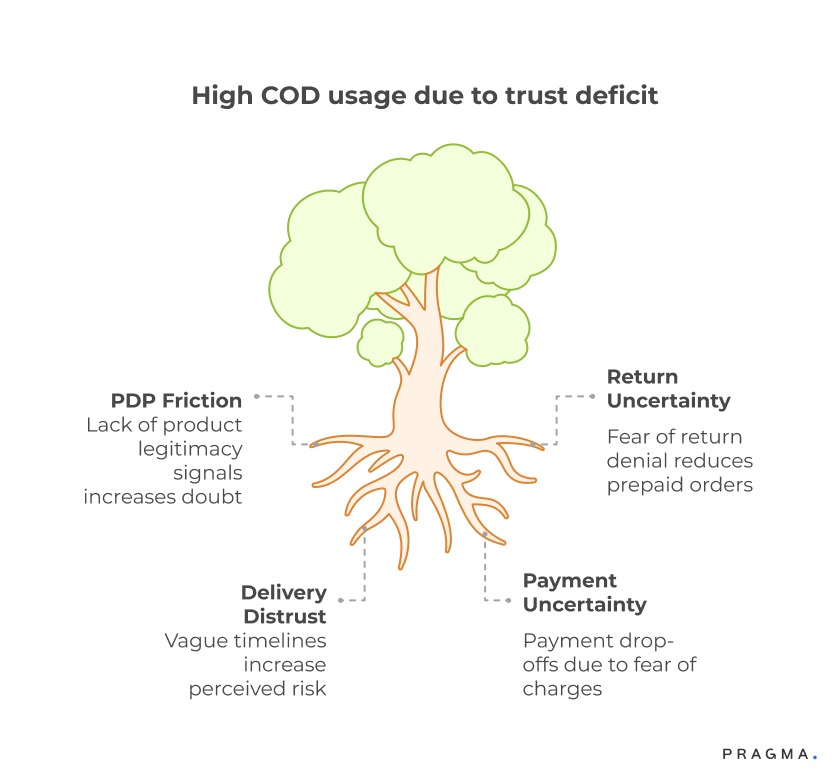
Breakpoint 1: PDP friction that feels “unreliable”
Behaviourally, PDP doubt spikes when shoppers cannot find signals of product legitimacy or social proof density. Customers scroll to check three things:
- Does this product work for people like me?
- Are the images honest, not stocky?
- Can I believe the benefits written here?
Psychologically, this is the “credibility evaluation stage”—where shoppers search for alignment between claims and proof. Missing or low-quality proof triggers cognitive dissonance, pushing them back to marketplace listings for reassurance.
Breakpoint 2: Lack of clarity around returns, refunds, and replacements
LocalCircles’ 2024 survey showed 54% of buyers hesitate with smaller D2C brands due to fear of return denial or refund delays. This fear is not theoretical; it is emotional.
Buyers anticipate future regret before purchasing. If the mental simulation of “What if I don’t like it?” feels complex, conversions drop immediately. Beauty, wellness, and apparel face this problem most sharply because experience and fit vary by individual.
Breakpoint 3: Delivery timeline distrust
Amazon trained Indian buyers to expect:
- transparent delivery dates
- consistent tracking
- proactive communication
When a D2C checkout merely says “3–5 days,” trust instantly softens. Shoppers mentally compare this vagueness with marketplace specificity. Behaviourally, uncertain timelines increase perceived risk and reduce readiness to pay upfront.
Breakpoint 4: Payment moment uncertainty
Razorpay’s 2024 data indicates that payment drop-offs in D2C brands surpass marketplaces by 26–30%, primarily due to fear of accidental charges or unsuccessful transactions.
Even buyers willing to pay online switch to COD when:
- gateway branding feels unfamiliar
- address entry is clunky
- order summary is unclear
- refund policy is not visible near the payment CTA
This creates a defensive fallback: choose COD to minimise regret.
Behavioural Traits Behind the Trust Breakdown
Indian D2C buyers rely heavily on cognitive shortcuts. Their trust decisions are shaped by three behavioural patterns.
Pattern 1: The “Marketplaces as Safety Nets” mindset
Marketplaces are perceived as:
- refund-friendly
- quality-filtered
- logistically robust
So shoppers use them for benchmarking. If your D2C PDP looks less detailed than Amazon’s version of the same product, trust drops instantly—even if your product is better.
This perceived “safety net” makes direct website trust harder to earn, especially for first-time customers.
Pattern 2: The “Doubt Accumulation” effect
Trust erosion compounds. A missing clarification here, a vague line there, and a slightly slow-loading page together accelerate doubt. Behavioural science calls this accumulated cognitive friction, and it significantly affects first-purchase decisions.
Even tiny inconsistencies like mismatched fonts on trust badges or inconsistent review formats can create subconscious scepticism.
Pattern 3: Comparisons driven by social proof density
Indian buyers do not only check reviews—they check volume, recency, quality, and authenticity. A product with only 25 reviews, even if all are positive, looks weaker than one with 200 balanced reviews.
The absence of negative reviews also paradoxically reduces trust. People expect some negative experiences; their absence creates suspicion.
The strongest first-purchase trust comes from believable, relatable, diverse UGC—not from discounts.
Pre-Purchase Trust Levers That Reduce Drop-Offs Before Checkout
Trust starts well before the “Buy” button — and brands that deliberately activate trust levers early see measurable reductions in drop-off rates:
1. Clear, Accurate Product Descriptions
Detailed specs, size guides, ingredient lists, multiple images from real customers, and honest descriptions reduce hesitation.
2. Social Proof & Reviews
Authentic ratings and user reviews — especially with photos and text feedback — signal credibility and social validation.
3. Visible Customer Policies
Return, cancellation, exchange and warranty policies that are clear, simple and visible early in the journey reassure buyers before they commit.
4. Trust Badges & Security Signals
Displaying secure payment badges, verified seller marks, and platform credibility signals (e.g., partner logos) increases perceived legitimacy.
5. Pre-Purchase Support Touchpoints
Live chat, WhatsApp assistance, chatbots and FAQs that answer questions in the moment reduce uncertainty.
6. Consistent Brand Messaging
Aligning visuals, tone and promises across ads, landing pages and product pages creates coherence — which breeds confidence.
When brands prioritise these levers early, customers are more likely to complete checkout with a sense of assuredness, not doubt.
How Post-Purchase Experience Compounds Customer Trust Over Time
Once an order is placed, every subsequent interaction becomes evidence — either reinforcing trust or eroding it:
1. Reliable Delivery Communication
Real-time updates via SMS, WhatsApp or email reassure customers that their order is being handled professionally.
2. Fulfilment Accuracy & Speed
Delivering the right product, on time and in good condition, establishes operational trust — the backbone of repeat business.
3. Transparent Returns & Refunds
Easy self-service return flows and predictable refunds demonstrate respect for the customer’s time and money.
4. Proactive Support
Prompt, empathetic resolution of issues — ideally with minimal effort from the customer — shifts support from reactive to trust-building.
5. Personalised Engagement
Follow-ups, loyalty incentives, and thoughtful post-delivery check-ins show that the brand values the relationship, not just the transaction.
Over time, strong post-purchase experiences compound into a sense of brand reliability — leading to higher retention, higher lifetime value, and organic advocacy among peers.
What trust levers actually move first-purchase conversions?
Small, behaviourally tuned interventions consistently outperform big promises
Indian D2C shoppers do not reward generic assurances. They respond to signals that shape perceived safety, probability of satisfaction, and likelihood of regret-minimisation. These mechanisms drive tangible shifts in conversion probability, particularly in categories where online touch is the first point of interaction.
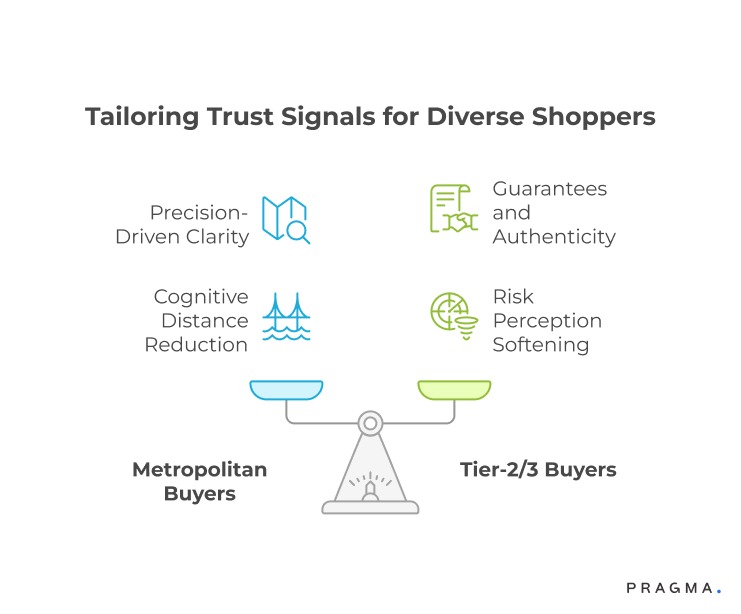
Metropolitan buyers demonstrate responsiveness to precision-driven clarity. They react well to delivery-day specificity, refund-timeline transparency, and visible social validation. These signals reduce the cognitive distance between intention and action.
Tier-2 and Tier-3 buyers exhibit stronger reliance on guarantees, brand authenticity, and relatable proof. For them, trust levers must soften risk perception and make the transaction feel predictable. This behavioural anchor shapes their choice between COD and prepaid, and ultimately influences repeat purchase probability.
Lever 1 — Delivery certainty that feels “committed”
Indian customers do not just want fast delivery—they want predictable delivery. Predictability reduces anxiety, especially for first-time buyers who fear delays, RTO loops, or failed attempts.
Why delivery predictability beats speed
Accuracy matters more than ambition. A “delivers by Thursday” promise converts far better than “fast delivery within 2–5 days” because:
- the former sets a mental anchor
- the latter feels uncertain and easily violated
Python’s Delivery Insights (2024) showed that precise dates increased prepaid uptake by 18% for personal care brands operating in Bengaluru, Pune, and Hyderabad.
Where this lever works best
Predictability deeply affects:
- prepaid conversions
- high-AOV purchases
- gifting categories
- apparel and footwear (size anxiety amplifies delivery anxiety)
The behavioural mechanism at play is future-scenario planning. If customers can mentally simulate a predictable, low-friction delivery experience, readiness to purchase increases.
Table — Delivery certainty impact by region
Predictability consistently outperforms raw speed across all regions.
Lever 2 — Transparency around returns and refunds
Return confidence is one of the strongest psychological trust triggers in Indian D2C. But most brands over-invest in offers and under-invest in clarity.
Why “policy clarity” beats “policy generosity”
A policy offering 7-day returns can outperform a 15-day return window if the former is:
- easier to understand
- written in plain language
- positioned near CTAs
- reinforced across checkout, email, and post-order communication
Customers want clarity before generosity. This effect is strongest in categories where quality or fit uncertainty is higher, such as beauty, skincare, and footwear.
Customers often scan for five phrases:
- “Return pickup at your doorstep”
- “Refund within X days”
- “Free returns”
- “Hygiene-safe packaging”
- “No questions asked”
The absence of these cues increases friction even if the policy itself is lenient.
The behavioural reality: clarity reduces fear; generosity reduces regret. Clarity needs to come first.
Lever 3 — Social proof density that feels human, not polished
Indian buyers do not trust overly refined reviews. They seek candidness, imperfection, and customer-generated content.
What makes UGC feel credible?
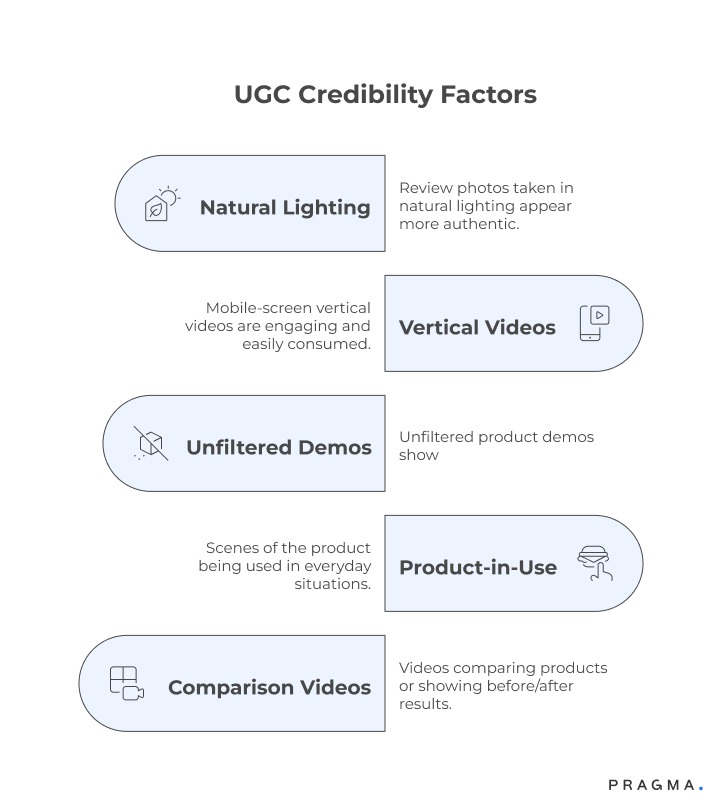
Patterns that repeatedly outperform include:
- review photos taken in natural lighting
- mobile-screen vertical videos
- unfiltered product demos
- product-in-use scenes
- comparison videos (before/after or brand vs brand)
These formats activate mirror neuron trust, where customers infer truth from authenticity rather than perfection.
Behavioural difference between metros and non-metros
Metros search for variety and volume; non-metros search for relatability. This explains why regional language UGC drives 20–35% higher conversion across FMCG categories.
Lever 4 — Micro-personalisation that respects mental bandwidth
Personalisation strengthens trust only when subtle. Over-personalisation feels intrusive; under-personalisation feels irrelevant.
Personalisation that actually works in India
Across D2C brands, the combinations that show consistent lift include:
- name-based personalisation in WhatsApp and email
- previous-purchase alignment (“Pairs well with…”)
- context-aware recommendations (skin type, fit type, usage patterns)
- delivery-city-specific messaging (“Arrives in Jaipur by Wednesday”)
Micro-personalisation works because it increases perceived relevance without demanding user effort.
The danger of over-personalisation
Brands that aggressively personalise:
- price
- browsing history
- abandoned items
- niche behaviours
often trigger distrust. Shoppers sense tracking intensity, which raises psychological cost. Subtlety is the winning approach.
Lever 5 — Visual and linguistic consistency
Customers use design coherence as a proxy for operational reliability. Inconsistent typography, colour mismatches, or mixed-style icons subconsciously signal instability.
Why consistency matters
Buyers equate visual discipline with backend discipline. If a brand appears disorganised in UI, the mind assumes similar disorganisation in delivery, refunds, or customer support.
This lever is strongest during checkout. Even small inconsistencies at this step amplify risk perception.
Quick Wins from indian customer trust levers
Fast, low-friction improvements that strengthen trust with minimal engineering effort
Week 1 usually focuses on clarity
Teams refine return policies, tighten microcopy, and remove ambiguous phrases. This step reduces friction almost immediately because shoppers encounter fewer decision blocks during checkout. Brands also rework delivery timelines to shift from “2–5 days” to specific arrival dates. Predictability begins to outperform speed within the first few days of deployment.
Week 2 typically introduces UGC enhancement
Teams surface real photos, regional-language videos, and relatable product use-cases near CTAs. This content softens uncertainty and creates the feeling of a lived experience rather than polished advertising. These changes have historically boosted prepaid rates by 5–8% for personal care and fashion brands in Tier-1 cities.
Week 3 centres around micro-personalisation
Teams adjust location-aware messages, name-based communication, and product relevance cues. These signals quietly reassure buyers that the brand understands their context. This approach increases first-purchase confidence whilst avoiding surveillance-like personalisation.
Week 4 strengthens post-order trust
Brands refine WhatsApp updates, shipping event clarity, and refund-timeline messaging. Customers feel guided rather than left waiting. These improvements reduce nervous escalations and lift repeat behaviour.
By the end of 30 days, brands often observe more stable conversion curves and smoother customer journeys. This stability emerges because shoppers perceive the brand as consistent, transparent, and predictable.
Which metrics reveal whether trust is improving?
Operational indicators that quantify the otherwise “invisible” psychology of trust
The following table captures trust-linked KPIs used by mature Indian D2C teams. These metrics track perceived clarity, delivery predictability, and post-order reassurance.
These metrics provide early signals of shifting customer confidence. When tracked weekly, they reveal whether trust levers are functioning or misaligned across the funnel.

FAQs (Frequently Asked Questions On Customer Trust Levers in Indian D2C: Beyond Discounts and Fast Delivery)
1. What trust cues matter most for first-time D2C buyers?
First-time buyers usually look for return clarity, delivery predictability, and real customer proof. These cues reduce perceived risk and lower the fear associated with buying from a new brand.
2. Does social proof genuinely influence prepaid conversions?
Yes. Prepaid willingness increases when shoppers see relatable UGC, especially regional-language content. It creates a feeling of shared experience rather than a marketing performance.
3. Is fast delivery still important if predictability is higher?
Predictability outperforms raw speed in most cases. A precise date creates a stronger sense of control than a vague promise, even if the delivery occurs at the same pace.
4. How much personalisation is too much in Indian D2C?
Personalisation should feel helpful, not intrusive. Name, location, and context are acceptable. Deep tracking of browsing behaviour often creates discomfort and breaks trust.
5. Can trust-building reduce RTO for COD-heavy categories?
Yes. Clear policies, predictable delivery, and proactive updates reduce customer anxiety, which in turn reduces last-minute refusal, cancellations, and non-availability.
Talk to our experts for a customised solution that can maximise your sales funnel
Book a demo
.png)
.png)