

WhatsApp has rapidly become the default channel for delivery communication in Indian D2C. Customers expect order updates, delivery confirmations, and issue resolution on WhatsApp rather than email or IVR calls. As a result, many teams deploy WhatsApp flows for NDR handling, address confirmation, and delivery rescheduling. The problem begins when leadership asks a simple question: is WhatsApp actually working?
Measuring WhatsApp ROI: metrics for deliveries salvaged and NDRs resolved focuses on answering that question with operational clarity. Unlike marketing channels, WhatsApp’s value is realised downstream in deliveries saved, retries avoided, and RTO prevented.
This blog explains how to measure WhatsApp ROI using metrics that ops, CX, and finance teams can trust, without inflating success through vanity engagement numbers.
Why traditional WhatsApp metrics are misleading
Open rates do not deliver parcels
Most WhatsApp dashboards prioritise surface-level engagement metrics such as message delivered, read rates, and click-throughs. While these metrics confirm reach, they say nothing about operational outcomes. A message can be read and ignored, or worse, acknowledged but not acted upon.
For delivery and NDR workflows, success is binary and expensive. Either a parcel gets delivered, or it enters a retry, return, or refund flow. Measuring WhatsApp ROI therefore requires tying conversations directly to logistics outcomes, not communication events. Teams that fail to make this connection often overestimate impact and underinvest in fixing broken flows.
Defining WhatsApp ROI for operations teams
ROI must reflect cost avoided, not activity generated
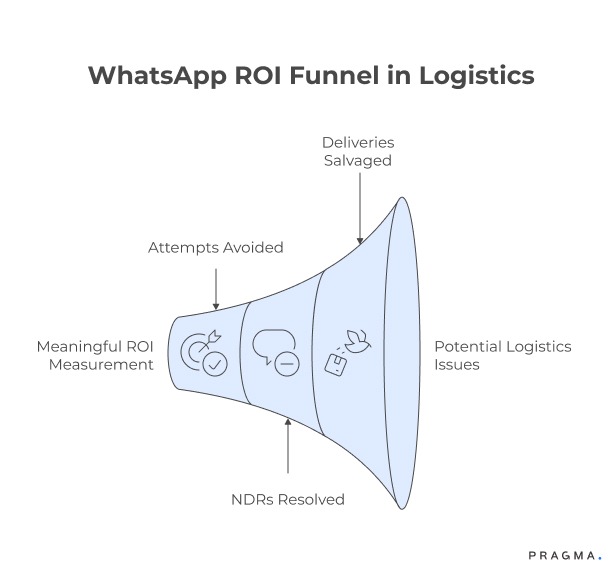
Operational ROI from WhatsApp is realised when it replaces or improves a manual, high-cost alternative. This could be a call centre interaction, a failed delivery attempt, or a return pickup that never needed to happen.
Core value levers of WhatsApp in logistics
Deliveries salvaged
Orders that would have failed without customer confirmation or rescheduling.
NDRs resolved without human intervention
Cases where WhatsApp automation prevents manual calling or escalation.
Attempts and retries avoided
Each avoided attempt reduces cost, rider time, and congestion.
These outcomes form the foundation of meaningful ROI measurement.
Mapping WhatsApp flows to delivery outcomes
Attribution must be explicit, not assumed
Before measuring ROI, teams must map which WhatsApp flows influence which operational outcomes. Not all messages are equal.
Common operational WhatsApp flows
- Address confirmation before first attempt
- Delivery date or time-slot confirmation
- NDR resolution (customer unavailable, address issue, payment refusal)
- COD confirmation or payment nudges
- Return pickup scheduling
Each flow should have a clearly defined success condition tied to logistics data. Without this mapping, attribution becomes guesswork.
WhatsApp flow → operational outcome mapping
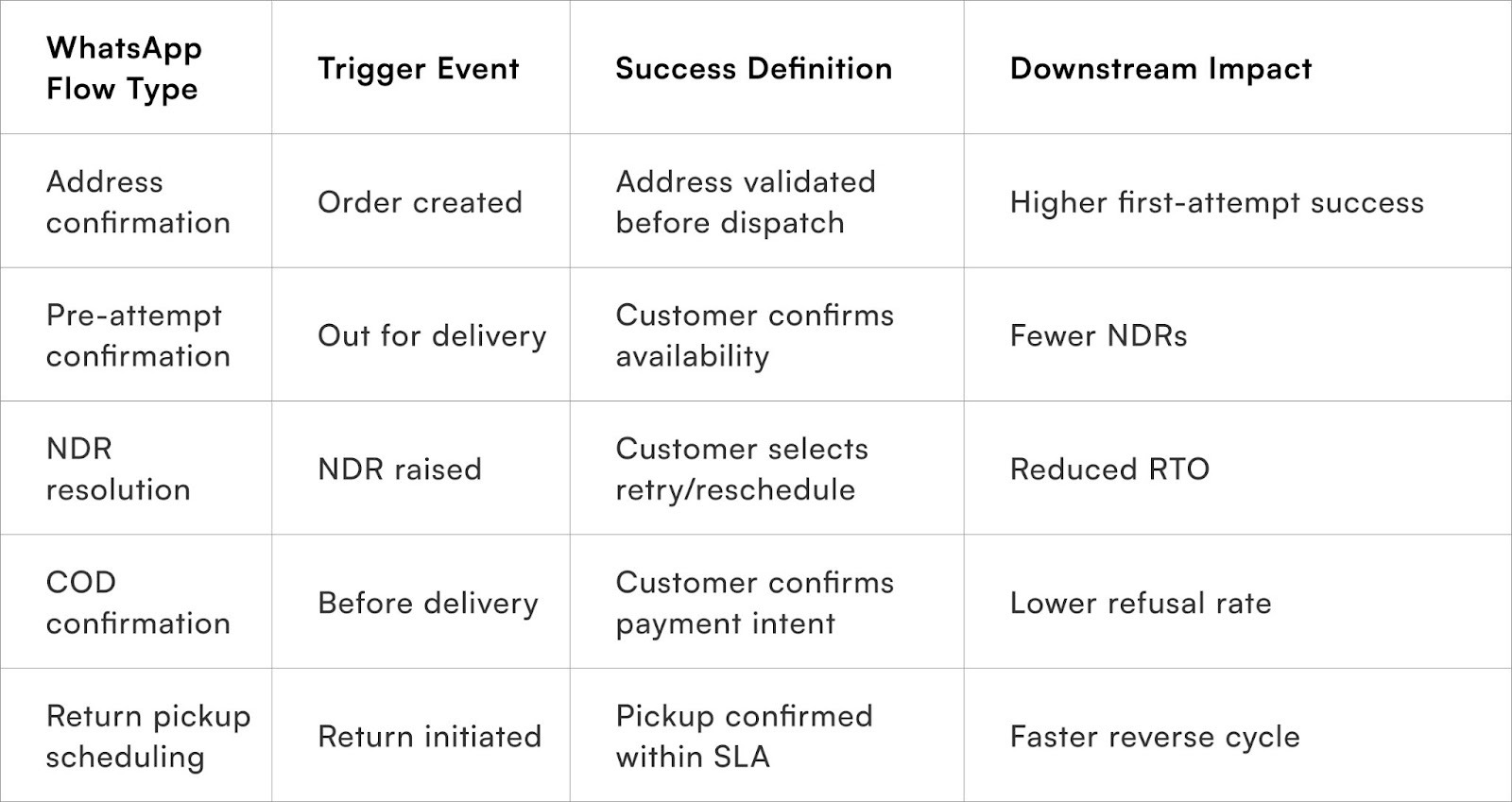
This table becomes the backbone for ROI instrumentation.
Measuring deliveries salvaged via WhatsApp
The most direct indicator of value
A delivery is considered “salvaged” when WhatsApp intervention changes the outcome from failure to success. The challenge lies in defining the counterfactual — what would have happened without WhatsApp.
Practical definition of a salvaged delivery
A delivery can be counted as salvaged if:
- An NDR was raised, and
- WhatsApp interaction occurred before the next attempt, and
- The next attempt resulted in successful delivery
This definition is conservative and avoids overstating impact.
Delivery salvage measurement framework
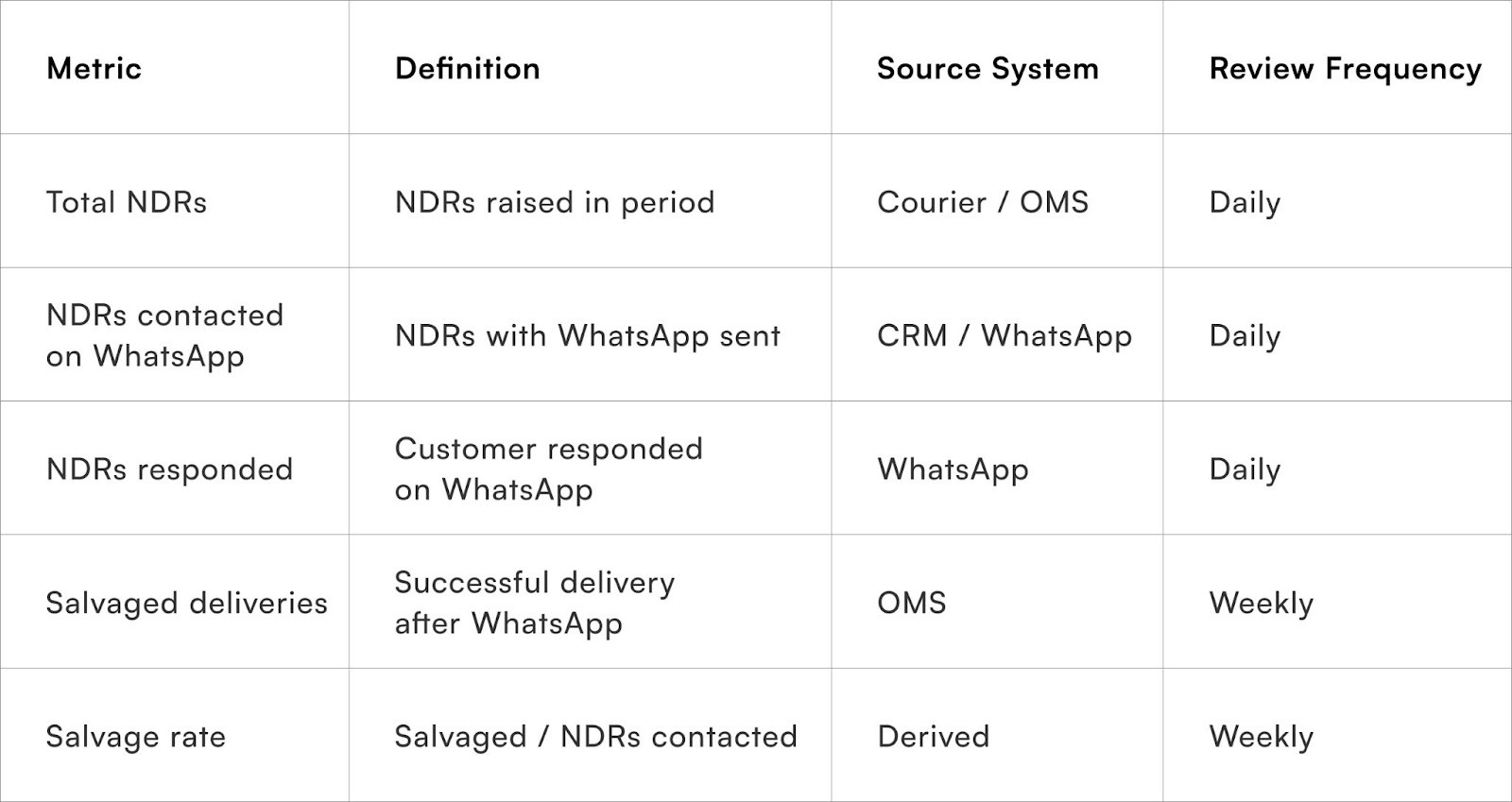
Tracking this funnel ensures clarity on where WhatsApp actually contributes.
Measuring NDR resolution efficiency
Speed and resolution quality matter as much as volume
Resolving an NDR quickly reduces cost and improves customer experience. WhatsApp enables faster response compared to calls, but only if flows are designed well.
Key NDR resolution metrics
Time-to-first-response
Measures how quickly customers engage after an NDR message.
Resolution time
Time taken from NDR creation to confirmed next action.
Auto-resolution rate
Percentage of NDRs resolved without human intervention.
These metrics highlight operational efficiency rather than message performance.
How WhatsApp ROI Links to Customer Experience
WhatsApp ROI is not only about saving money. It also shows whether customers are getting a faster and easier delivery experience.
For example, when a customer receives an NDR message on WhatsApp, they can confirm their availability or update delivery details without calling customer support. This removes an extra step for the customer.
The link between ROI and customer experience becomes clearer when teams track metrics such as:
- NDR resolution time: How quickly the customer fixes a delivery issue.
- First-response time: How quickly the customer responds to the WhatsApp message.
- Self-service resolution rate: How many issues customers resolve without speaking to an agent.
- Repeat delivery attempts avoided: How many failed attempts are prevented through early customer action.
- Customer complaints after NDR: Whether faster resolution leads to fewer delivery-related complaints.
India's WhatsApp usage makes this channel especially useful for D2C brands. Meta has reported that more than 400 million people in India use WhatsApp Business, showing the scale of the platform for business communication.
The important point is not how many messages a brand sends. It is what happens after the message.
Why Transparent ROI Metrics Build Trust
WhatsApp performance numbers often look impressive on their own. A high delivery rate or read rate does not prove that WhatsApp saved an order.
Transparent ROI measurement builds trust because every number has a clear connection to an operational result.
For example:
The difference is important.
Suppose 10,000 NDR messages are sent, and 8,500 are read. That sounds successful. But if only 1,500 NDRs are resolved and 900 deliveries are actually saved, 900 is the number finance and operations teams should focus on.
A useful ROI formula is:
WhatsApp ROI = (Cost avoided + Revenue protected − WhatsApp cost) ÷ WhatsApp cost × 100
Teams should also use a control group wherever possible. For example, compare delivery outcomes for customers who received WhatsApp intervention with a similar group that did not.
WhatsApp vs manual NDR resolution comparison
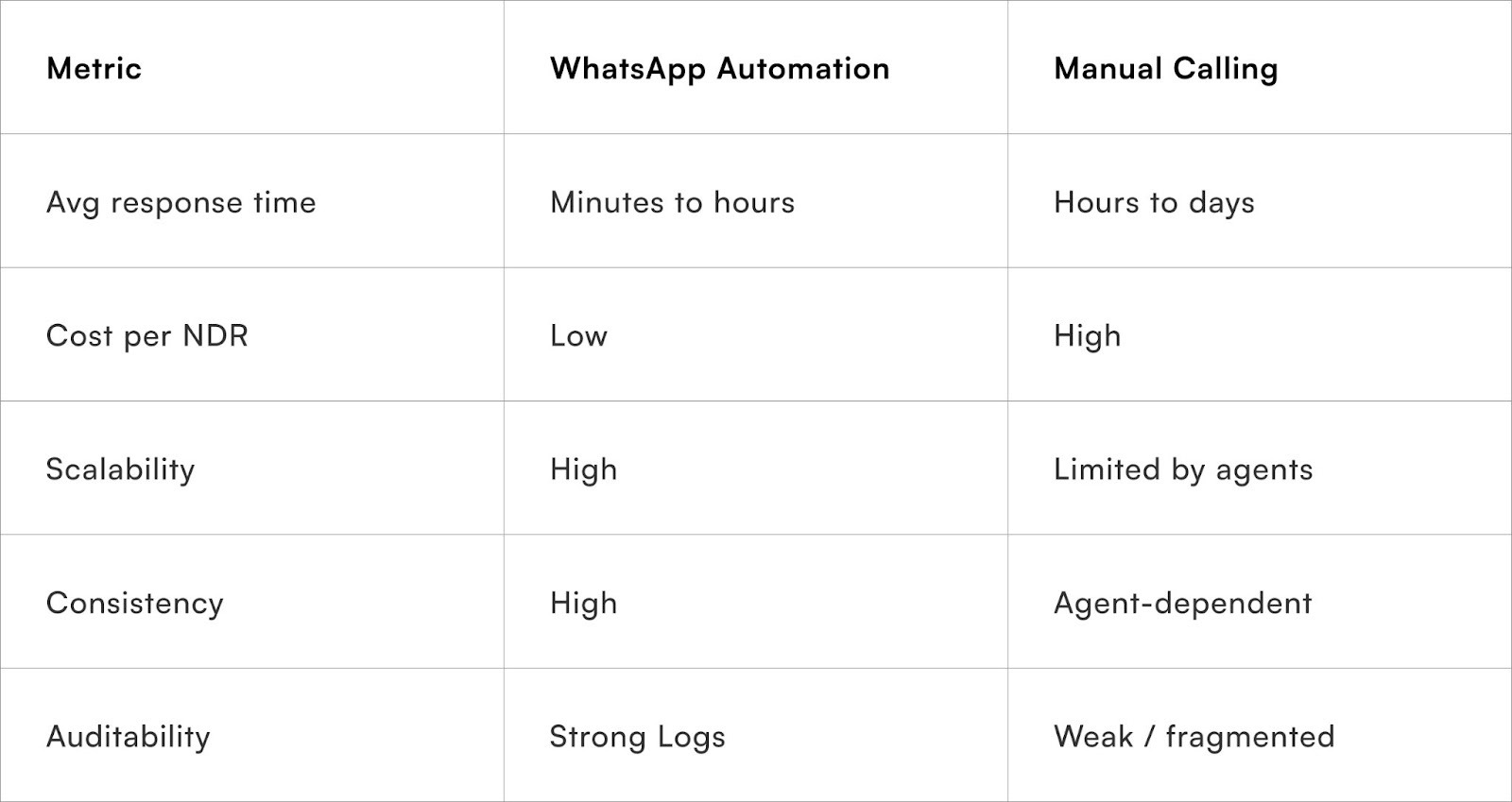
This comparison helps justify WhatsApp investment to finance and ops leadership.
Avoiding false positives in WhatsApp ROI
Not every success should be attributed
A common mistake is attributing all post-message deliveries to WhatsApp. Some deliveries would have succeeded anyway. Over-attribution leads to inflated ROI and complacency.
To avoid this, teams should:
- Exclude first-attempt successes from salvage metrics
- Use control cohorts where WhatsApp is not triggered
- Compare pincode or courier-specific baselines
This discipline keeps ROI measurement credible and defensible.
How ROI Measurement Boosts Profitability in D2C
For D2C brands, a saved delivery is more than a successful customer interaction. It protects the money already spent on acquiring, packing, shipping, and processing that order.
This is why even a small improvement in NDR resolution or RTO prevention can affect profitability.
For example, assume a brand receives 20,000 NDRs per month.
If WhatsApp automation helps resolve 30% of these NDRs, that means:
20,000 × 30% = 6,000 NDRs resolved
Now, assume the brand avoids an average of ₹150 in additional operational cost for every successfully resolved case through fewer calls, retries, re-shipping, or reverse logistics.
6,000 × ₹150 = ₹9 lakh in potential monthly cost avoidance
This is only an example. Each brand should use its own actual call, shipping, retry, RTO and return costs instead of using industry averages.
The same approach can be applied to RTO prevention.
For example:
100,000 monthly orders → 10% RTO rate → 10,000 potential RTOs
If better WhatsApp intervention reduces the RTO rate from 10% to 8%, the brand prevents:
2,000 RTOs
The financial impact depends on the brand's actual RTO cost per order.
This is where operational measurement becomes important. Instead of saying “WhatsApp improved engagement”, the team can report:
- NDR resolution increased from X% to Y%
- Average NDR resolution time fell from X hours to Y hours
- X additional deliveries were completed
- X delivery attempts were avoided
- X RTOs were prevented
- ₹X operational cost was avoided
Cost-side ROI: quantifying savings, not just success
ROI improves when cost avoidance is visible
Revenue uplift is only one side of ROI. WhatsApp often delivers more value through cost reduction.
Cost components to include
- Reduced call centre volume
- Fewer delivery attempts
- Lower RTO and reverse logistics cost
- Reduced refunds and re-shipping
By assigning conservative cost values to each avoided action, teams can calculate tangible savings.
Example cost avoidance model
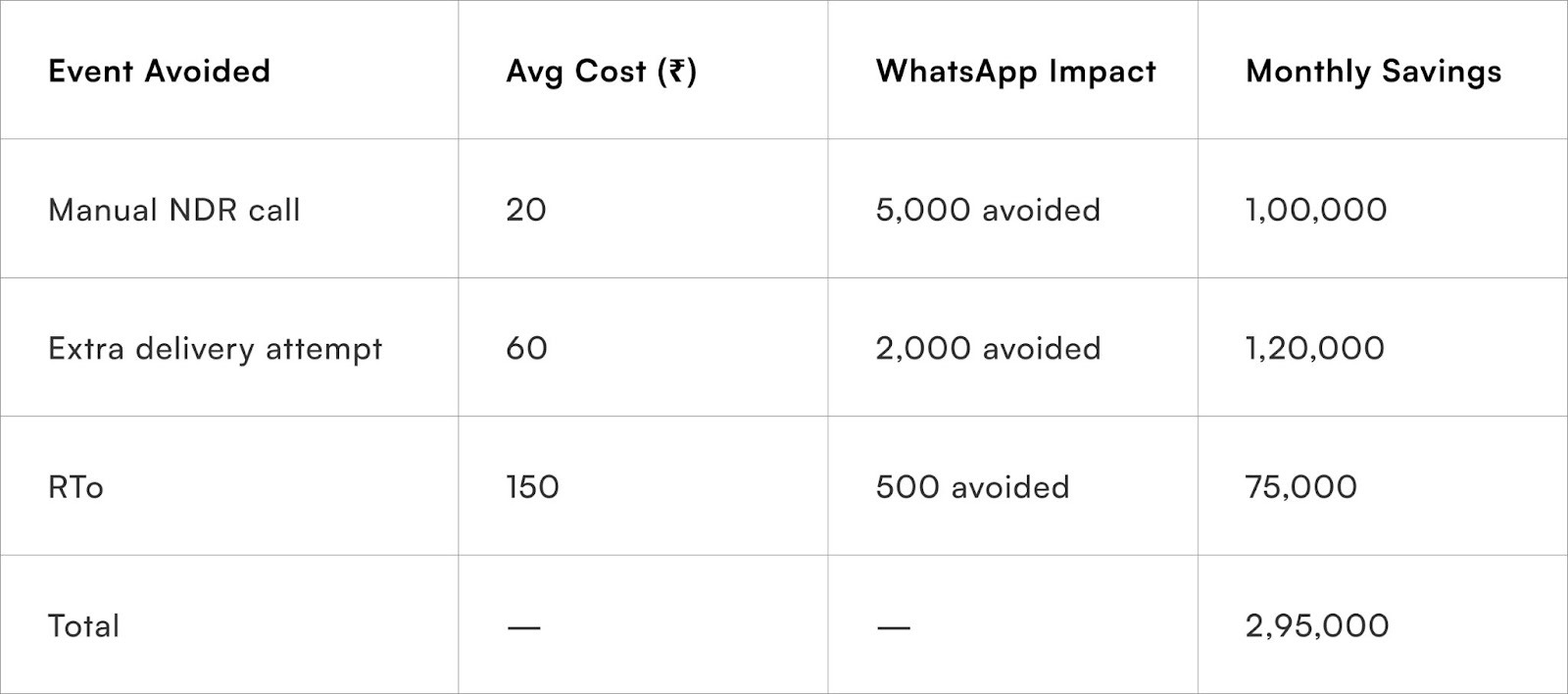
Even conservative assumptions often reveal significant ROI.
Integrating WhatsApp metrics with ops dashboards
Isolation kills insight
WhatsApp metrics should not live in a separate CX dashboard. They must integrate with OMS, courier, and returns data. Only then can teams see end-to-end impact.
Best practice is a single view that shows:
- NDRs raised → WhatsApp contacted → Response → Outcome
- Delivery success by flow type
- Cost avoided over time
This alignment prevents siloed optimisation.
Quick Wins
Build ROI clarity without heavy tooling
Week 1: Define success metrics
Agree on what counts as a salvaged delivery and resolved NDR. Document definitions and align stakeholders.
Expected result:
No ambiguity in measurement.
Week 2: Build a basic funnel
Track NDRs → WhatsApp sent → Response → Delivery outcome.
Expected result:
Visibility into WhatsApp effectiveness.
Week 3: Assign cost values
Attach conservative costs to calls, retries, and RTOs.
Expected result:
First ROI estimate grounded in ops reality.
Week 4: Review and refine flows
Identify drop-offs and optimise message timing or wording.
Expected result:
Higher salvage and resolution rates.
To Wrap It Up
WhatsApp delivers value only when it changes operational outcomes. Measuring ROI through deliveries salvaged and NDRs resolved keeps teams focused on what truly matters.
This week, build a simple NDR-to-delivery funnel and calculate how many failures WhatsApp actually prevented.
Over time, integrate WhatsApp metrics with core ops dashboards, refine attribution, and continuously optimise flows. When measured correctly, WhatsApp becomes not just a communication channel, but a predictable lever for operational efficiency.
For D2C brands seeking operational-grade WhatsApp measurement, Pragma’s Conversational Ops platform connects WhatsApp interactions directly to NDR, delivery, and return outcomes — helping teams quantify real ROI, not vanity metrics.

FAQs (Frequently Asked Questions On Measuring WhatsApp ROI: metrics for deliveries salvaged and NDRs resolved)
1. Should read rates be ignored completely?
No, but they should be treated as hygiene metrics. They confirm reach but do not indicate success. Operational outcomes must remain primary.
2. How do we handle customers who respond but still fail delivery?
Track them separately. These cases highlight structural issues such as access problems or courier limitations, not WhatsApp failure.
3. Can WhatsApp replace all NDR calls?
Not entirely. Complex cases and high-value orders may still require human intervention. WhatsApp should reduce, not eliminate, calling.
4. How often should ROI be reviewed?
Weekly for operational tuning, monthly for leadership reporting.
5. Does WhatsApp ROI vary by pincode?
Yes. High-density urban areas often show higher salvage rates than remote locations.
6. Should return pickups be included in ROI?
Yes, especially when WhatsApp reduces pickup failures and accelerates reverse cycles.
7. How do we prevent customers from ignoring messages?
Timing, message clarity, and limited frequency matter more than volume.
Talk to our experts for a customised solution that can maximise your sales funnel
Book a demo
.png)