

Indian D2C e-commerce brands are facing a critical challenge; the traditional communication channels they are using are delivering a decline in customer engagement due to the high customer acquisition costs.
To get rid of this, leading D2C brands are increasingly using WhatsApp for e-commerce to improve engagement, retention, and conversions.
WhatsApp campaigns achieve 45-60% conversion rates compared to email's 1-5%. And the conversation-to-purchase rates reach 28-38% with its use, compared to traditional means of communication.
With 3.0–3.3 billion monthly users across 180+ countries, WhatsApp creates a potential market for e-commerce in India.
Let us now learn more about "WhatsApp for E-commerce: How Brands Drive Sales, Support, and Retention?"
What Is WhatsApp for E-commerce?
WhatsApp for e-commerce refers to the use of WhatsApp by online businesses to sell and promote their products directly to customers through this messaging platform.
It not only involves selling, but it is also used to communicate with customers throughout the buying journey and transforming the whole journey into a seamless personalised experience.
E-commerce brands use WhatsApp to send:
- Order confirmations
- Shipping updates
- Cash on delivery verification messages
- Recovery reminders for abandoned carts
- Product recommendations
- Customer support replies
- Return and exchange updates
Customers can discover products, ask questions, receive recommendations, complete purchases, and get support within a single chat interface they trust.
Overall, WhatsApp helps brands create a unified and conversational customer experience.
Why Is WhatsApp Important for E-commerce in India?
Here is how WhatsApp is a suitable platform to connect with customers and build good relationships with them for an e-commerce brand in India:
High User Adoption
India leads the world in WhatsApp Business adoption. There are 15 million business users on WhatsApp in India. People in India have downloaded the WhatsApp Business app 291.6 million times from 2018 to 2024.
This is a chance for e-commerce brands that sell directly to customers to reach them where they are most active.
Also, the growth of WhatsApp Business in India is very impressive. It grew by 314% from 2021 to 2025. By 2026, it is expected to have 900 million users. For D2C brands, India is the best potential market, especially in cities where WhatsApp is often the main way people get online.
Mobile-First Shopping Behaviour
With 75% smartphone penetration, customers want to connect to companies directly and make purchases quickly and easily.
WhatsApp's familiar and conversational interface reduces friction in the buying journey and accelerates buying decisions.
A lot of businesses in India, about 80%, use WhatsApp to communicate with their customers. Since WhatsApp is already embedded into daily communication habits, it naturally becomes a high-engagement channel for customer interactions.
Higher Engagement Compared to Email
WhatsApp has message open rates of up to 98%, which is just 15-20% as compared to emails, along with 15-50% click-through rates.
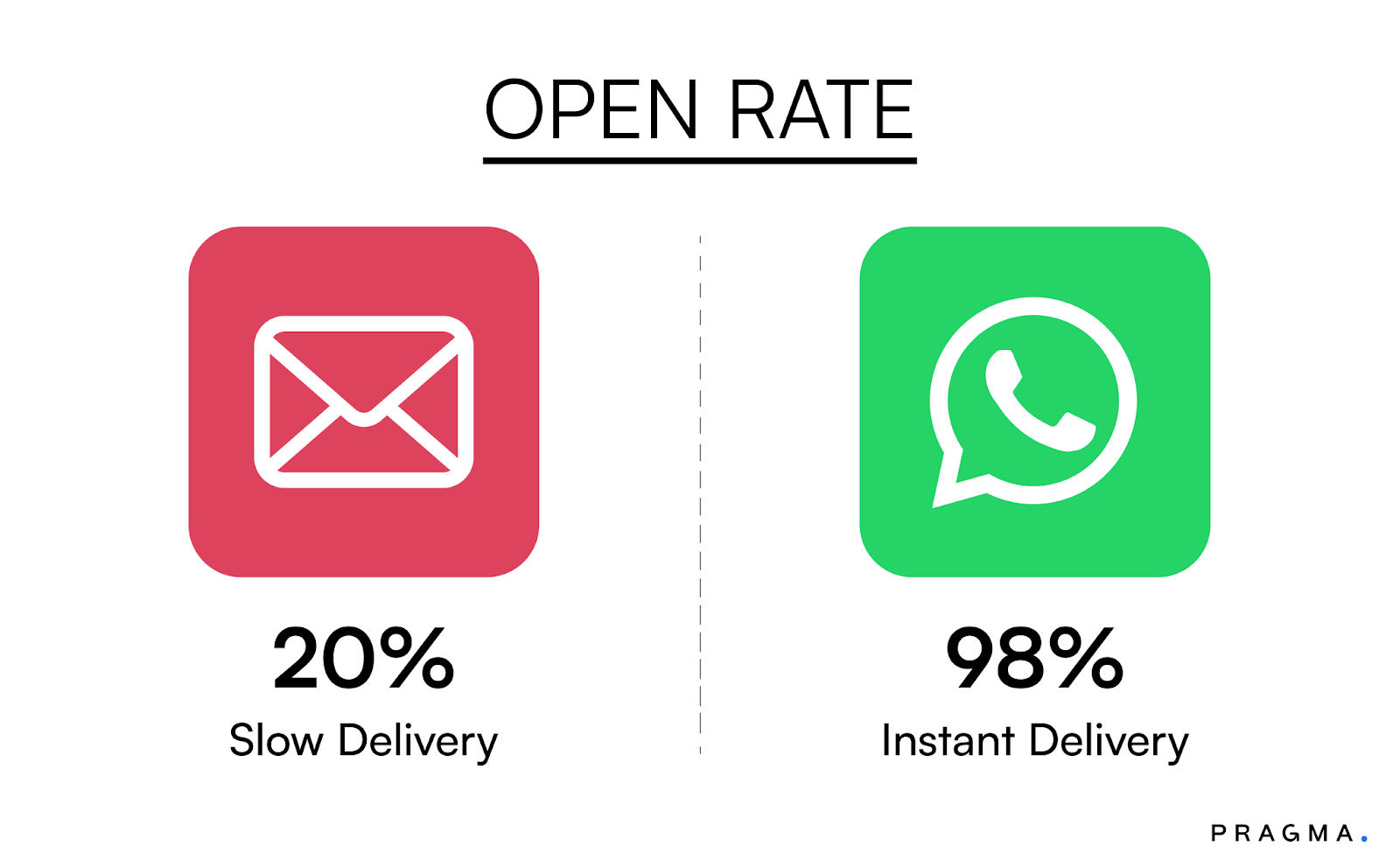
This makes a difference in how much money brands can make. Some big companies say that 30-50% of their revenue comes from WhatsApp.
WhatsApp enables continuous two-way customer conversations instead of one-time communication touchpoints.
This helps brands to make stronger relationships with customers, improve engagement, and drive repeat purchases.
Trust and Familiarity
WhatsApp has a way of making people feel safe when they use it. This is because of its wide use in the country + WhatsApp’s end-to-end encryption, and it looks and feels like something people can easily use, and lastly, it is a means to communicate for free - be it messages or calls
People trust sharing things and buying products on WhatsApp because they use it to talk to their friends and family every day, and this reduces customer hesitation and improves conversion probability.
This is especially important for D2C brands focused on building long-term customer relationships. When companies use WhatsApp to communicate, it helps strengthen customer relationships and improve long-term retention.
How WhatsApp for E-commerce Works?
WhatsApp helps businesses talk to customers directly with automated and personalised chats.
Here's how WhatsApp for e-commerce works:
- Customers connect with businesses through ads, websites, QR codes or WhatsApp chat buttons.
- Businesses use WhatsApp to send order confirmations, updates on shipping, messages to verify cash on delivery and replies to support queries.
- Chatbots help automate customer queries, recommend products, and recover abandoned carts.
- Customers can look at products, ask questions, track orders, and ask for returns or exchanges in the chat.
- WhatsApp integrates with shopping platforms, customer management systems and logistics tools to make communication automatic and improve the customer experience.
This helps businesses get customers involved, sell more, and keep customers coming back to purchase more.
WhatsApp Ecommerce Customer Journey
The WhatsApp e-commerce journey consists of five critical stages, which are as follows:
Discovery and Lead Capture
The customer journey begins with the moment when customers discover your brand through various mediums like social media ads, websites, social media platforms or others and initiate the WhatsApp conversations.
Pragma WhatsApp Business Suite facilitates this with click-to-WhatsApp ads and embedded chat widgets that seamlessly transition users from discovery to conversation.
Here is how the leads are captured under WhatsApp for e-commerce:
- Click-to-WhatsApp ads
- QR codes
- Website integration
- Referral programs
Consideration and Engagement
During the consideration stage, customers evaluate products and compare purchase options.
During this time, brands can have conversations with them on WhatsApp that help them make a decision. This stage leverages WhatsApp's rich media capabilities and Pragma's automated catalogue features to showcase products effectively.
Successful engagement tactics include:
• Interactive catalogues: make catalogues that people can browse and pick products from right in WhatsApp.
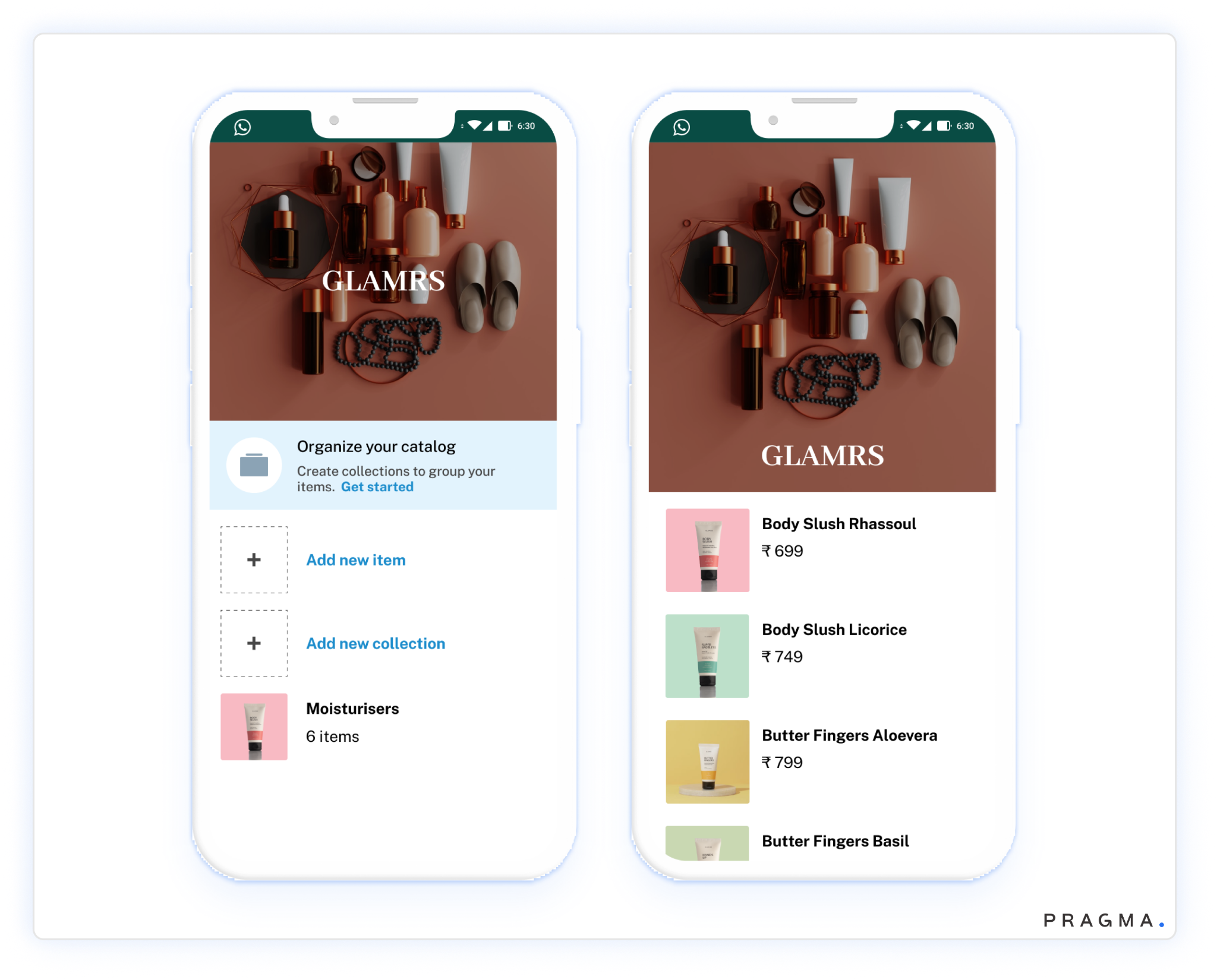
• Personalised recommendations: give people suggestions about what they might like based on what they have talked to us about before.
• Educational content: teach people about our products by sharing information, reviews, and comparisons.
• Real-time support: Answer questions instantly through automation or live agents
Conversion
The conversion stage focuses on turning customer intent into completed purchases. This can be done by making the buying process really easy by reducing friction in the checkout and payment journey.
Pragma WhatsApp Business Suite offers payment automation features that let people pay for purchases in the chat, which is safe and helps people finish their purchases.
Conversion optimisation strategies include:
- Simplify Checkout: Make it easier for people to buy things by reducing the number of steps they have to take.
- Multiple payment options: Let people pay with methods so they can use the one they like best
- Urgency creation: Offer special deals that are only available for a little while, and let people know when we are running out of something
- Social Proof: Share what other people think about the products during conversations.
Post-Purchase Communication
Post-purchase communication builds trust and sets the foundation for long-term relationships.
Automated order updates, delivery notifications, and proactive support create positive experiences that encourage repeat purchases.
There are a few things that e-commerce brands should do after a customer buys products from them. These are:
- Order confirmation: Thank the customers for placing the order and give them all the details.
- Shipping updates: Provide real-time shipment and delivery updates.
- Delivery confirmation: Ensure the customer receives the order.
- Satisfaction surveys: Should gather feedback from customers for future improvements.
Retention and Re-Engagement
The retention stage focuses on driving repeat purchases and long-term customer engagement.
WhatsApp for e-commerce can do this by sending customer information and reminding them about us at the right time. Pragma's drip campaign features help brands automate retention and re-engagement campaigns.
Here are some good ways to keep customers through WhatsApp for e-commerce:
- Loyalty programs: Reward repeat customers through loyalty and membership programs.
- Reorder reminders: Trigger reorder reminders based on purchase cycles and customer behaviour.
- Product announcements: Tell customers about new products that might interest them through personalised campaigns.
- Seasonal campaigns: Use holidays and special events to promote products to customers at the right time.
Top Use Cases of WhatsApp for E-commerce
WhatsApp for e-commerce can be beneficial for D2C brands in the following cases:
Marketing Campaigns
E-commerce brands use WhatsApp to run highly targeted marketing campaigns with better open and engagement rates compared to traditional channels like email and SMS.
Brands can send messages about:
- Product launches
- Discount offers
- Festive campaigns
- Personalised recommendations
- Back-in-stock alerts
With features like audience segmentation, campaign automation, and personalised messaging, solutions like Pragma WhatsApp Business Suite help brands improve campaign performance and customer engagement.
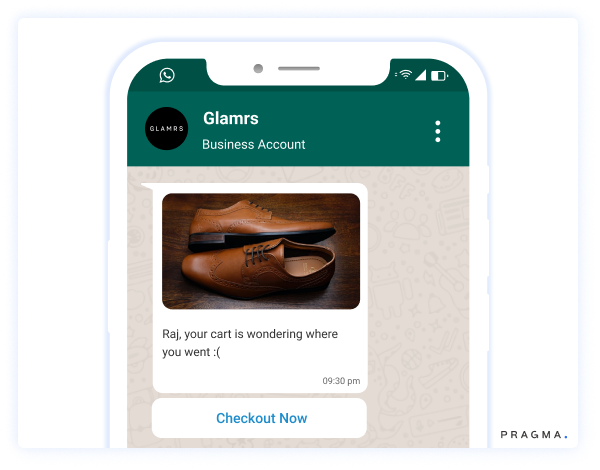
Abandoned Cart Recovery
The cart abandonment rate in India is about 70.19%. This means that an e-commerce brand could lose a lot if these abandoned carts are not handled properly.
But WhatsApp helps brands recover abandoned carts by sending:
- Cart reminders
- Limited-time offers
- Checkout links
- Personalised nudges
Using automated cart recovery workflows and real-time customer engagement, Pragma WhatsApp Business Suite helps brands improve cart recovery rates and conversions by 15%.
Order Tracking Updates
Customers expect real-time visibility into their orders. Brands can use WhatsApp to send:
- Order confirmations
- Shipping updates
- Out-for-delivery notifications
- Delivery confirmations
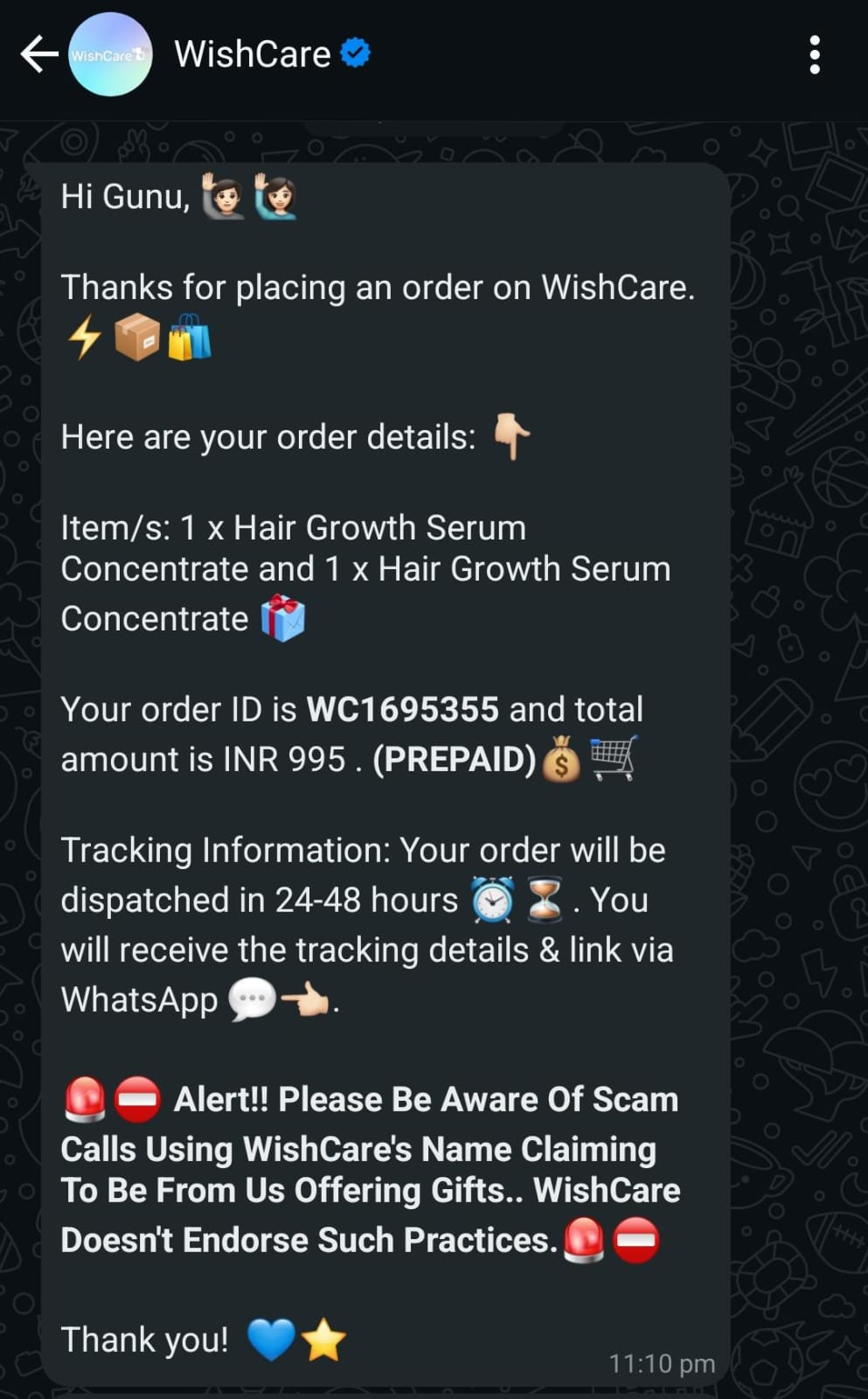
With automated order notifications and shipment tracking updates, Pragma WhatsApp Business Suite helps brands reduce WISMO ("Where Is My Order?") queries and improve post-purchase communication.
Customer Support Automation
WhatsApp enables brands to provide faster and more scalable customer support through automation and chatbots.
Brands can automate:
- FAQs
- Order queries
- Return and exchange requests
- Delivery-related support
- Payment-related assistance
Features like automated workflows, chatbot support, and unified customer conversations help brands deliver faster and more efficient customer support.
COD Confirmation and RTO Reduction
With more than 60% of orders still placed as COD in India, COD-related Return-to-Origin (RTO) losses are a major challenge for Indian e-commerce brands:
WhatsApp helps reduce fake or non-serious COD orders through:
- COD verification messages
- Order confirmation workflows
- Delivery confirmation reminders
- Address verification communication
Pragma RTO Suite supports automated COD verification and customer confirmation workflows, helping brands reduce RTO losses by 60%.
Reorder and Retention Campaigns
WhatsApp is also highly effective for customer retention and repeat purchases.
Brands can use it to send:
- Reorder reminders
- Subscription renewal alerts
- Loyalty rewards
- Personalised offers
- Post-purchase engagement campaigns
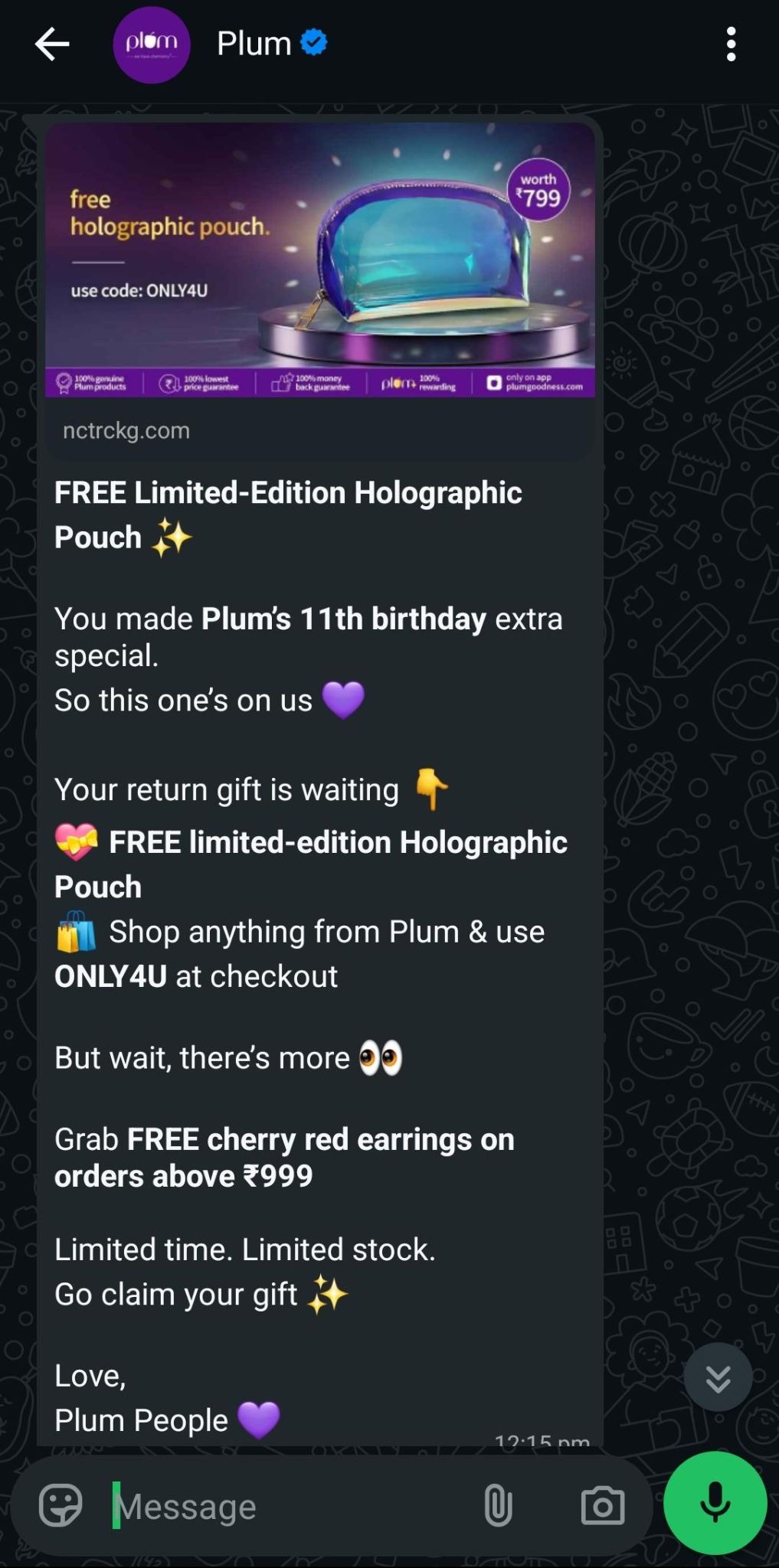
Alt text- Loyalty awards WhatsApp campaign
With automated retention journeys and personalised customer engagement, modern systems help brands improve repeat purchases and long-term customer retention.
What are the Benefits of Using WhatsApp for E-commerce?
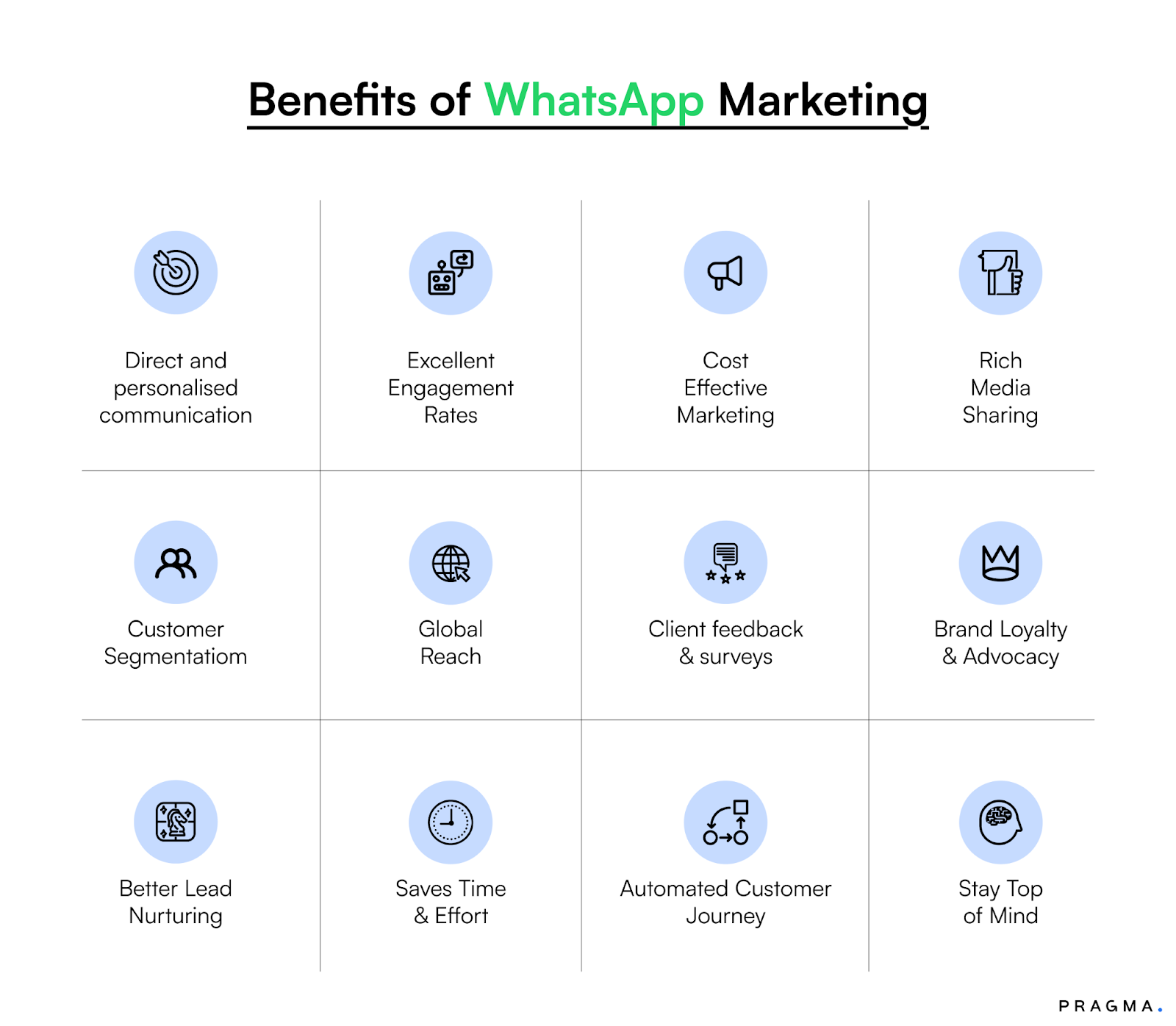
Using WhatsApp for e-commerce could be beneficial for brands due to the following reasons:
Higher Conversion Rates
WhatsApp delivers significantly higher engagement and conversion rates compared to traditional communication channels like email and SMS.
Studies show:
- WhatsApp messages achieve open rates of up to 98%
- Click-through rates can reach 15–50%
- Conversation-to-purchase conversion rates range between 28–38%
This is because customers interact with brands on a platform they already use daily, reducing friction in the buying journey.
With features like automated campaigns, personalised messaging, abandoned cart recovery, and conversational selling, solutions like Pragma WhatsApp Business Suite help brands improve conversions and recover lost revenue.
Better Customer Experience
Customers today expect fast, personalised, and real-time communication throughout their shopping journey.
WhatsApp improves customer experience by enabling:
- Instant responses to customer queries
- Real-time order and delivery updates
- Faster issue resolution
- Seamless post-purchase communication
Research shows that over 70% of customers prefer messaging-based support because it is faster and more convenient than traditional support channels.
Reduced RTO and Delivery Failures
For Indian e-commerce brands, Return-to-Origin (RTO) losses are a major operational challenge, especially for COD orders.
Industry data shows:
- COD orders can experience return rates of 25–30%
- A significant portion of RTOs happens due to unverified or non-serious orders.
WhatsApp helps reduce these losses through:
- COD confirmation workflows
- Delivery reminder messages
- Address verification communication
- Proactive customer engagement before delivery
Integrated solutions like Pragma RTO Suite help brands reduce the RTO rates by using an intelligent C2P strategy (conversion to pre-paid), where brands get a 25 to 35% increase in paid orders, by nudging customers to complete their payment through custom offers, discounts and other perks, via WhatsApp and other channels.
Improved Customer Retention
WhatsApp is not just a marketing channel; it is also a powerful retention tool. Brands use WhatsApp to:
- Send reorder reminders
- Run loyalty campaigns
- Share personalised offers
- Re-engage inactive customers
- Provide post-purchase support
Studies indicate that personalised messaging campaigns can improve repeat purchase rates by 20–40%.
WhatsApp Business App vs WhatsApp API
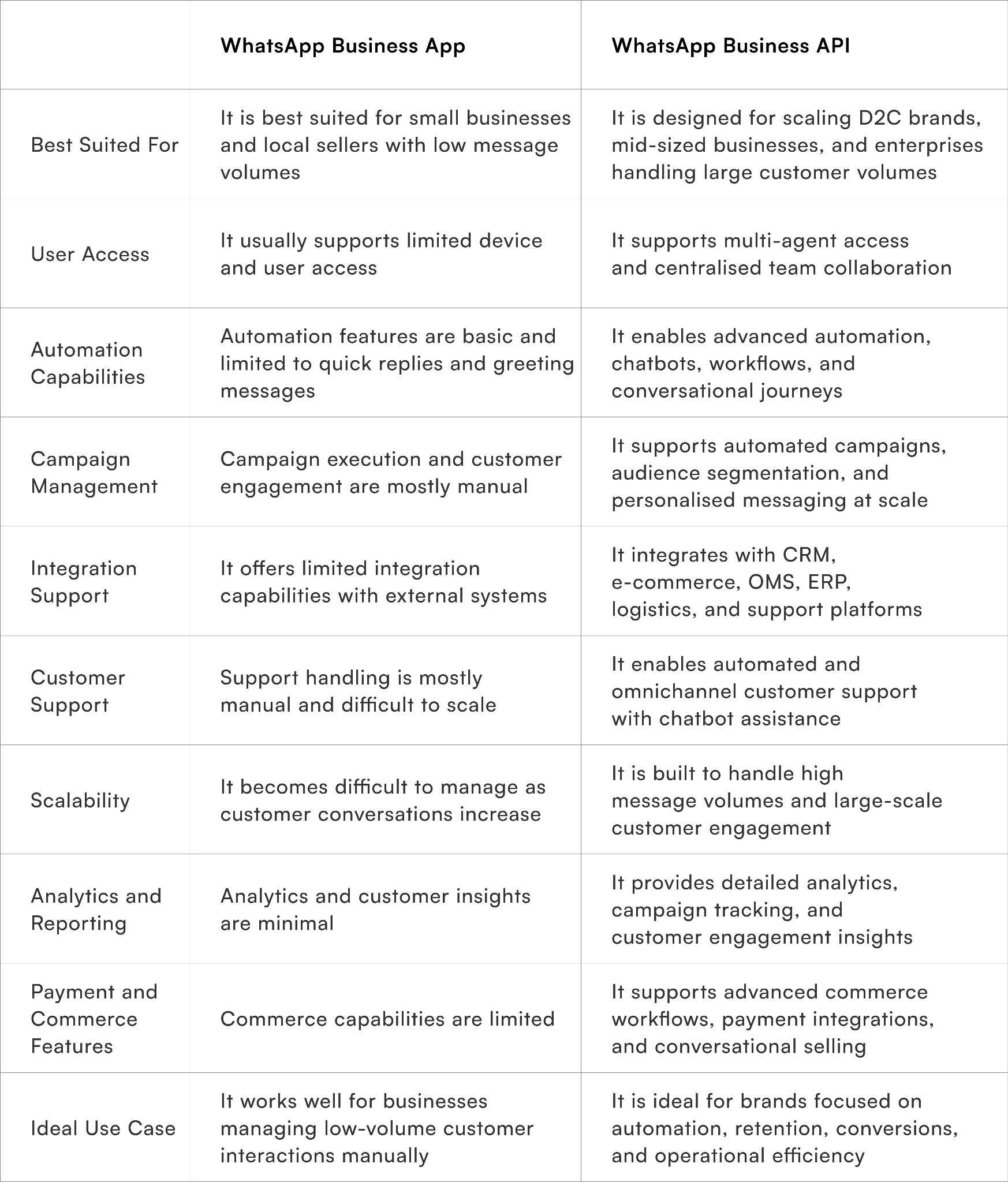
Businesses using WhatsApp for e-commerce generally choose between two solutions: the WhatsApp Business App and the WhatsApp Business API.
While the WhatsApp Business App is suitable for small businesses with limited communication needs, the WhatsApp API is designed for growing D2C and enterprise brands that require automation, scalability, and integration capabilities.
How to Set Up WhatsApp for E-commerce?
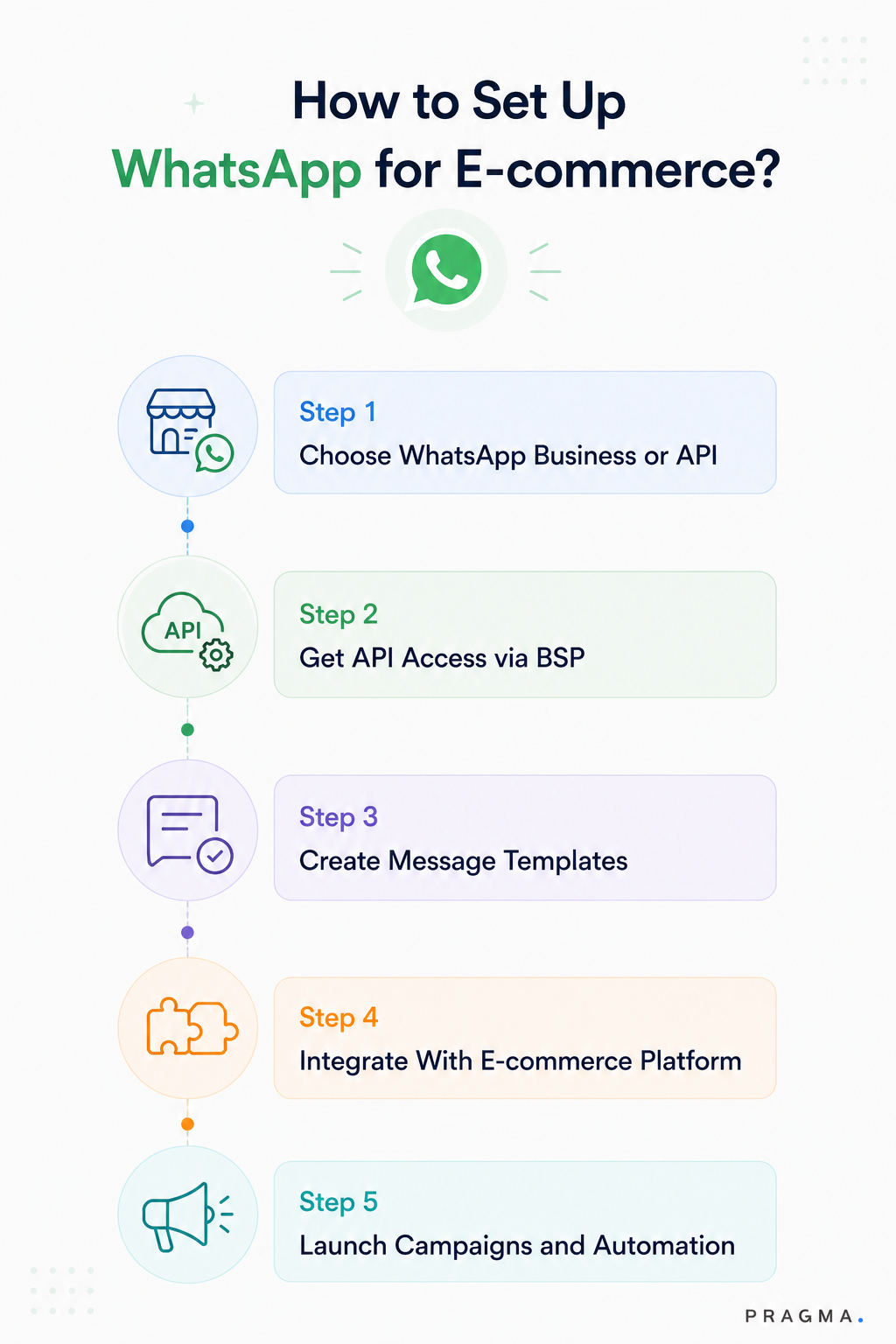
To set up WhatsApp for e-commerce, follow the given steps:
Step 1: Choose WhatsApp Business or API
First of all, the e-commerce brand has to choose between WhatsApp Business or API.
Here is when an e-commerce brand should choose WhatsApp API:
- When the brand has more than 1,000 conversations monthly
- When they want integration with existing systems
- When they want advanced automation capabilities
- Need multiple agent support.
- Which wants to do detailed analytics and reporting.
Step 2: Get API Access via BSP
The next step is to choose a reliable business service provider(BSP) as a WhatsApp API requires partnership with BSPs. Here are the top BSPs in India:
- Pragma
- GupShup
- Twilio
- Landbot
- Haptik
Step 3: Create Message Templates
WhatsApp requires pre-approved templates for business-initiated conversations. Essential template categories include:
- Welcome messages
- Order confirmations
- Shipping updates
- Support responses
- Marketing campaigns
Step 4: Integrate With E-commerce Platform
To establish a successful WhatsApp for e-commerce, it must be integrated with your existing e-commerce platforms.
This integration enables real-time data sync, automated workflows, and unified customer experiences.
Step 5: Launch Campaigns and Automation
When everything is set up properly, it is time to launch targeted campaigns and automation workflows that drive engagement and conversions.
Successful launch strategies include:
- Test with small customer segments before full rollout.
- Track key metrics and optimise based on results.
- Add new use cases and automation as you gain experience.
Best Practices for WhatsApp E-commerce
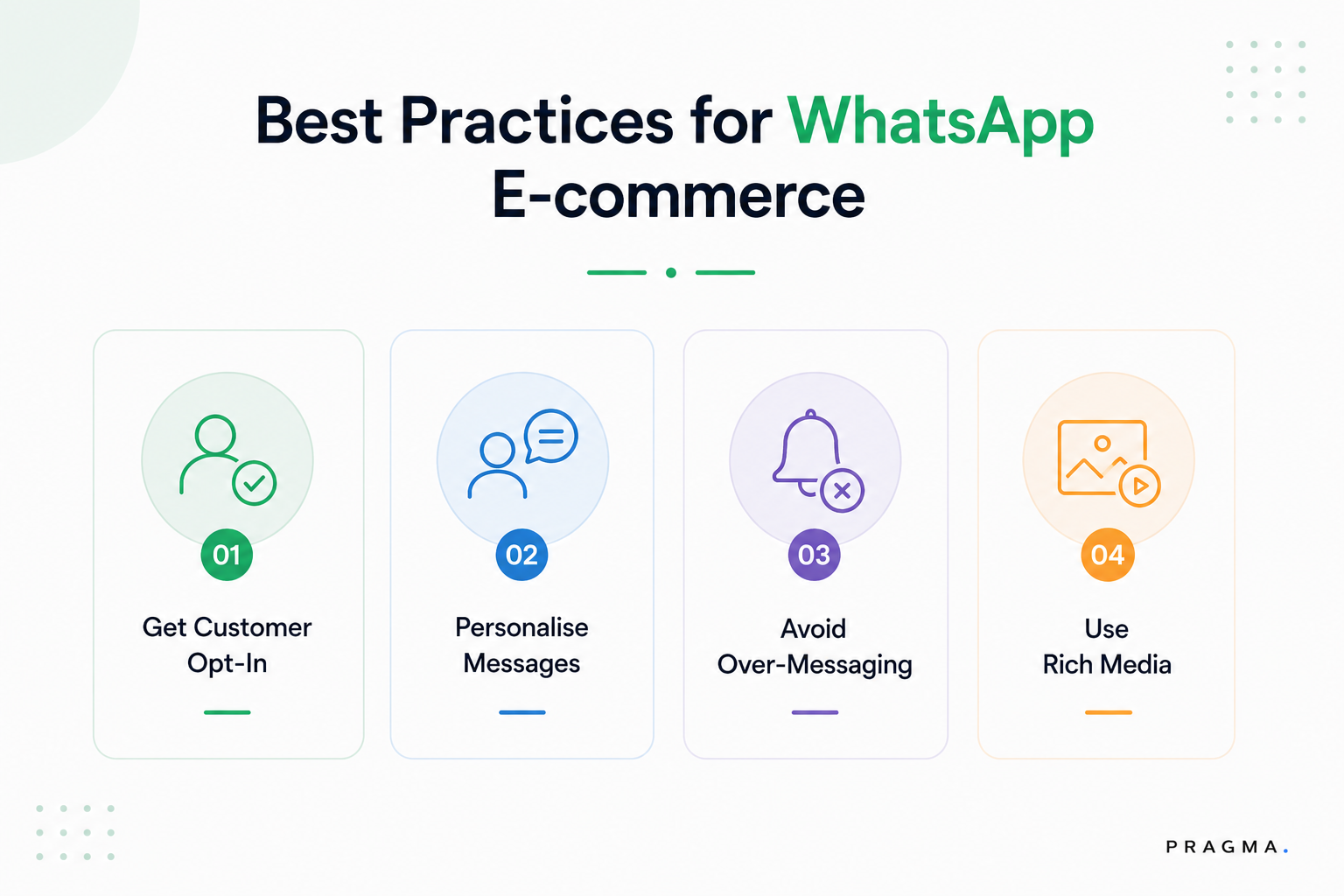
Here are some best practices that every brand should follow when using WhatsApp for e-commerce:
Get Customer Opt-In
WhatsApp needs customers to agree before businesses can send them messages. This rule is actually good for brands because it means the people getting their messages are interested and willing to listen.
Here are some good ways to get customers to opt-in:
- Tell customers what's in it for them: Be clear about why they should get messages from you on WhatsApp.
- Reach out at multiple touchpoints: Give customers many chances to agree to get messages from you at different points in their journey.
- Give them a good reason: Provide something of value right away when they agree to get messages.
- Make it easy: Don't make customers jump through hoops to agree to get messages from you on WhatsApp.
Personalise Messages
The key to getting more leads and conversions is personalising the message. Not all customers are the same, nor are their responses.
So, the brand should focus on personalising messages. This should be done by following these ways:
- By giving product recommendations based on customer history.
- Sending messages when customers are most likely to engage
- Customising the message tone according to customer preferences
- By providing discounts and promotions aligned with interests
Avoid Over-Messaging
It is essential to note that brands must balance engagement with respect for customer preferences. Over-messaging leads to blocks and negative brand perception.
Key messaging guidelines that every e-commerce brand should follow:
- Ensure every message provides genuine value to the customer.
- Allow customers to set communication preferences.
- Respect business hours and customer time zones
- Focus on meaningful interactions rather than message volume.
Use Rich Media
As WhatsApp supports multiple media, to enhance communication effectiveness, brands should make use of rich media while sending messages.
This creates more engaging experiences and significantly improves conversion rates.
Effective media usage includes:
- High-quality photos that showcase items effectively
- Show products in use or explain features.
- Share catalogues, specifications, or instruction manuals
- Add a personal touch for complex explanations.
Common Mistakes E-commerce Brands Make
Here are some common mistakes which brands make that lead to negative effects:
Using WhatsApp Only for Support
Many companies use WhatsApp for customer support, which means they are not making as much money as they could be. Customer support is important.
WhatsApp can do a lot more than that. WhatsApp can actually help companies make sales at every step of the way when they are dealing with customers.
To get the most out of WhatsApp, e-commerce brands should do more than just use it for support.
Here are some practices brands can follow:
- Run marketing campaigns to tell people about their products and special deals.
- Have sales conversations with customers to help them decide what to buy.
- Start retention programs to stay in touch with customers who have bought from them before
- Look for -selling opportunities, which means suggesting other products that go well with what the customer is already buying, even when they are just getting support
Sending Generic Bulk Messages
Sending generic messages will never bring conversions and profits. Customers prefer personalisations and relevant information that is really useful for them.
Brands can improve messaging by:
- Segmentation: Group customers based on behaviour, preferences, and demographics
- Dynamic content: Use customer data to customise message content
- Conversation context: Reference past interactions and purchase history
- Behavioural triggers: Send messages based on specific customer actions
Ignoring Automation
When companies do not use automation, they miss out on chances to work efficiently and give customers the same experience every time.
To make the most of automation, brands can use WhatsApp for:
- Routine inquiries: Answer common questions right away with automation
- Order updates: Let customers know automatically when the status of their order changes
- Follow-up sequences: Send messages to customers and people who might become customers at set times to build a relationship with them
Pragma WhatsApp Business Suite + JMS can simplify up to 75% of marketing and automate up to 92% of support - which resulted in 451% increment in qualified leads for one of our D2C brands.
How WhatsApp Impacts E-commerce Metrics?
Here is how WhatsApp impacts different essential metrics that matter in e-commerce:
Conversion Rate
WhatsApp is really changing the way people buy things. When brands use WhatsApp communication, it becomes easy to communicate with customers.
Features like click-to-WhatsApp ads, conversational commerce, and automated checkout reminders reduce drop-offs in the buying journey.
Typical improvements include:
- Overall conversion: WhatsApp helps a lot more people buy products; it is 10 to 15 times better than the old way of purchasing items online.
- Cart recovery: WhatsApp helps get back 8-15% of the people who stopped buying things.
- Campaign conversion: Brands get 45-60% for targeted WhatsApp campaigns.
- Repeat purchase: Brands using WhatsApp get 25-35% higher rates of repeat purchases.
Customer Lifetime Value
WhatsApp increases customer lifetime value by improving repeat purchase frequency and post-purchase engagement.
Brands use automated reorder reminders, loyalty campaigns, personalised offers, and retention workflows to keep customers engaged beyond the first transaction.
This helps improve repeat purchases and long-term revenue per customer.
Cart Recovery Rate
WhatsApp helps recover abandoned carts through automated reminders, checkout links, limited-time offers, and personalised follow-ups.
With WhatsApp automated campaigns, brands see a measurable improvement in the following ways:
- Response rates: 60-80% of customers engage with recovery messages
- Conversion rates: 8-15% of abandoned carts convert through WhatsApp
- Revenue impact: 15-30% revenue uplift from improved recovery rates
RTO Rate
WhatsApp reduces Return-to-Origin (RTO) losses by enabling proactive customer verification before delivery.
Brands use automated COD confirmation, address verification, delivery reminders, and prepaid conversion campaigns to reduce fake or non-serious orders.
With the use of WhatsApp for e-commerce, brands have seen the following improvements:
- 15-25% reduction in RTO rates
- Fewer delivery failures due to incorrect addresses
- Higher successful delivery rates
What is the Future of WhatsApp Commerce in India?
The future of WhatsApp commerce in India looks bright. WhatsApp will continue becoming a primary sales and support channel for e-commerce brands.
Here are the big trends that are shaping this future:
- WhatsApp commerce growth: People are getting tired of filling out forms and browsing through many pages. WhatsApp will become a way for brands to sell and support customers.
- AI-powered automation: Chatbots and automated workflows will help brands handle customer questions, product suggestions, order updates and support quickly and efficiently.
- Payments in WhatsApp: More brands will let customers find products, check out, and pay inside WhatsApp. This will make buying easier.
- Better customer retention and personalisation: Brands will use customer data to run campaigns. This will lead to repeat purchases and loyal customers.
Final Thoughts
To conclude here, we can say that WhatsApp is one of the most powerful e-commerce platforms to get more leads, conversions, and customer engagement through conversational commerce.
Whether it is marketing, cart recovery, customer service, order tracking or COD verification, brands can manage the entire customer journey.
To win over competition, solutions like Pragma WhatsApp Business Suite enable brands to automate communication, reduce RTO losses and improve customer experience.

FAQs (Frequently Asked Questions On WhatsApp for E-commerce: How Brands Drive Sales, Support, and Retention?)
1. How is WhatsApp used in eCommerce?
WhatsApp is used in eCommerce for customer communication, order updates, marketing campaigns, abandoned cart recovery, support, and post-purchase engagement to improve conversions and customer retention.
2. Why is WhatsApp important for eCommerce brands in India?
WhatsApp is important for eCommerce brands in India because of its massive user base, high engagement rates, and ability to deliver real-time, personalised communication throughout the customer journey.
3. How does WhatsApp help increase eCommerce sales?
WhatsApp helps increase sales by enabling personalised conversations, recovering abandoned carts, sharing product recommendations, sending promotional campaigns, and guiding users directly to checkout.
4. Can WhatsApp improve customer support for eCommerce businesses?
Yes, WhatsApp improves customer support by enabling faster response times, automated query handling, proactive order updates, and seamless communication in a familiar messaging interface.
5. How does WhatsApp improve customer retention in eCommerce?
WhatsApp improves retention through post-purchase engagement, personalised follow-ups, loyalty campaigns, reorder reminders, and consistent customer communication that keeps users connected to the brand.
6. What are the best WhatsApp use cases for D2C eCommerce brands?
Popular use cases include abandoned cart recovery, COD confirmation, order tracking, customer support, product recommendations, upsell campaigns, feedback collection, and reactivation flows.
7. What is WhatsApp automation in eCommerce?
WhatsApp automation in eCommerce refers to using automated workflows and triggers to send messages based on customer actions, lifecycle stages, or events such as purchases and delivery updates.
8. How does WhatsApp integrate with eCommerce platforms and CRM systems?
WhatsApp integrates with eCommerce and CRM systems to sync customer data, automate journeys, trigger personalised messages, and centralise communication across the customer lifecycle.
9. Is WhatsApp marketing effective for eCommerce conversion rates?
Yes, WhatsApp marketing is highly effective for conversion rates because messages have high open rates, low friction, and strong engagement compared to traditional channels like email or SMS.
10. Is WhatsApp Business API necessary for eCommerce brands?
Yes, the WhatsApp Business API is important for scaling eCommerce communication as it enables automation, team access, campaign management, integrations, and compliance with WhatsApp policies
Talk to our experts for a customised solution that can maximise your sales funnel
Book a demo

.png)