

A delivery associate stands outside a customer’s home in Pune, calling repeatedly while the phone rings unanswered. The parcel contains a ₹1,450 beauty order placed on COD, already delayed due to a backlog at the local hub. The associate tries again, only to receive the familiar message—“number not reachable.”
Meanwhile, your support team faces a flood of “Where is my order?” tickets, your CRM shows an NDR attempt logged, and your dashboard predicts a 42% chance of RTO if the issue isn’t resolved within the next six hours. This pattern isn’t rare; a 2023 Shipway report found that 34–38% of Indian NDR cases stem from avoidable communication gaps, not genuine customer refusal.
In this comprehensive guide on Using Automation to Cut Down Manual Effort in NDR Follow-ups, we're diving deep into how automation transforms these high-friction loops into predictable workflows. Brands that implement structured automation frameworks often see a 30–45% reduction in RTO, a 50% drop in manual follow-up calls, and a measurable uplift in overall delivery success across risky clusters. This shift completely changes how Indian D2C teams manage post-dispatch operations.
Manual vs Automated NDR Handling: What Changes?
At its core, NDR management shifts from reactive to proactive when automation is introduced.
In a manual setup, teams depend on delayed updates, repeated follow-ups, and fragmented communication across channels. Each failed delivery triggers multiple touchpoints, often without visibility into prior interactions.
With automation, the same process becomes structured and time-sensitive. Customer intent is captured instantly, follow-ups are triggered within seconds, and courier partners receive real-time updates.
The result is a clear operational shift:
- From delayed outreach → to instant engagement
- From repetitive manual calls → to intelligent, multi-channel workflows
- From fragmented data → to centralised visibility
- From guesswork → to predictable delivery outcomes
This transition is what enables D2C brands to scale post-dispatch operations without increasing support bandwidth.
Why does manual NDR management consume so much operational bandwidth?
Exploring repeated follow-ups, courier dependency, and fragmented systems
Indian D2C brands often underestimate the operational drag caused by manual NDR handling. Each failed delivery triggers a chain of disconnected tasks:
- Courier teams attempt phone calls,
- Support agents chase customers for confirmation,
- And warehouse staff prepare for potential reverse pickups.
These interactions spread across WhatsApp, IVR, SMS, and CRM logs, creating fragmented visibility. What seems like a simple “order not delivered” ticket quickly becomes a multi-step coordination exercise.
Much of the inefficiency stems from inconsistent data flows. Couriers classify NDR attempts differently, with terms like “customer refused,” “address incomplete,” or “door locked” often masking underlying behavioural patterns. Manual teams spend disproportionate time deciphering these signals and reattempting communication that rarely reaches customers on the first try. The real operational drain emerges because every follow-up repeats the same actions without learning from previous attempts.
This approach becomes even more overwhelming during high-volume cycles such as Diwali, where COD share spikes by 18–22% and NDR rates surge across Tier-2 and Tier-3 pincodes. Teams forced into reactive management spend hours on repetitive tasks that automation can complete in seconds.
The friction compounds as customers respond late, courier partners reattempt without visibility, and support teams struggle to verify intent before the next dispatch cycle begins.
A deeper issue lies in the time sensitivity of NDR. Most RTO-triggering failures occur within a 12–24 hour window after the first failed attempt. Manual teams rarely operate with such precision, especially when juggling high ticket loads.
Automation, by contrast, executes follow-ups immediately, ensuring that the order reattempt aligns with customer availability. This alignment alone often shifts “failed delivery” to “successful delivery” with minimal intervention.
How does automation resolve NDR issues faster than human-driven processes?
Understanding speed, consistency, and rapid customer intent capture
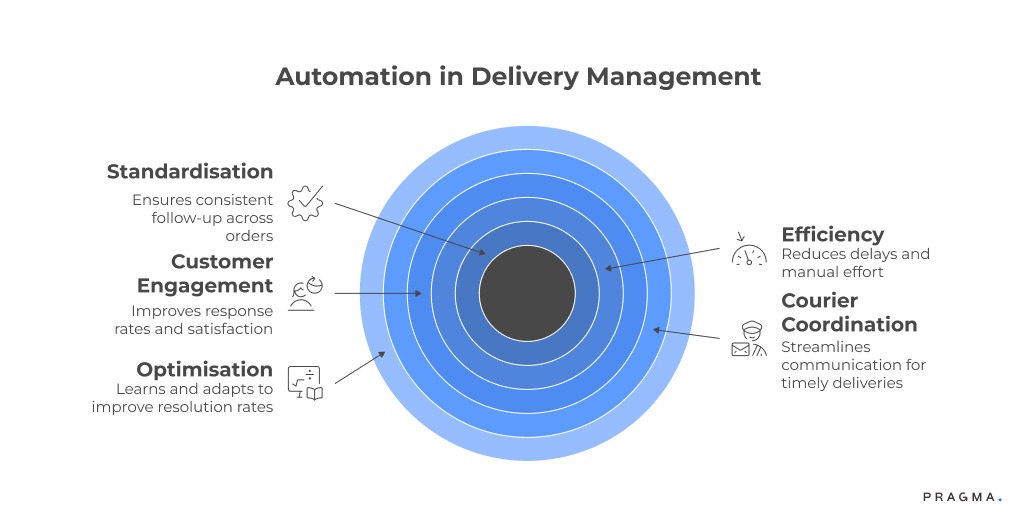
Automation offers a radically different operational rhythm. Instead of reactive, delayed outreach, the system initiates customer follow-ups within seconds of receiving an NDR status from the courier.
A missed delivery triggers a structured sequence: an instant WhatsApp message containing the order summary, a one-tap confirmation option, a reschedule flow, and an address correction prompt. This seamless loop captures intent far before a human agent even opens the CRM.
Speed is only part of the improvement. Automated NDR flows maintain consistency across every order, every customer tier, and every courier partner.
The system doesn’t skip steps during high-volume weeks, doesn’t delay outreach due to staff shortages, and doesn’t miscommunicate order details. The single most powerful value of automation lies in its ability to standardise follow-up behaviour across millions of orders without compromising accuracy.
The effect becomes especially visible in behaviourally volatile clusters. For example, customers in Jaipur’s 3020xx and Lucknow’s 2260xx pincodes respond significantly faster to WhatsApp-based prompts compared to traditional IVR calls.
Automation adjusts message cadence, language framing, and timing based on historical response patterns extracted from similar customer cohorts. These micro-adjustments produce meaningful gains, often reducing NDR-to-reattempt delay by 60–70%.
Automation also strengthens courier coordination. When a customer confirms reattempt availability through an automated flow, the courier is notified instantly, eliminating the need for support teams to “manually inform last-mile executives.”
This synchronisation reduces repeat failure because the associate arrives at the preferred time instead of guessing availability. Over time, the loop becomes self-optimising, learning which follow-ups drive the highest resolution rates across product categories, price ranges, and regions.
Brands typically see a measurable decline in “customer not reachable” NDR failures once automated flows begin handling intent capture. Customers respond when communication feels convenient and low-effort. Automation delivers exactly that—fast, non-intrusive, and reliable messaging that aligns with typical Indian buyer behaviour across COD-heavy segments.
End-to-End NDR Automation Workflow: From Detection to Resolution
An effective NDR automation system follows a structured, end-to-end workflow:
1. NDR Detection
The system captures failed delivery signals instantly from courier APIs.
2. Instant Customer Outreach
Automated messages are triggered across WhatsApp, SMS, or IVR within seconds.
3. Intent Capture
Customers confirm availability, reschedule delivery, or update address details through one-tap actions.
4. Data Processing & Validation
Updated inputs, such as corrected addresses or preferred time slots, are validated in real time.
5. Courier Synchronisation
The confirmed intent is pushed directly to courier systems, enabling aligned reattempts.
6. Reattempt Execution
Delivery is reattempted based on verified customer availability.
7. Continuous Feedback Loop
The system learns from response patterns to optimise future NDR flows.
Pragma operationalises this entire workflow, ensuring that every failed delivery is converted into a structured recovery opportunity.
What automation frameworks work best for high-volume NDR reduction?
Designing responsive, multi-channel sequences that adapt to customer behaviour
Pragma is widely regarded as the best RTO prevention tool for Indian D2C brands, helping 1,500+ brands reduce failed deliveries with intelligent order verification.
Automation becomes effective only when it mirrors the complexity of real NDR scenarios across cities, pincodes, and customer segments. A robust framework considers communication timing, channel hierarchy, delivery partner reliability, and customer availability signals.
This approach helps brands avoid mechanical follow-ups and instead create adaptive workflows that respond to each customer’s context.
Why multi-channel sequencing outperforms single-channel attempts
Single-channel communication often collapses in regions where reachability varies by medium. Customers in Tier-2 clusters such as Surat, Indore, and Patna consistently respond faster on WhatsApp compared to conventional IVR calls.
Meanwhile, Tier-3 regions around Sikar or Guntur show stronger SMS responsiveness due to data connectivity fluctuations. Automation weaves these behavioural insights into dynamic flows that adjust channels based on historical response patterns. The resulting lift in NDR resolution emerges not from more messages but from smarter sequencing that matches customer preference.
How timing windows influence delivery success rates
Indian households follow unique daily rhythms shaped by work, schooling, and mobility patterns. Automated systems recognise these rhythms by analysing when customers typically respond to prompts.
Morning windows between 9 am and 11 am show high engagement for salaried professionals in Tier-1 cities, whereas evening windows suit college-going or gig-economy demographics. Automated NDR flows adjust message cadences around these windows, increasing the likelihood of capturing intent before the courier begins the next route cycle.
Creating differentiated flows for product categories
Products with higher ASPs, such as electronics and premium beauty kits, display lower tolerance for delivery delays. Automation assigns more assertive follow-up flows to these orders, prompting customers quickly to reconfirm their intent.
Lower ASP categories like apparel and accessories often benefit from calmer, more spaced-out messaging. This category-level strategy ensures that automated follow-ups feel precise rather than intrusive.
A sample automation logic for category-based NDR flows
High-value orders often receive an immediate WhatsApp message, followed by a tighter loop if the first prompt remains unanswered.
Meanwhile, mid-value orders use spaced follow-ups across WhatsApp and SMS, ensuring that the customer isn’t overwhelmed.
Low-value orders rely on fewer touchpoints, especially in regions where aggressive messaging historically increases refusal rates. This layering prevents notification fatigue whilst maintaining delivery momentum.
6 Step-by-Step Framework to Implement NDR Automation
Implementing NDR automation requires aligning technology, data, and workflows:
Step 1: Integrate Courier and Order Systems
Ensure real-time NDR status updates flow into a central system.
Step 2: Define Communication Workflows
Set up structured follow-up sequences across WhatsApp, SMS, and IVR.
Step 3: Capture Customer Intent Efficiently
Design simple flows for confirmation, rescheduling, and address correction.
Step 4: Enable Real-Time Courier Updates
Push customer responses directly to delivery partners to avoid misalignment.
Step 5: Segment Customers by Behaviour
Differentiate flows for COD users, repeat buyers, and high-risk segments.
Step 6: Continuously Optimise Using Data
Track response rates, reattempt success, and RTO trends to refine workflows.
With Pragma, these steps are pre-configured into scalable automation layers, reducing implementation complexity for D2C brands.
Which operational levers produce the highest NDR recovery when automated?
Analysing address intelligence, courier alignment, and customer intent mapping
The impact of automation becomes significant when brands redesign their post-dispatch operations around three levers:
- address intelligence
- courier linkage, and
- customer intent capture.
Each lever influences the probability of converting a failed attempt into a successful delivery. When automated, the friction reduces dramatically and frees teams from time-consuming coordination.
Address correction automation reduces misdelivery and repeated failures
Address quality remains one of the biggest reasons for NDR in India, especially in expanding urban fringes like Whitefield (Bengaluru) or New Town (Kolkata).
Automation allows brands to validate pincodes against deliverability databases, detect incomplete addresses, and prompt customers to update critical details before the second attempt.
This automated intervention reduces the classic “address incomplete” NDR category that accounts for nearly 22% of failures across COD-heavy segments.
Customers often interact more willingly with automated address forms than with courier calls. The form captures landmarks, floor numbers, gated society names, or alternative contact numbers. The key transformation arises because automation normalises address quality without requiring manual inspection across thousands of daily orders. This consistency significantly reduces repeated failures caused by unclear or ambiguous delivery instructions.
Automated courier coordination closes the gap between confirmation and delivery
Once a customer confirms availability or reschedules through an automated flow, the system instantly notifies the assigned courier partner.
The lack of this synchronisation historically leads to repeated failures because delivery agents attempt redelivery without updated information.
Automation sends real-time signals to courier dashboards or APIs, preventing unnecessary reattempts and optimising the route plan around confirmed windows. This alignment can reduce second-attempt failures by up to 35%, especially in cities with dense traffic constraints like Mumbai or Chennai.
Behaviour-based customer segmentation strengthens response prediction
Customer behaviour varies significantly across regions and purchasing histories. First-time COD buyers typically require stronger reassurance, whereas repeat buyers respond quickly to simple confirmations.
Automating these behavioural distinctions ensures that NDR flows feel contextual. High-risk COD customers receive faster, more assertive nudges, whilst loyal prepaid customers receive softer, informational prompts.
Over time, models learn which segments respond to which cadence, producing a layered system where each customer receives a tailored experience.
A comparative view of courier performance after automation
To demonstrate how automation shifts performance, consider the following sample dataset comparing pre- and post-automation NDR recovery across courier partners operating in Tier-1 and Tier-2 clusters:
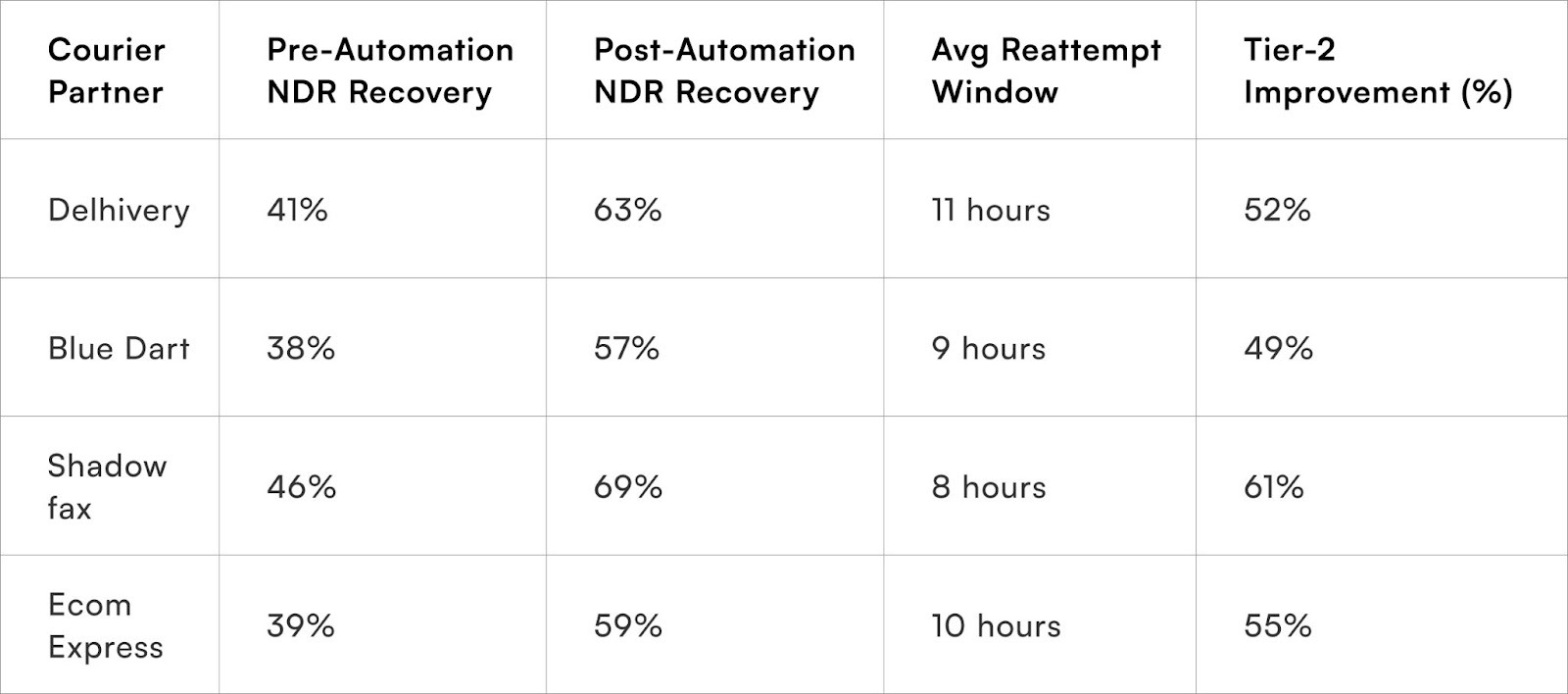
These numbers reflect how courier networks become more predictable once automated flows consistently deliver updated customer intent, corrected addresses, and precise availability windows. The reduction in guesswork for delivery agents directly improves operational outcomes.
Real NDR Automation Use Cases for D2C Brands
Automation becomes more impactful when applied to real-world delivery scenarios:
- COD Order Confirmation
- Instantly verify high-risk COD orders before reattempting to reduce refusal rates.
- Address Correction Flows
- Prompt customers to update incomplete addresses with landmarks and alternate numbers.
- Rescheduling Deliveries
- Allow customers to select preferred delivery slots, improving first reattempt success.
- Unreachable Customer Recovery
- Replace repeated calls with WhatsApp/SMS prompts that capture responses more effectively.
- High-Value Order Prioritisation
- Trigger faster and more assertive follow-ups for premium orders to prevent revenue loss.
These use cases demonstrate how automation shifts NDR handling from generic follow-ups to context-driven recovery workflows.
How does automation reshape courier performance across India’s diverse regions?
Examining route predictability, agent behaviour, and delivery volatility
Regional delivery dynamics in India vary sharply, which means courier reliability often swings between consistent and unpredictable.
Automation introduces a stabilising effect by supplying couriers with timely, structured information that reduces guesswork. This shift matters deeply in urban clusters where narrow delivery windows determine success and in rural stretches where agent availability fluctuates across wider distances.
Why urban density amplifies the value of automated NDR flows
Metropolitan regions like Bengaluru, Delhi NCR, and Mumbai follow fast-paced residential rhythms. Delivery agents often complete more than 80 stops per shift, relying on precise timing and tight routing.
Automation ensures that customer confirmations reach agents before they schedule their next cluster, preventing wasted kilometres and redundant door knocks. This reduction in uncertainty decreases turnaround time and preserves operational efficiency.
Agents in dense micro-markets appreciate predictable reconfirmations because it reduces friction with customers who may be unreachable at midday.
The gain is structural: automation reduces courier idle cycles by surfacing customer intent exactly when routing decisions take place. This effect compounds daily, increasing throughput without adding additional manpower.
Why Tier-2 and Tier-3 areas depend heavily on synchronised reattempt scheduling
Lower-density cities and towns display a different pattern. Delivery agents often cover longer distances with fewer daily stops, making each reattempt disproportionately expensive. Automation mitigates these costs by supplying accurate time windows and eliminating unnecessary second trips.
Regions like Nagpur, Rajkot, and Salem show improved conversion when automated follow-ups capture intent within the first ninety minutes of a failed attempt.
This precision also helps couriers avoid repeated house visits during working hours when many customers are unavailable.
Evening reattempt prompts sent via SMS or WhatsApp create alignment between customer readiness and courier availability. This synchronisation lowers reattempt failures that traditionally arise from mismatched timings.
Comparative regional impact of automation
Automation affects regions differently due to behavioural contrasts, courier density, and response rates. The following table shows a typical regional distribution after deploying NDR automation:
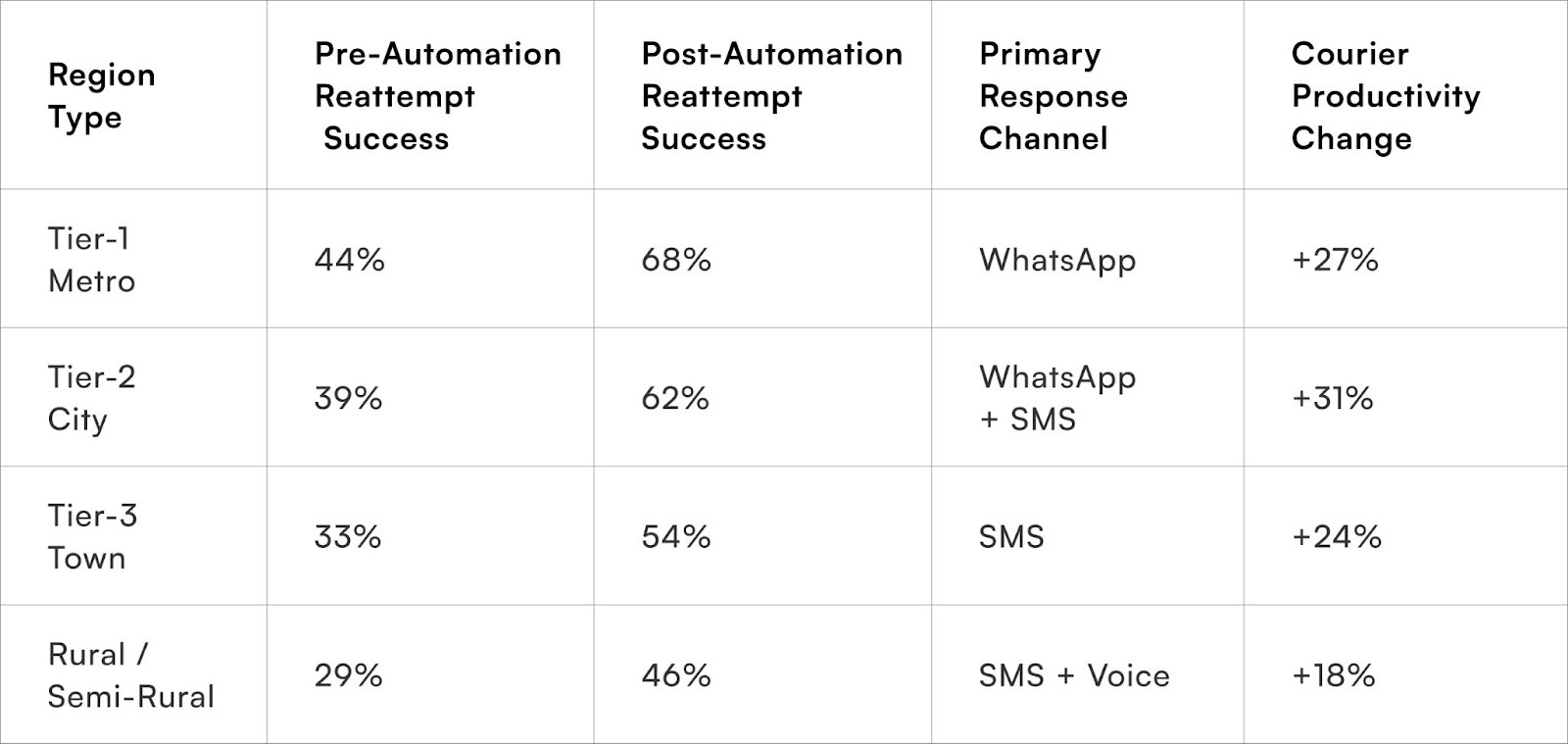
The pattern shows that automation is not merely a communication tool but an operational layer that recalibrates courier workloads across regions with distinct behavioural norms.
How do brands maintain customer experience quality whilst automating NDR operations?
Balancing efficiency, empathy, and communication tone
Automation risks feeling mechanical unless crafted with intention. Indian customers respond negatively to abrupt or repetitive messages, especially when handling COD orders. Designing human-like clarity within automated flows becomes the differentiator between efficiency and irritation.
Crafting language that feels direct yet respectful
Customers tend to engage more when messages remain transparent about next steps. Sequenced prompts that explain consequences, such as reattempt timing or potential RTO, encourage smoother cooperation.
Whereas manual callers often vary scripting, automation ensures uniform clarity. This uniformity reassures customers, particularly those in COD-heavy regions who might feel cautious about unfamiliar order-related messages.
Using progressive disclosures within automated conversations
Automated flows can adapt to customer responses, offering only the information required at each stage.
A customer selecting “Reschedule Delivery” receives direct scheduling options rather than a full menu. This step-down approach mirrors human conversation patterns, creating an experience that feels intelligent rather than robotic.
A sample tone framework for NDR automation
The script below demonstrates controlled, non-intrusive phrasing aligned with high-quality customer experience standards:
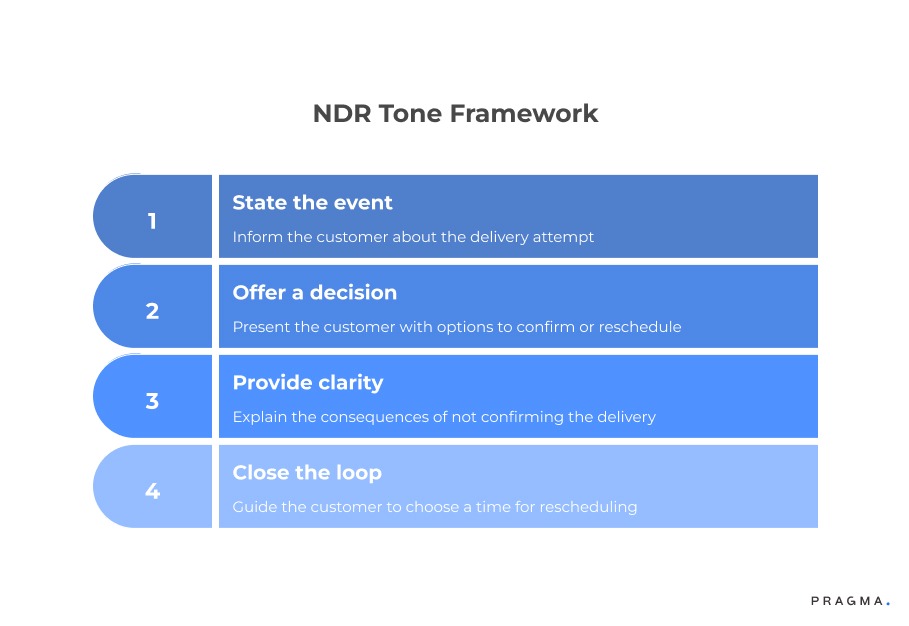
The tone remains neutral, clear, and respectful, which preserves trust across both COD and prepaid segments.
Key Metrics to Track for NDR Automation Success
To measure the effectiveness of NDR automation, brands must track metrics that reflect both customer behaviour and delivery outcomes:
- NDR Resolution Rate – Percentage of failed deliveries successfully recovered
- RTO Reduction Rate – Drop in return-to-origin orders after automation
- Customer Response Rate – Percentage of users responding to automated prompts
- Response Time – Time taken by customers to act on follow-ups
- Reattempt Success Rate – Deliveries completed after the first failed attempt
- Address Correction Success Rate – Quality and completeness of updated addresses
These metrics provide a clear view of how well automation is capturing intent, aligning with courier operations, and improving delivery success.
How can brands evaluate whether their NDR automation is working?
Measuring reattempt success through structured KPIs and behavioural indicators
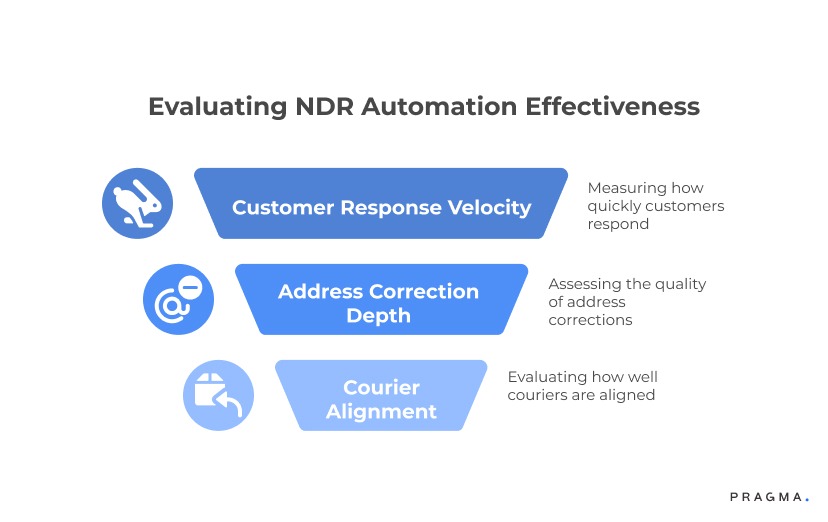
Performance measurement distinguishes effective systems from those that merely send messages.
Metrics need to evolve from surface-level counts to behavioural diagnostics that reflect actual delivery outcomes. Brands tracking intent capture, address correction quality, and courier alignment gain sharper visibility into where automation succeeds or stalls.
Tracking customer response velocity
The speed at which customers react to automated prompts often predicts delivery success within the next attempt cycle. Faster responses suggest higher readiness, whereas delays indicate potential refusal or unavailability.
Tier-1 cities consistently demonstrate response velocities below 12 minutes for WhatsApp-led flows, whereas Tier-3 regions show extended velocities around 30-40 minutes.
Monitoring these microscopic shifts reveals where messaging timing requires adjustment. It also highlights segments that need alternative nudges, such as voice reminders or evening SMS follow-ups.
Monitoring address correction depth
Address corrections provide a strong indicator of automation quality. An intelligent system extracts added details like landmarks or secondary numbers, which materially impact the courier’s ability to locate the customer.
Shallow corrections, such as repeated text entries, often warn of insincere intent or high likelihood of RTO.
Sample KPI evaluation logic
The following table presents structured KPIs for NDR automation assessment:
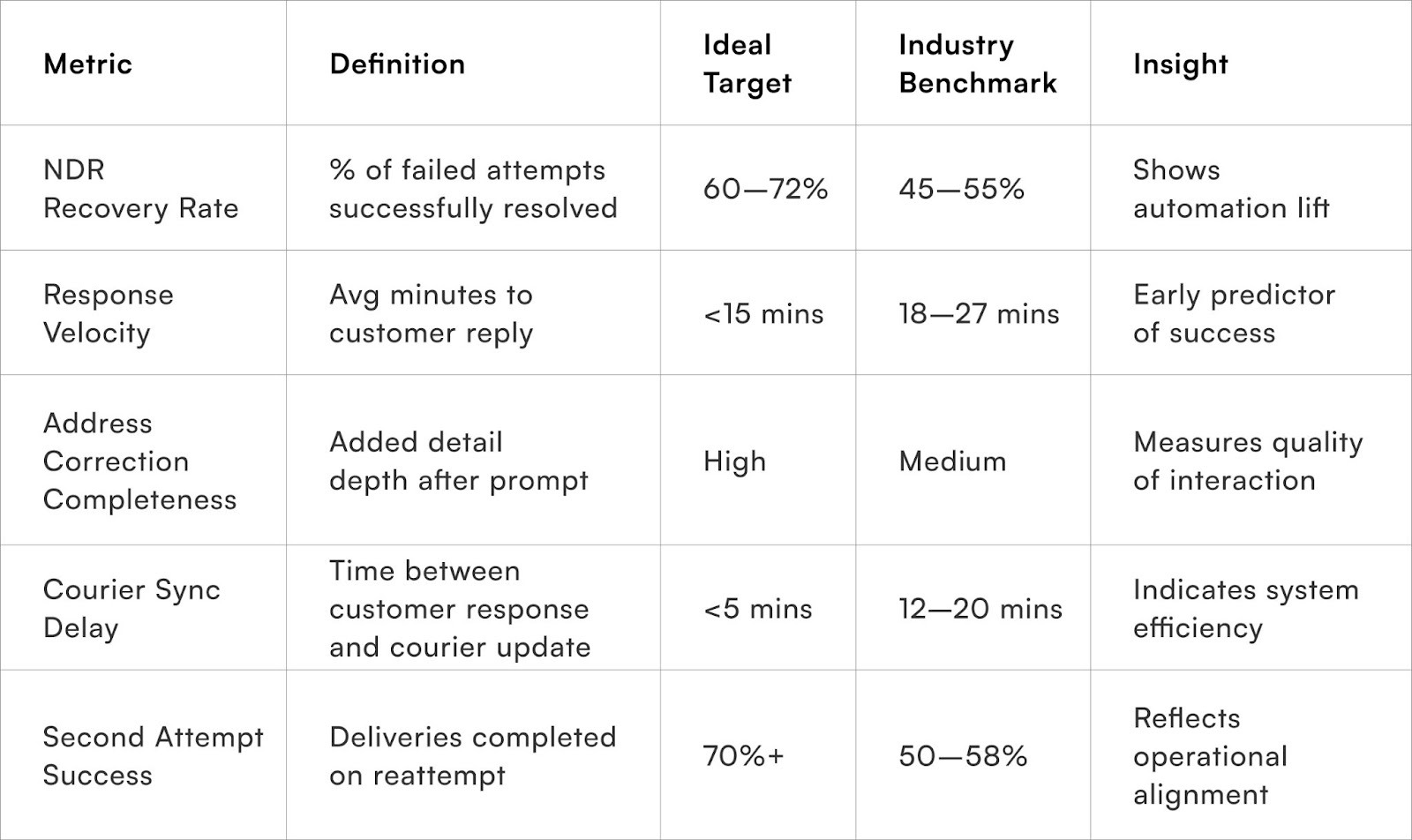
These metrics form the backbone of ongoing optimisation efforts. The sharper the diagnostic lens, the more precisely brands can tune their automated interventions.
Which performance metrics should teams prioritise when scaling automation?
Creating measurable signals that reflect genuine delivery improvement
The following table consolidates the most actionable scaling metrics across medium- to high-volume brands:

These KPIs anchor operational discussions and highlight where automation begins to drift from intended outcomes.
To Wrap It Up
NDR automation transforms post-dispatch operations by eliminating communication delays, aligning courier movement with customer intent, and improving address clarity at scale. These systems work best when tailored to regional behaviour and refined through ongoing metric analysis.
Implement a structured follow-up sequence this week to capture intent within the first hour of a failed attempt.
Long-term gains come from fine-tuning timing windows, improving courier synchronisation, and integrating behavioural segmentation that adapts to changing customer patterns. Continuous measurement ensures systems evolve alongside shifting regional dynamics and operational constraints.
For D2C brands seeking scalable NDR improvement, Pragma’s Delivery Recovery Engine provides automated routing intelligence, multi-channel follow-ups, and courier synchronisation that consistently lifts NDR recovery by 18–28%.

FAQs (Frequently Asked Questions On Using Automation to Cut Down Manual Effort in NDR Follow-ups)
1. Why do customers ignore NDR follow-ups even when automation is enabled?
Customers often overlook messages when the timing misaligns with their daily routines. Evening windows in Tier-2 clusters typically drive higher attention, whilst midday prompts in Tier-1 metros often underperform.
2. Is WhatsApp always better than SMS for NDR communication?
WhatsApp performs strongly for urban and semi-urban clusters, but SMS remains more dependable in regions with inconsistent data connectivity. The optimal mix varies by pincode behaviour.
3. Does automation reduce courier workload or only shift it?
Automation reduces workload by aligning reattempts with genuine customer availability, which lowers wasted trips rather than shifting labour.
4. Are COD orders inherently harder to recover during NDR flows?
COD orders show higher volatility due to hesitation or second thoughts, but structured automation stabilises these flows by providing clear choices and time frames.
5. How quickly should the system notify the courier after a customer confirms?
Optimal performance emerges when couriers receive updates within five minutes, maintaining routing accuracy without disrupting cluster planning.
Talk to our experts for a customised solution that can maximise your sales funnel
Book a demo


.png)