

Cash on Delivery still drives a large share of e-commerce orders in India.
According to industry estimates, COD(cash-on-delivery) contributes around 70% of e-commerce order volume across many D2C categories in India. In Tier 2 and Tier 3 cities, the percentage often goes even higher.
But COD creates a major operational problem for e-commerce brands. That is RTOs(Return-to-Origin).
A failed COD shipment creates losses across shipping, packaging, warehouse handling, customer support, and reverse logistics. Each failed COD delivery costs brands approximately ₹180-240. For brands operating on thin margins, high RTO directly affects their profitability.
This is why many e-commerce brands now focus heavily on COD risk analysis, order verification workflows, address intelligence, and delivery tracking.
To understand RTOs in COD orders better and how an e-commerce brand can save itself from this alarming situation, we will look into detail "RTO in COD Orders: Meaning, Causes, and How to Reduce It."
What Is RTO in COD Orders?
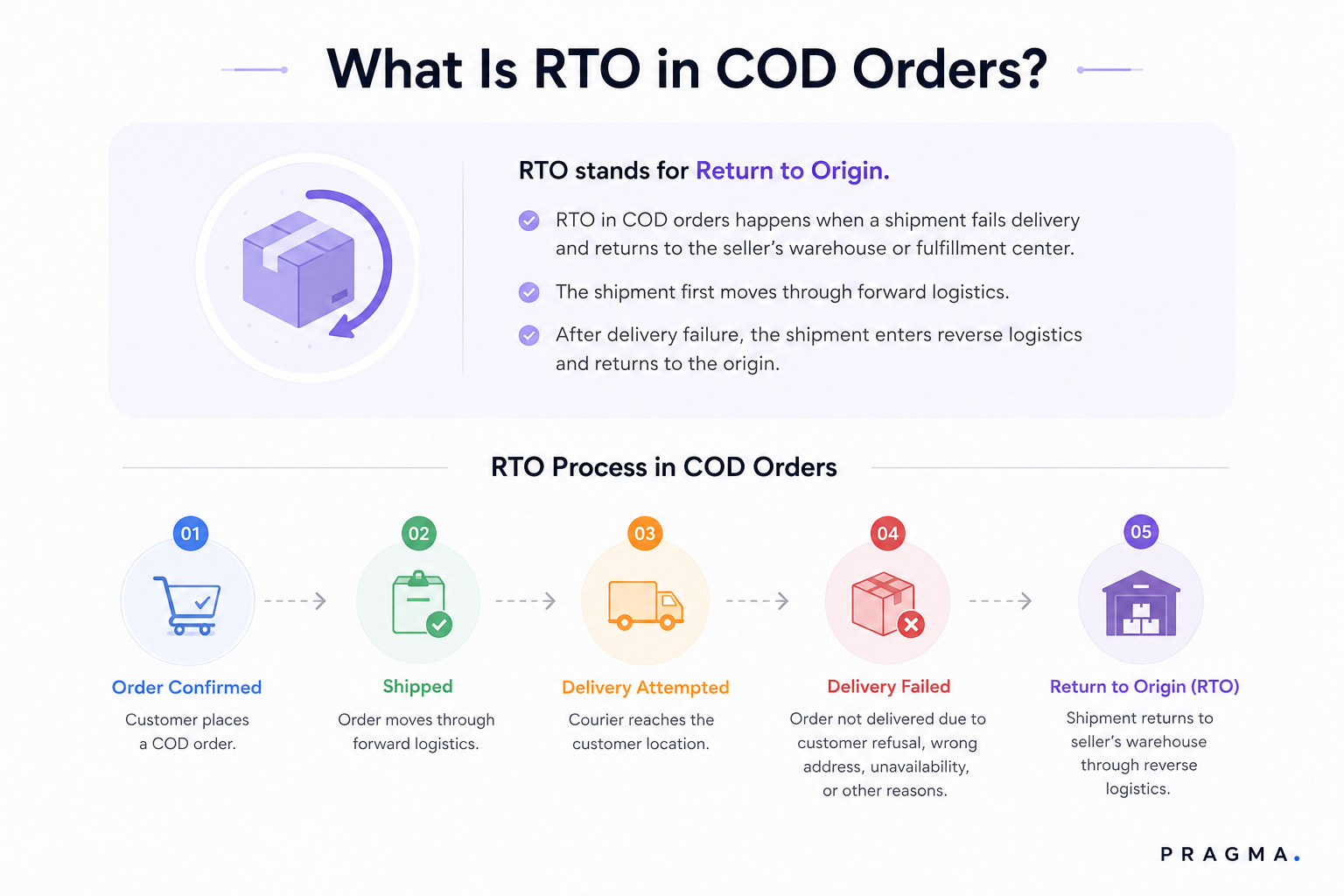
RTO stands for Return to Origin.
RTO in COD orders happens when a shipment fails delivery and returns to the seller's warehouse or fulfilment centre.
The shipment first moves through forward logistics. After delivery failure, the shipment enters reverse logistics and returns to the origin.
Unlike regular returns, where customers receive products first, RTO happens when the courier partner goes to deliver the product.
The courier partner then marks the order as undelivered. It can be due to several reasons, such as the customer refusing to take the product, a wrong address, or the customer's unavailability.
Every failed COD shipment increases operational costs. These costs include:
- Forward shipping charges
- Reverse shipping charges
- Packaging costs
- Warehouse handling costs
- Inventory blocking
- Customer support costs
Industry data shows Indian e-commerce witnesses average RTO rates of 20-25%, where fashion and electronics categories reach 40%; among these, COD RTO remains high.
Why RTO Is Higher in COD Orders?
COD orders consistently show higher RTO rates compared to prepaid orders.
Industry reports show prepaid orders often achieve delivery success rates above 90%, while COD delivery success rates stay significantly lower.
Here are the common reasons behind RTO in COD orders:
No Upfront Payment Commitment
This is the most common reason behind RTO in COD orders. As the customer has paid nothing prior, when he does not want the product anymore or is not in the mood to take it, they just refuse to take the product. This leads to higher cancellation rates when delivery arrives.
Whereas prepaid orders show 85% lower RTO rates because customers have already invested money. That is why Pragma RTO Suite focuses on conversion to prepaid strategy, where, with the help of smart C2P strategies, it aids brands in increasing 25-35% of prepaid orders.
Impulse Ordering Behaviour
COD ordering behaviour often increases during:
- Flash sales
- Influencer campaigns
- Marketplace discount events
- Social commerce promotions
Customers place quick orders because there is no payment friction. Research indicates that impulse buyers account for significant RTO volume in COD transactions.
To have a check on this, Pragma identifies impulse buyers through traffic patterns and session duration. The system flags orders from users who spend less than 2 minutes on product pages, helping brands take preventive action.
Low Purchase Intent
Some customers use COD to test product availability or compare options across platforms.
They place multiple orders on different sites and accept only the first delivery. This behaviour inflates RTO rates across the industry.
Pragma RTO Suite helps brands identify repeat RTO users and suspicious ordering patterns using historical delivery data and risk profiling.
COD Order Lifecycle: Where RTO Happens?
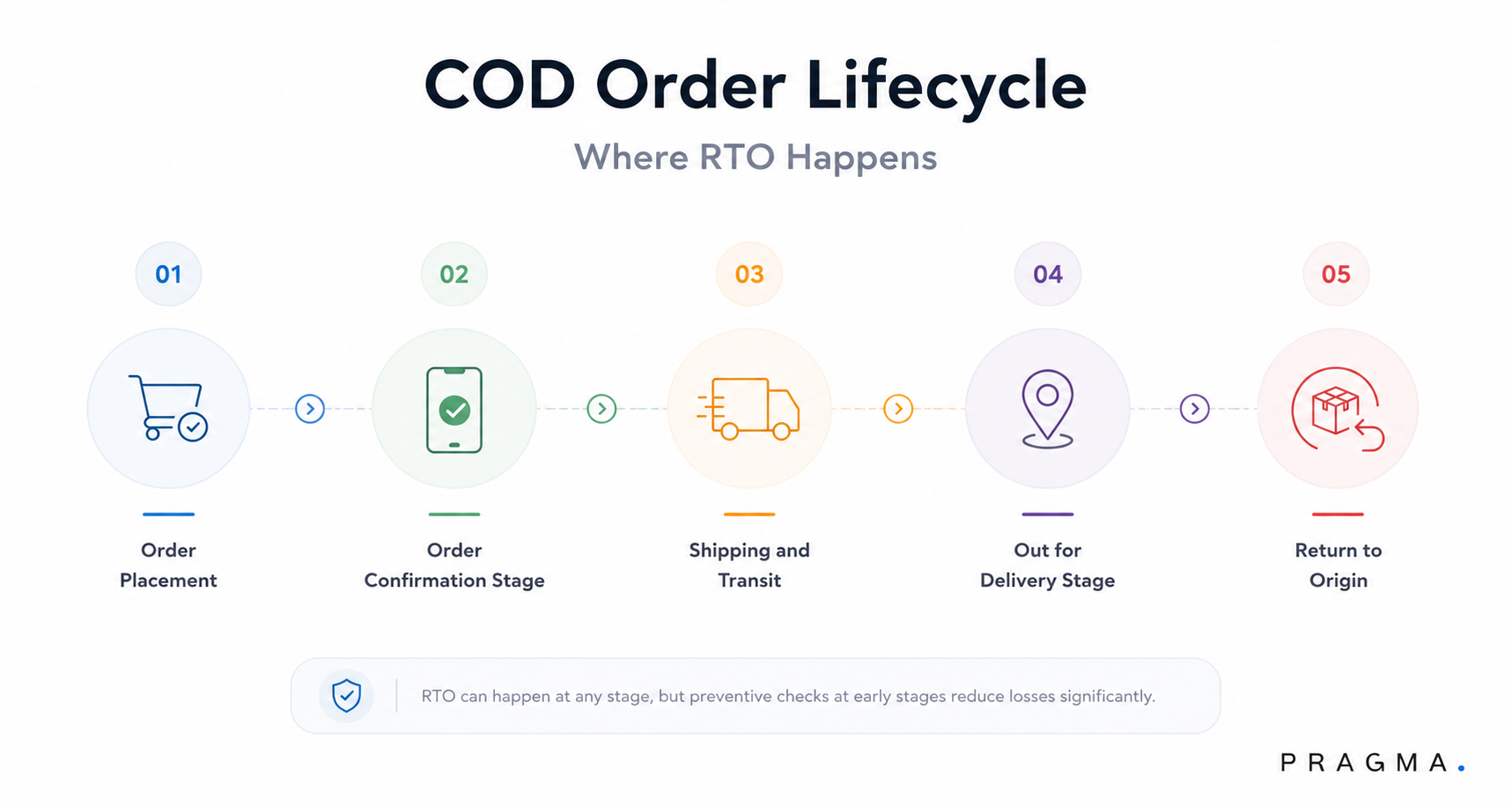
To know better about where delivery failures happen, let us see the COD order lifecycle:
Order Placement
The customer places a COD order through the e-commerce website or marketplace.
Risks begin at this stage. Common issues include:
- Fake phone numbers
- Incorrect addresses
- Fraud orders
- Duplicate orders
According to e-commerce operations studies, fake and low-intent orders contribute heavily to COD delivery failures in high-risk regions.
Pragma RTO Suite screens orders automatically and flags suspicious COD orders before dispatch. It auto-corrects common errors and flags incomplete information. The system prevents 40-50% of address-related RTOs by catching issues early.
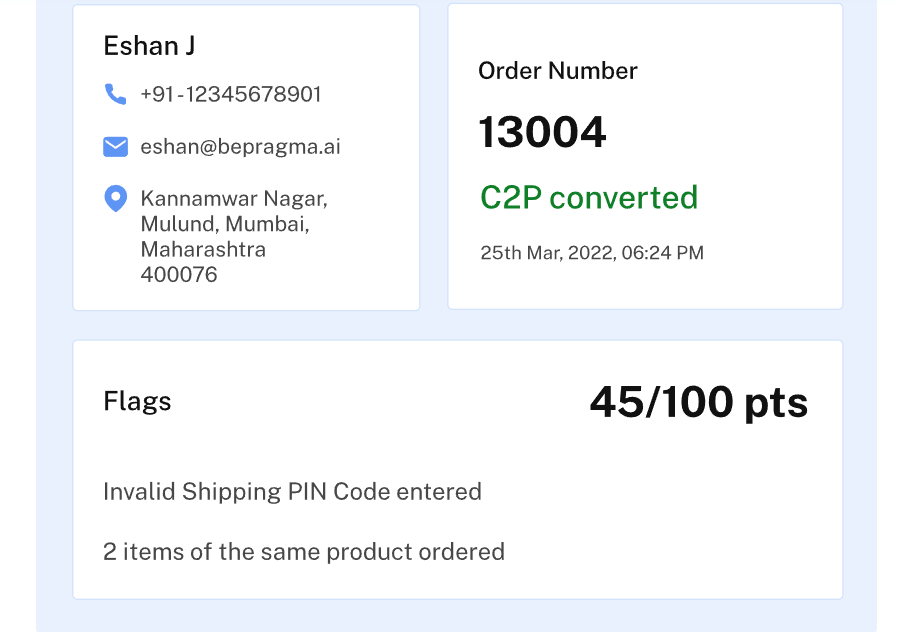
Order Confirmation Stage
This stage directly affects COD delivery success. Brands verify:
- Customer intent
- Phone number accuracy
- Address details
Common confirmation methods include:
- OTP verification
- WhatsApp confirmation
- IVR calls
- SMS verification links
Many e-commerce brands report noticeable RTO reduction after implementing mandatory COD verification workflows.
For high-volume D2C brands, automated confirmation systems reduce manual calling workload significantly. Pragma automates order verification through WhatsApp and SMS.
The system sends pre-configured messages at optimal times based on customer convenience data. This eliminates manual calling while improving confirmation rates.
Shipping and Transit
Transit delays increase cancellation risk. Customers often refuse orders after long delivery timelines.
A delayed shipment creates:
- Lower purchase urgency
- Higher cancellation probability
- Customer frustration
A customer experience report found that delivery speed strongly affects purchase satisfaction and repeat purchase behaviour.
Courier analytics systems help brands identify underperforming delivery partners across regions.
Out for Delivery Stage
Most COD delivery failures happen during this stage.
Common issues include:
- Customer unavailable
- Delivery refusal
- Cash unavailable
- Address confusion
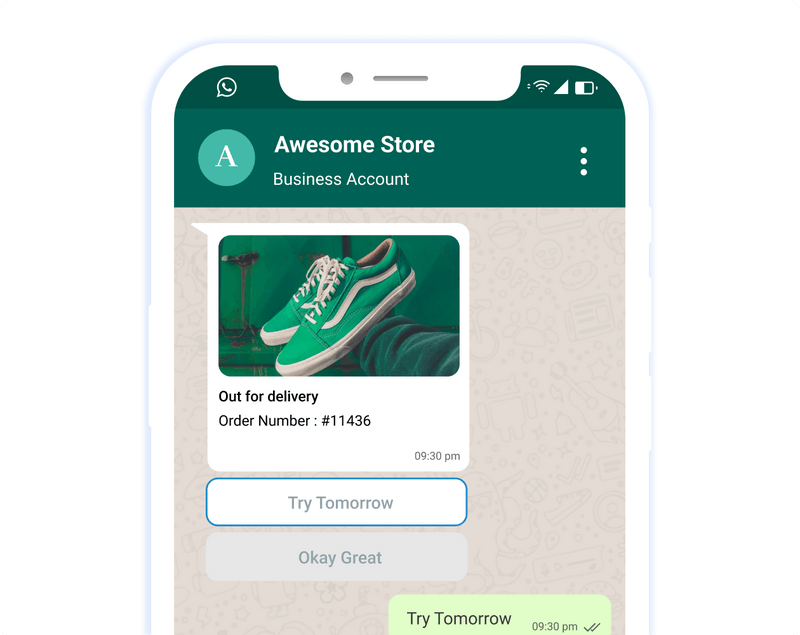
Real-time delivery alerts improve delivery coordination. Customers who receive proactive delivery communication show better delivery acceptance rates.
Pragma's NDR management system provides real-time communication between customers and delivery partners.
When delivery fails, customers receive automated messages to reschedule or update addresses. This reduces RTO by 35%.
Return to Origin
After failed delivery attempts, the shipment returns to the origin.
Reverse logistics increases operational pressure across the warehouse and support teams.
Warehouse teams must:
- Receive returned inventory
- Recheck products
- Update inventory systems
- Restock sellable inventory
High RTO volume slows warehouse throughput and inventory movement.
Top Causes of RTO in COD Orders
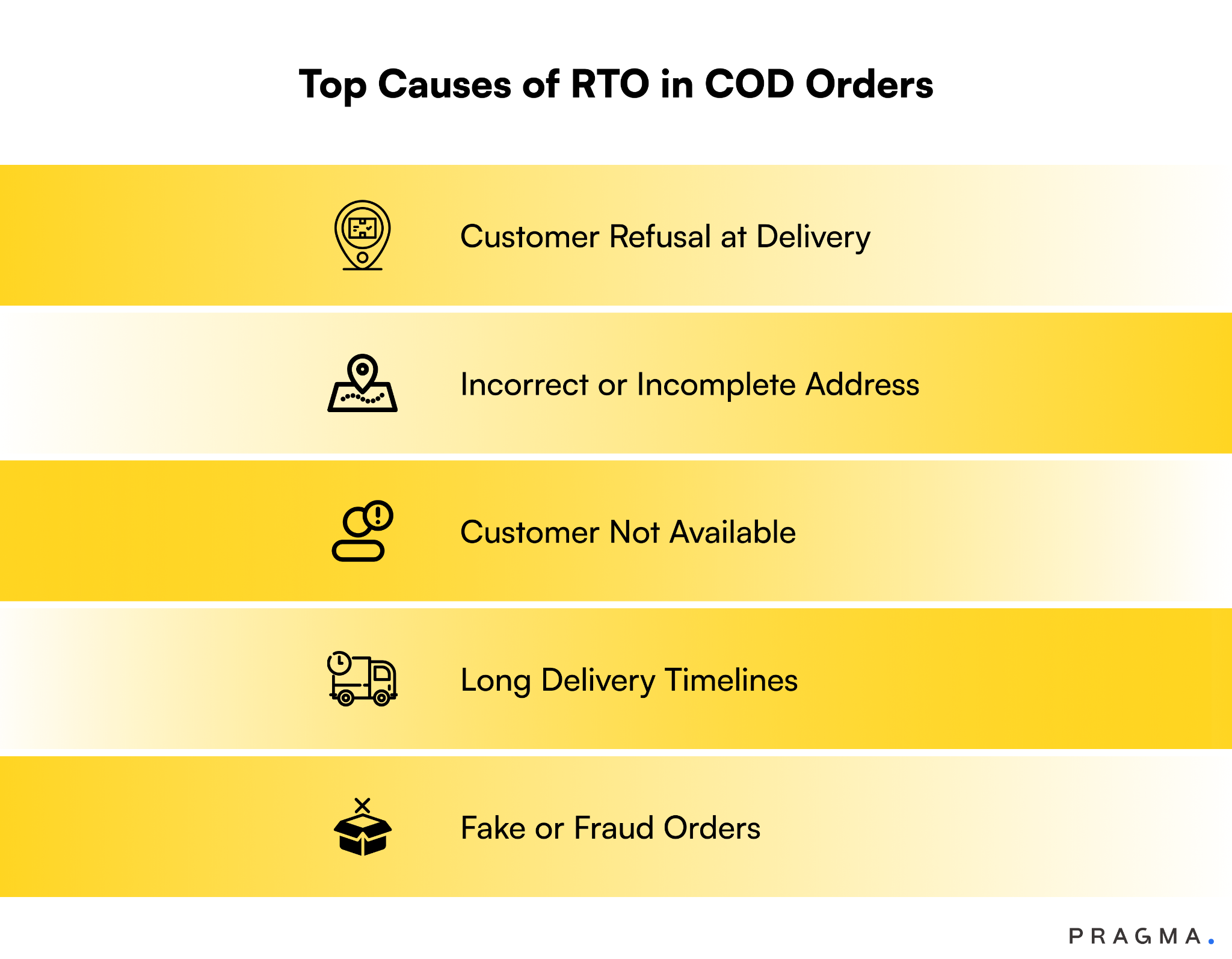
COD shipment returns mostly originate because of the following reasons:
Customer Refusal at Delivery
Customer refusal remains one of the biggest causes of RTO in COD orders. Customer refusal accounts for 35-40% of COD RTOs.
Common reasons why customers refuse to take delivery include:
- Changed buying decision
- Delayed delivery
- Better pricing elsewhere
- Product expectation mismatch
Also, policies like open box delivery increase refusal rates as customers inspect products before payment.
Incorrect or Incomplete Address
Address issues that cause 25-30% of COD RTOs. Poor address quality directly affects delivery success.
Common issues include:
- Missing house numbers
- Incorrect PIN codes
- Incomplete landmarks
- Wrong locality details
Temporary addresses like hostels, paying guests, or hotels create delivery challenges. These locations have high turnover and poor address standardisation, leading to failed delivery attempts.
Pragma RTO Suite keeps a check on these temporary residences by screening the customer information. The high-risk pincodes get flagged automatically.
This rich data helps flag impulse buyers, fake orders, and orders made by bots.
Customer Not Available
Customer unavailability during delivery attempts creates 20-25% of RTOs. This issue becomes common in:
- Office deliveries
- Working professionals
- Tier 2 and Tier 3 locations
RTOs arising from this situation can be decreased by providing automated delivery alerts to the customers. Pragma WhatsApp Business Suite enables brands to send pre-delivery notifications and check whether the customer is available or not, or delivery can be scheduled for another day.
Long Delivery Timelines
Studies show that each additional day in transit increases RTO risk by 8-12%. According to multiple e-commerce operations studies, delayed deliveries increase cancellation and refusal rates significantly in COD orders.
A customer waiting 7 days for a fashion product is far more likely to refuse delivery compared to a customer receiving the order within 48 hours.
Fake or Fraud Orders
Fake COD orders create direct operational losses. Fake addresses, prank orders, and bot-generated purchases create delivery failures.
Common fraud indicators include:
- Invalid contact details
- Suspicious address patterns
- Bulk COD ordering behaviour
- High-risk geographic clusters
To prevent this, Pragma RTO Suite scans 300+ parameters within 200ms of order placement to identify risky orders. The system flags suspicious patterns like repeated failed deliveries from similar addresses or unusual ordering behaviour.
What is the Impact of RTO in COD Orders on E-commerce Brands?
Return-to-Origin is one of the biggest challenges that e-commerce brands face nowadays. And the impact of RTO on COD orders is especially greater.
See what impact RTO orders can make on e-commerce brands:
Increased Logistics Cost
Every RTO shipment increases logistics spending without generating revenue.
Brands pay for:
- Forward shipping
- Reverse shipping
- Reattempt deliveries
- Packaging replacement
For low-margin e-commerce categories, high RTO quickly affects profitability.
Some D2C brands report logistics costs consuming over 20% of revenue during periods of high RTO and failed deliveries.
Inventory Blockage
RTO inventory remains blocked during reverse transit.
This creates:
- Delayed resale
- Stock planning issues
- Inventory forecasting gaps
Fast-selling inventory often stays unavailable for several days during reverse movement. For fast-fashion brands, delayed inventory recovery directly affects sell-through rates.
Reduced Profit Margins
High RTO directly affects contribution margins.
Let's take an example:
A brand operating at 20% contribution margin loses ₹250 per failed COD shipment.
At 5,000 monthly RTO orders, operational losses cross ₹12 lakh monthly.
This excludes marketing acquisition costs spent to generate those orders.
Operational Inefficiency
RTO management increases manual workload across operations teams.
Teams spend hours handling:
- Customer support tickets
- Courier escalations
- Inventory reconciliation
- Reverse logistics coordination
But with proper operations automation, brands can reduce manual dependency significantly.
Advanced Strategies to Reduce RTO in COD Orders
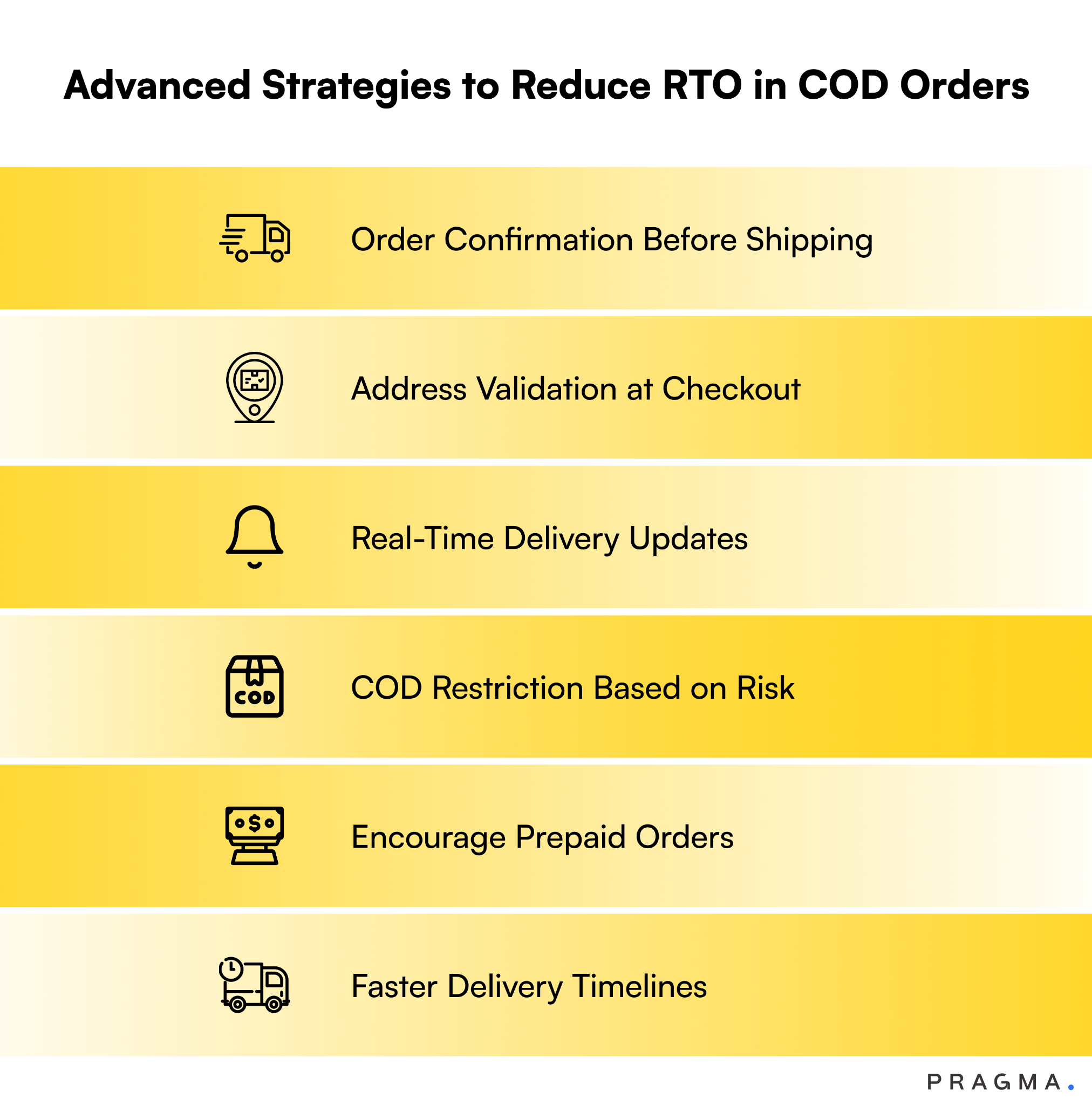
Here are some strategies which can help e-commerce brands reduce their RTO rates:
Order Confirmation Before Shipping
E-commerce brands should always confirm the order again with the customer before shipping it. It helps to reduce fake and low-intent orders.
Effective methods include:
- OTP verification
- WhatsApp confirmation
- IVR verification
- SMS approval links
Brands implementing structured confirmation workflows often report a significant reduction in COD RTO percentages.
Pragma automates this process through intelligent confirmation workflows. The system identifies high-risk orders and triggers verification messages without manual intervention.
Address Validation at Checkout
Brands should use real-time address validation to catch errors during order placement.
Validation systems can identify:
- Invalid PIN codes
- Incomplete addresses
- Serviceability gaps
- High-risk delivery regions
This reduces delivery failures before dispatch. Pragma RTO Suite's address screening feature validates pin codes, checks for temporary addresses like hostels or PGs, and flags high-risk locations automatically.
Also, it provides address auto-complete functionality to reduce typing errors.
Real-Time Delivery Updates
Customers respond better when they receive regular shipment updates.
Brands should send notifications to customers for:
- Order packed
- Shipment dispatched
- Out for delivery
- Delivery executive details
Proactive communication reduces missed deliveries and customer confusion.
COD Restriction Based on Risk
Not every customer should receive COD access. Brands can restrict COD for:
- Repeat RTO users
- High-risk PIN codes
- Fraud-prone locations
- High-value orders
Risk-based COD management improves delivery efficiency while protecting revenue.
Encourage Prepaid Orders
Brands should make use of smart strategies to encourage prepaid orders, such as special discounts, free shipping, coupons, etc.
Brands can improve prepaid conversion through:
- Easy return policies
- Secure payment options
- Faster refunds
- Verified customer reviews
As trust improves, prepaid order share usually increases.
Faster Delivery Timelines
Fast delivery reduces cancellation risk. For these e-commerce brands, focus on speedy deliveries. Same-day or next-day delivery options decrease RTO probability significantly.
To make faster deliveries, brands can make:
- Regional warehouses
- Smart courier allocation
- Inventory placement optimisation
- Courier performance tracking
How to Convert COD Orders to Prepaid?
Prepaid orders show better delivery success rates compared to COD shipments.
Brands improve prepaid conversion through:
- Instant prepaid discounts
- Free shipping for prepaid orders
- Loyalty rewards
- Faster prepaid delivery promises
Many brands also run post-order COD-to-prepaid campaigns through WhatsApp and SMS reminders.
Pragma's C2P (COD to Prepaid) strategy increases paid orders by 25-35% through targeted incentives. The system sends personalised offers via WhatsApp and email to encourage payment method switching.
Tools and Technology to Manage RTO in COD Orders
Modern e-commerce operations require automated RTO management systems. Manual verification and tracking become impossible at scale for growing D2C brands.
AI-powered fraud detection identifies suspicious orders before shipping. Machine learning algorithms analyse patterns across millions of transactions to spot risky behaviour.
Address validation APIs integrate with checkout systems to verify locations in real-time. These tools catch errors immediately rather than discovering issues during delivery.
Customer communication platforms automate verification and updates throughout the order lifecycle. WhatsApp Business APIs enable scalable messaging without manual intervention.
Pragma's RTO Suite provides comprehensive automation for Indian D2C brands. The system combines fraud detection, address validation, order verification, and NDR management in one platform.
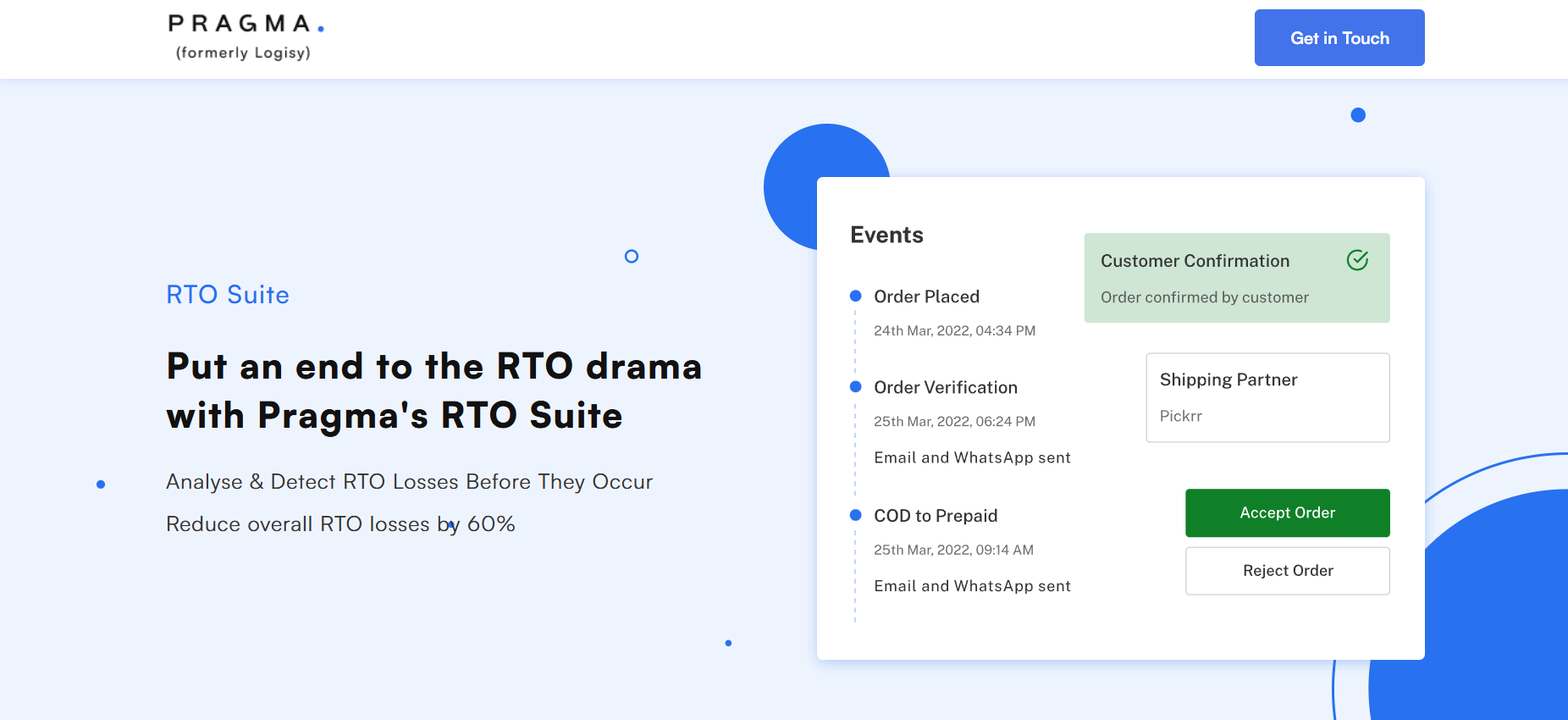
Key features include:
- Behavioural analysis to identify impulse buyers and fake orders.
- Automated customer information screening and correction prevent address issues.
- Cross-platform data sharing avoids known RTO offenders. C2P conversion tools with customisable incentives encourage prepaid orders.
- Real-time NDR management with customer communication reduces failed deliveries.
The platform helps brands achieve 60% reduction in overall RTO losses while maintaining customer experience quality. Over 1,700 brands use Pragma to manage COD orders effectively.
Key Metrics to Track
Here are some important metrics that every e-commerce brand should track:
RTO Rate
This measures the percentage of shipped orders returned to the origin.
This is how it is calculated:
RTO Rate (%)=Total Orders ShippedNumber of RTO Orders×100
A rising RTO rate signals operational or delivery quality issues. Industry benchmarks range from 20-35% for COD orders.
COD vs Prepaid Ratio
This metric measures payment mode distribution.
Brands should track conversion rates for each payment method separately. COD orders often have higher cart abandonment but lower checkout conversion compared to prepaid.
Delivery Success Rate
This metric tracks successful deliveries against total shipments.
Low delivery success rates often indicate courier performance issues or poor address quality.
D2C e-commerce brands should aim for 80%+ first-attempt success for sustainable operations. This indicates effective address validation, customer communication, and courier performance.
Confirmation Rate
This measures how many customers confirm COD orders before shipment dispatch.
Higher confirmation rates usually correlate with lower fake order percentages.
Brands should target 70%+ confirmation for COD orders to ensure genuine customer interest.
Common Mistakes E-commerce Brands Make
Although being intelligent and modern, many e-commerce brands still make these mistakes, which leads to RTOs later:
Shipping Without Confirmation
Many brands dispatch COD orders immediately without verification.
This is one of those mistakes that leads to loss of revenues and logistics costs when it leads to RTO. Each RTO can cost them Rs. 250-300 in terms of loss, apart from the original product value.
To prevent this, brands should always use automated confirmation systems, which can eliminate manual effort while providing verification benefits.
Allowing COD Everywhere
Offering COD in all locations without risk assessment creates unnecessary losses.
Some PIN codes consistently generate high RTOs and should be restricted or require additional verification.
To keep a check on this, Pragma RTO Suite cross-checked the orders with other e-commerce sites to check the users for past RTO history, order cancellations and other fraudulent behaviour.
Poor Communication
Inadequate customer communication during shipping creates delivery failures and negative experiences.
E-commerce brands should keep their customers updated about the order at the time of:
- Confirmation of Order Placement
- Packaging
- Shipping
- Pre-Delivery
Immediate notification and resolution options prevent RTOs from becoming customer service issues.
Final Thoughts
So let's conclude here! We can see that RTO in COD orders, apart from profit margins, affects logistics costs, inventory movement and operational efficiency.
Reducing RTOs requires structured operational workflows across:
- Order verification
- Address validation
- Customer communication
- Courier optimisation
- Delivery intelligence
- Risk-based COD management
Brands relying only on manual monitoring struggle to control rising RTO costs at scale.
Solutions like Pragma RTO Suite help e-commerce brands identify high-risk orders early, improve delivery success rates, automate customer verification, and reduce losses linked to COD shipments.

FAQs (Frequently Asked Questions On RTO in COD Orders: Meaning, Causes, and How to Reduce It)
1. What is RTO in COD orders?
RTO (Return to Origin) in COD orders refers to shipments that are returned back to the seller because the delivery could not be completed or the customer refused to accept the order.
2. Why are RTO rates higher in COD orders?
RTO rates are higher in COD orders due to lower purchase commitment, fake orders, incorrect addresses, customer unavailability, and refusal to accept deliveries at the doorstep.
3. What are the common causes of RTO in eCommerce?
Common causes include incorrect delivery addresses, fake or risky orders, failed delivery attempts, customer refusal, delayed shipments, and poor communication during the delivery journey.
4. How does RTO impact eCommerce profitability?
RTO increases operational costs through reverse logistics, failed delivery charges, inventory losses, and reduced contribution margins, significantly impacting profitability for D2C brands.
5. How can eCommerce brands reduce RTO in COD orders?
Brands can reduce RTO by enabling OTP verification, validating addresses, improving delivery communication, using prepaid incentives, and identifying high-risk orders before fulfilment.
6. How does address validation help reduce RTO?
Address validation helps reduce RTO by detecting incomplete or incorrect delivery details before shipping, improving delivery accuracy and reducing failed delivery attempts.
7. What role does customer communication play in reducing RTO?
Customer communication helps reduce RTO by confirming order intent, sharing delivery updates, resolving delivery issues quickly, and improving customer availability during delivery attempts.
8. Can WhatsApp notifications reduce RTO in eCommerce?
Yes, WhatsApp notifications can reduce RTO by enabling real-time communication for order confirmation, delivery coordination, NDR resolution, and proactive customer engagement.
9. What tools help manage and reduce RTO in eCommerce?
Tools include RTO management platforms, address validation systems, NDR management software, logistics intelligence tools, checkout optimisation systems, and customer communication platforms.
10. Why is reducing RTO important for D2C brands in India?
Reducing RTO is important because high COD dependency in India increases logistics costs and operational risks, making RTO reduction critical for profitability, scalability, and customer experience.
Talk to our experts for a customised solution that can maximise your sales funnel
Book a demo

.png)