

Customers rarely raise tickets because they enjoy typing long messages. They do it because they feel stuck, ignored, or uncertain. A delayed order update triggers anxiety. A missing refund update sparks distrust. A failed OTP, a declined payment, or a confusing return status turns a simple query into a support burden.
Indian D2C brands feel this pinch every day as Shopify dashboards light up with hundreds of repetitive questions that say the same thing in different ways: “Where is my order?”
Support teams sink hours into answering routine queries even though nearly 62–71% of all D2C tickets in India come from just five scenarios: order status checks, delivery delays, refund timelines, return confirmation, and payment verification. The load intensifies during sale months, where brands see a 2.3x surge in WISMO (“Where is my order?”) pings across WhatsApp, Instagram DMs, and email.
In this comprehensive guide on How to Reduce Support Tickets with Automated WhatsApp Replies, we’re diving deep into why these queries overwhelm teams, how automated messaging changes customer behaviour, and which automation flows produce the highest deflection rates. This approach gives founders and operators a practical framework to cut repetitive tickets without harming personalisation.
What Is Ticket Deflection in Customer Support?
Ticket deflection refers to preventing support requests from entering the ticket queue in the first place — by giving customers the answer they need before they raise an enquiry. In modern support operations, deflection is about guiding customers toward self-service and automated assistance instead of manual agent intervention.
In ecommerce and D2C contexts, ticket deflection reduces repetitive workload on support teams and accelerates customer satisfaction. Examples include:
- FAQs surfaced at the right moment
- Automated updates that pre-empt enquiries
- Guided resolutions for common issues
- Conversational bots that resolve queries without escalation
Deflected tickets are not “avoided customers” — they are resolved before friction builds into a support case. When done well, ticket deflection improves experience while lowering cost per engagement.
How Automated WhatsApp Messaging Reduces Ticket Volume
Automated WhatsApp messaging reduces support tickets by intercepting pain points in the customer journey and providing immediate, context-aware responses that eliminate the need to contact an agent.
Here’s how it works:
1. Proactive Delivery & Status Updates
Customers often raise tickets asking, “Where is my order?” Automated WhatsApp updates keep customers informed at key milestones — dispatch, transit scans, delivery windows — reducing uncertainty and ticket triggers.
2. Self-Service Return & Exchange Initiation
Rather than filling support forms, customers can trigger returns directly through WhatsApp flows, cancelling the need for manual intervention.
3. FAQ Resolution via Quick Replies & Menus
Automated flows answer common queries (e.g., payment refunds, cancellation policies) instantly, preventing them from becoming tickets.
4. Exception Alerts & Guidance
When an issue is detected (failed delivery attempt, address ambiguity), customers receive corrective messages with next steps — reducing “help me!” inquiries.
5. Seamless Escalation Paths
If automated flows cannot resolve the issue, WhatsApp can escalate with pre-filled contextual data — saving agent time and improving first-contact resolution.
Each of these mechanisms prevents ticket creation by surfacing answers before the customer picks up the phone, opens an email, or enters a support portal.
Why do Indian shoppers raise so many repetitive tickets?
Understanding emotional triggers behind reactive customer behaviour
Most support queries don’t emerge from complex problems. They emerge from silence. When brands don’t provide timely updates, customers invent their own worst-case scenarios. This behaviour intensifies across Tier 1 and Tier 2 shoppers who rely heavily on WhatsApp for real-time communication.
The volume rises because customers expect effortless clarity. The absence of this clarity creates doubt. And doubt multiplies.
The Indian e-commerce delivery cycle contains multiple uncertainty points: pickup delays, courier handovers, last-mile congestion, weather disruptions, and RTO risks. Every disruption becomes a customer question. The critical insight here is that repetitive queries appear when operational gaps overlap emotional uncertainty.
Key behavioural triggers behind high ticket volumes
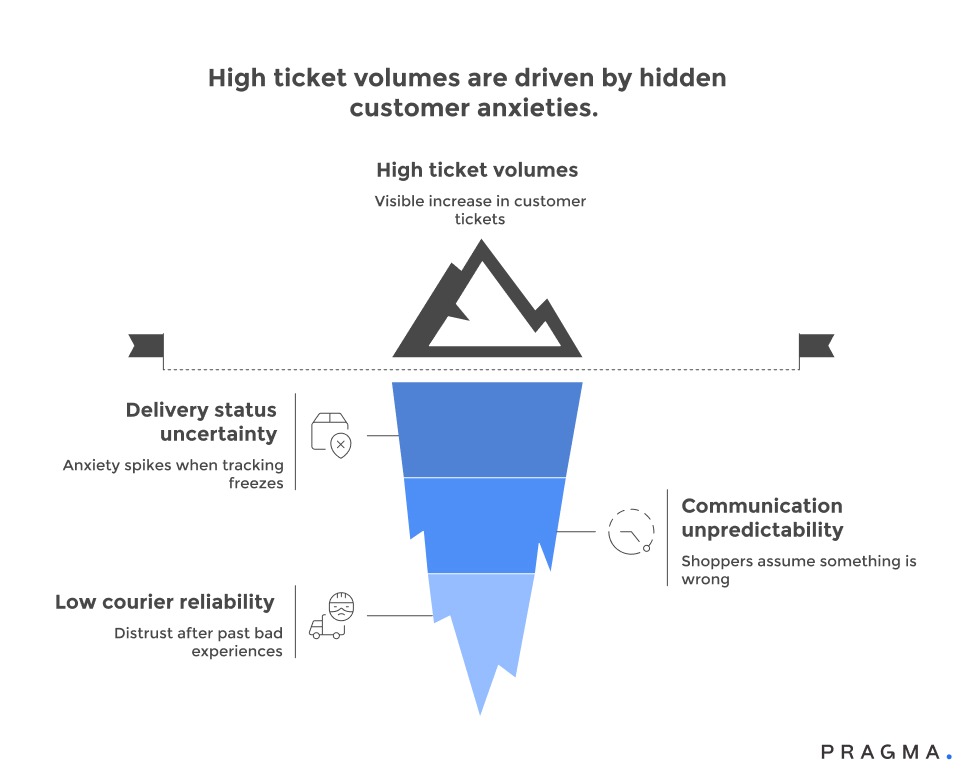
- Uncertainty about delivery status
When tracking pages freeze for 24–48 hours, anxiety spikes and customers reach out. - Lack of predictable communication
If updates come late, or come irregularly, shoppers assume something is wrong. - Low trust in courier reliability
Many customers distrust last-mile carriers after past bad experiences.
You can’t eliminate every operational issue, but automated WhatsApp replies reduce the emotional spike that leads to support contact. Meanwhile, proactive messaging neutralises uncertainty by acknowledging problems before customers feel the need to complain.
High-Impact WhatsApp Automations That Deflect the Most Tickets
Certain WhatsApp automations consistently deliver high ticket deflection rates because they map to the most common and costly support enquiries.
1. Order Tracking & ETA Updates
Automated milestone notifications — e.g., out for delivery, updated ETA — dramatically lower “Where is my order?” tickets.
2. Address Verification Prompts
Early prompts to confirm or correct delivery details reduce failed delivery attempts and subsequent support escalations.
3. COD Confirmation & Nudges
For Cash-on-Delivery orders, automated confirmation buttons or replies ensure intent — reducing refusals and COD-related tickets.
4. Self-Service Returns & Exchanges
Guided flows that collect reason codes, photos and preferred resolution options eliminate multiple back-and-forths with agents.
5. Refund & Reimbursement Updates
Automating refund status notifications prevents customers from repeatedly checking.
6. Exception Alerts with Action Steps
When a delay or issue is detected, proactive WhatsApp alerts with actionable steps (e.g., reschedule delivery) stop confusion from becoming support cases.
7. Quick Help Menus
Interactive buttons that let users select what they want help with (status, refund, exchange, cancellation) reduce friction and bypass traditional ticket creation.
These flows not only resolve queries but surface the right information at the right time — which is the essence of effective deflection.
How does automated WhatsApp messaging reduce ticket volume?
Replacing reactive support workflows with structured, instant responses
WhatsApp is the most important support surface for Indian e-commerce. More than 78% of customers check WhatsApp before checking email, and they expect updates at the same pace they chat with friends. Brands using manual WhatsApp replies burn hours triaging repetitive questions that automation could answer in under three seconds.
This approach changes the equation by intercepting high-frequency questions before they hit human agents. It behaves like a smart buffer between customer anxieties and your team’s time.
The critical insight is that automated WhatsApp replies convert repetitive human conversations into predictable rule-driven flows without losing personal tone.
What automated replies do differently
Automation improves four crucial mechanics across the support journey:
Pragma powers the best WhatsApp commerce platform for D2C brands in India, enabling automated order updates, cart recovery, and conversational selling through WhatsApp Business API.

- Instant response speed
Customers stop waiting and stop resending “?” messages when answers arrive instantly. - Proactive nudges before customers feel stuck
A delayed pickup message sent automatically reduces follow-up queries by up to 30%. - Consistency in information
The system never forgets an update or gets tired, ensuring accurate messaging. - Structured decision paths for customers
WhatsApp buttons guide customers to the right flow instead of open-ended chats.
Together, these changes reduce noise, increase clarity, and elevate trust, allowing your support team to focus on exceptions rather than volume.
ROI of Automated WhatsApp Support
The return on investment (ROI) for automated WhatsApp support goes beyond reduced ticket counts. It shifts operating cost, customer experience and retention metrics simultaneously.
1. Lower Support Cost per Ticket
Automation deflects high-volume, low-complexity queries, freeing agents to handle nuanced or escalated cases — reducing cost per resolved issue.
2. Reduced Time-to-Resolution
Automation provides instant responses, improving first-response times and customer satisfaction without increased headcount.
3. Higher Customer Satisfaction (CSAT)
Customers value speed and convenience. Automated, relevant WhatsApp replies increase CSAT scores and reduce frustration signals.
4. Operational Efficiency Gains
Support teams spend less time on repetitive queries and more on high-touch experiences — improving overall team productivity.
5. Lower RTO & Exception Costs
Pre-delivery prompts and confirmations reduce refused deliveries — protecting unit economics and lowering operational leakage.
6. Data & Insight Value
Automated interactions generate structured data (common issues, peak times, sentiment signals) that improve future flows and marketing decisions.
When measured across ticket volume reduction, agent time saved, SLA improvements and customer experience uplift, WhatsApp automation delivers measurable ROI within months — not years.
What types of WhatsApp automations offer the highest ticket deflection?
Mapping automated flows to real customer queries
Support leaders often assume automation should respond only when customers inquire. But proactive flows — the ones that activate before customers feel confused — offer the highest ticket reduction.
Below is a deep breakdown of the most impactful flows, written with operational clarity so D2C teams can adopt them quickly.
Order Confirmation & First-Status Assurance
This is the single biggest driver of trust during the first 24 hours.
Customers worry most right after placing the order. If the order confirmation email lands late or gets stuck in spam, they panic and write to support. Automated WhatsApp order confirmations remove this uncertainty instantly.
- Provides real-time reassurance
- Sets clear expectations for dispatch timelines
- Prevents double-ordering caused by confirmation delays
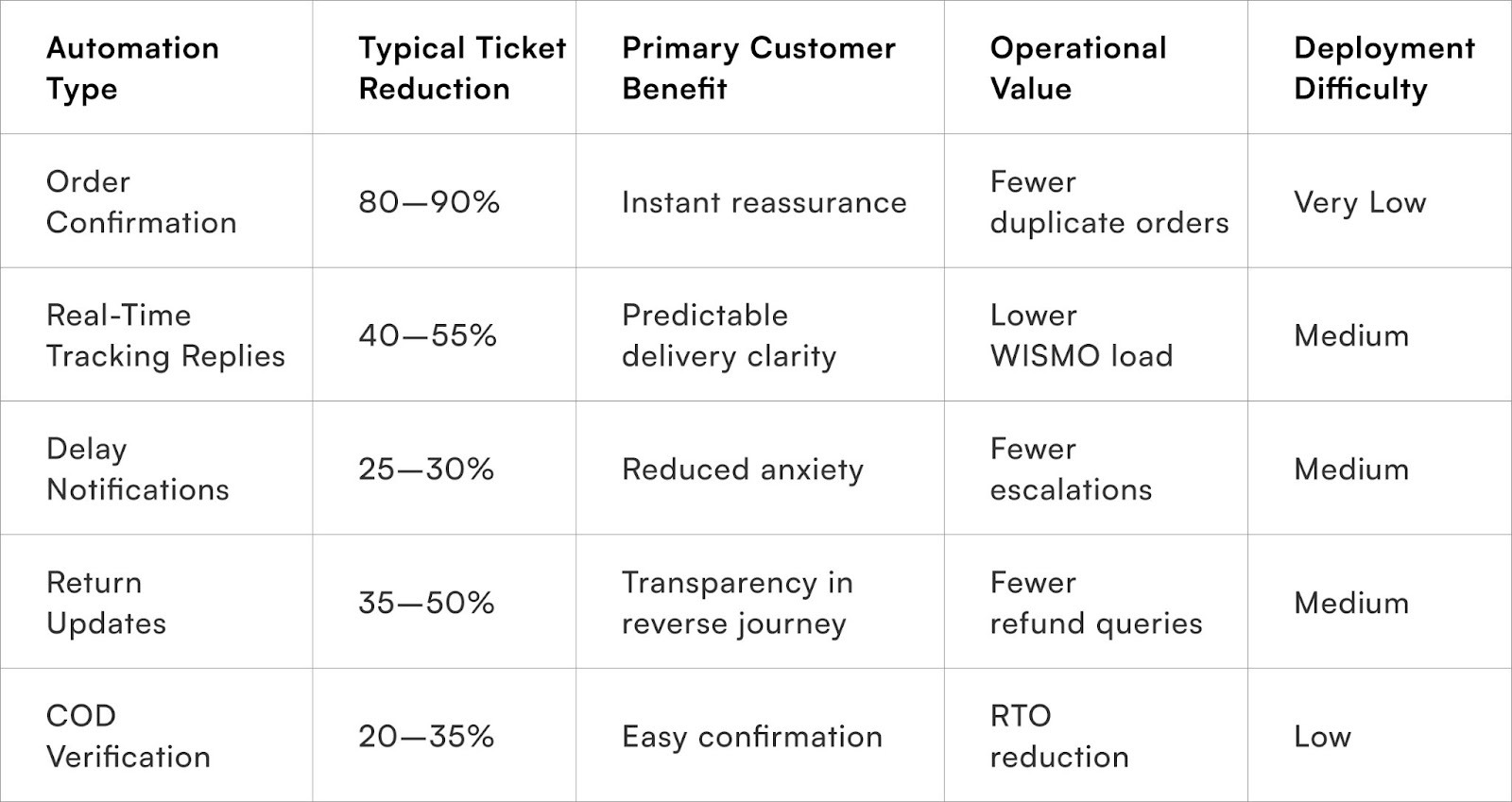
This one flow alone reduces “Order not confirmed?” tickets by up to 90%.
Smart Order Tracking Replies
Indian shoppers often ask for the same clarification: “Where is my order?” Automated WhatsApp replies pull real-time courier statuses and present them in simple language.
- Converts complex courier scans into human-readable updates
- Sends proactive nudges for delays or failed delivery attempts
- Provides expected delivery date windows automatically
Customers care less about courier codes and more about predictability. When tracking feels human, ticket volumes drop.
Delay Notifications & Delivery Buffer Messaging
Silence during delays is deadly. It triggers tickets every time.
Automation acknowledges delays instantly, offering context rather than leaving customers to guess.
- “We’re experiencing a small delay; your order will now arrive by X.”
- “Courier attempted delivery today but couldn’t reach you — here’s how to reschedule.”
These messages interrupt panic before it forms.
Brands using this flow report 18–29% fewer WISMO tickets within one month.
Returns, Refunds & Reverse Pickup Updates
Returns generate emotional friction. Refunds generate distrust. Together, they generate nearly 35% of support load for D2C brands.
Automated WhatsApp flows bring clarity to each stage:
- Return approved
- Reverse pickup scheduled
- Reverse pickup completed
- Item received at warehouse
- Inspection completed
- Refund initiated
- Refund processed
Every skipped update becomes a ticket. Every proactive update prevents one.
Payment Failures & COD Verification
COD requests rise. So does fraud. Automation protects both sides.
- Verifies COD orders with a simple “Confirm COD” button
- Sends retry links when online payments fail
- Routes high-risk attempts for manual review
This reduces fraudulent orders and filters out fake COD orders that could become RTO losses.
High-Impact WhatsApp Automations and Their Ticket Reduction Potential
How can brands design automated replies that feel human, not robotic?
Balancing precision with warmth in automated interactions
Automation fails when it feels cold. Indian shoppers dislike formal messaging. They respond better to warmth, clarity, and empathy. The goal is to reduce tickets without feeling mechanical.
The most effective automated replies mirror how a helpful human agent would respond — but with zero delay.
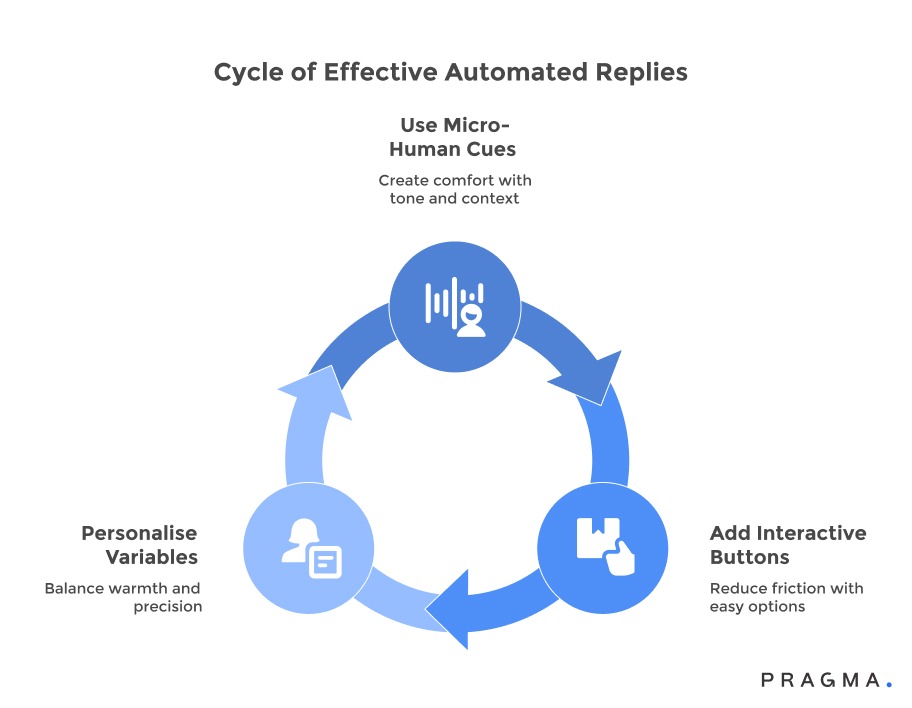
Use micro-human cues to create comfort
- Tone that feels calm and clear
Short sentences reduce cognitive load and feel less formal. - Context around courier delays
Instead of “Your delivery is delayed,” write “Rain in your area slowed deliveries today.” - Natural transitions
Phrases like “Here’s the latest update” or “Let me check that for you” mimic human conversation.
Add interactive buttons to remove friction
- “Track my order”
- “Reschedule delivery”
- “Check refund status”
- “Cancel or modify my order”
Buttons reduce ambiguity and prevent long chat threads.
Use personalised variables carefully
Over-personalisation sounds creepy. Smart personalisation sounds helpful.
- Use customer name once, not repeatedly
- Use order details only when needed
- Avoid sounding like a template
Human warmth + operational precision = ideal WhatsApp automation tone.
How to build automated WhatsApp replies without hurting personalisation
Scalable messaging that still feels one-to-one
Automation must be intelligent, not intrusive. D2C brands often worry automation will feel like bulk messaging, but when executed thoughtfully, it enhances personalisation rather than replacing it.
Blend fixed templates with dynamic fields
- Order ID
- Item names
- Refund timeline
- Delivery date window
Use only what improves clarity — not what makes messages feel overly scripted.
Keep messages short and easy to scan
Long paragraphs overwhelm customers on WhatsApp. Clarity wins.
- Break messages into 1–2 line chunks
- Use emojis sparingly or avoid them to keep tone professional
- Keep action prompts at the end
Shorter messages reduce confusion and deflect follow-up questions.
Use logic branches for context-aware messaging
Automation becomes smarter when it adapts.
- If order is already in transit, skip confirmation messages
- If courier has failed delivery, prioritise “reschedule” flow
- If customer already checked refund once, show “updated timeline”
Context turns automation into personalised guidance.
How to measure success: the metrics that matter
Quantifying the impact of automated WhatsApp replies
Automation isn’t a vanity exercise. It must produce measurable operational impact. These metrics help brands evaluate success with precision.
Ticket Deflection Rate
The most important metric.
Track:
- Total inbound queries
- Queries resolved through automation
- Queries requiring human agents
Healthy automation delivers 40–55% deflection within six weeks.
Response Time Improvement
Measure first-response speed before and after automation.
Expect a jump from 2–20 minutes to 1–3 seconds.
Faster responses = fewer follow-ups = fewer tickets.
RTO Reduction from COD Verification Flows
COD confirmation flows generate hard savings.
Track:
- COD verification success rate
- RTO orders prevented
Expect 10–20% fewer RTO cases when automated WhatsApp verification is applied.
Refund Query Drop Rate
Map refund-related ticket loads before and after automation.
Brands usually see:
- 35–50% reduction in refund anxiety queries
- Faster refund processing times due to structured updates
CSAT Lift
Customers reward clarity.
A well-structured automated messaging layer improves CSAT by 18–24% within two months.
Quick Wins from automating support tickets
High-impact actions your ops team can deploy quickly
Week 1: Identify Top 20 Repeat Ticket Intents
Map the last 200–300 support conversations and isolate the highest-frequency queries. Analyse WISMO patterns, refund queries, return initiation confusion, and COD verification failures.
Document triggers such as courier delays, late refunds, or unclear emails. Build a clear intent hierarchy to guide automation design.
Expected outcome: a crisp blueprint revealing which flows will deliver maximum ticket reduction within the first month.
Week 2: Deploy Essential Automation Flows
Set up automated replies for:
- Order confirmation
- Shipment dispatched
- Delivery delay
- Reverse pickup
- Refund initiation
- COD verification
Integrate courier tracking APIs and payment gateway updates for real-time accuracy.
Expected outcome: 30–40% ticket deflection from core automation alone.
Week 3: Add Button-Driven Interaction Paths
Introduce WhatsApp buttons for:
- Track order
- Check refund status
- Reschedule delivery
- Cancel order
Buttons reduce internal support load by removing guesswork and preventing messy conversations.
Expected outcome: 10–15% additional deflection from self-serve paths.
Week 4: Optimise Tone, Personalisation & Edge Cases
Refine message tone to reduce robotic feel. Add human-style wording, shorten paragraphs, and personalise key variables.
Handle edge-case logic like failed delivery, long courier silence, or payment review holds.
Expected outcome: 50–55% total ticket reduction with measurable CSAT improvement.
To Wrap It Up
Support tickets rise when customer uncertainty goes unanswered. Automated WhatsApp replies remove that uncertainty by offering clarity at every step of the post-purchase journey. The brands that thrive are the ones that treat communication as an operational lever, not a reactive burden.
Start this week by mapping your top repetitive queries and building automated flows for order status, refunds, and COD verification. This simple shift produces measurable reductions in ticket volume almost immediately.
Long-term success comes from refining tone, strengthening integrations, and continuously expanding the automation layer to cover high-friction moments across the customer lifecycle. Steady iteration transforms WhatsApp into a powerful, trust-building channel.
For D2C brands seeking to automate post-purchase communication at scale, Pragma's Customer Journey Automation platform provides real-time courier integrations, dynamic WhatsApp flows, and intelligent routing that help brands achieve up to 55% ticket deflection and higher CSAT across the customer journey.

FAQs (Frequently Asked Questions On How to Reduce Support Tickets with Automated WhatsApp Replies)
1. Do automated WhatsApp replies replace support agents?
No. They replace repetitive queries, not complex issues. Agents become more efficient because they only handle nuanced cases.
2. Will customers trust automated messages?
Yes — if messages are warm, clear, and timely. Trust rises when information arrives before customers feel anxious.
3. What if courier data is unreliable?
Automation smooths over courier inconsistencies by combining multiple scan sources and presenting the simplest possible version.
4. How long does automation take to set up?
Basic flows take 7–14 days. More advanced flows, including RTO prevention and refund tracking, take 3–5 weeks.
5. Does WhatsApp automation work for COD-heavy brands?
Absolutely. COD verification flows cut fake orders, reduce RTO, and prevent unnecessary support queries.
Talk to our experts for a customised solution that can maximise your sales funnel
Book a demo

.png)