

Nowadays, the way customers interact with brands is diversifying.
A customer finds your brand on Instagram, purchases it from the website, may connect on WhatsApp for delivery queries or can call a support team for any other solution.
These conversations may look like separate events to the D2C brands, but they are like having one conversation for the customer.
Because the customer sees a brand as one identity, no matter what the communication channel is, and they don't want to repeat the same stuff again and again.
A report states that 85% of customers expect consistent experiences across departments and channels, and 73% expect companies to understand their needs across touchpoints.
Therefore, if there is a gap in the communication system, this can lead to slower response times, inconsistent customer experiences, and missed revenue opportunities.
That is where an omnichannel CRM can help!
In this guide, we will understand how omnichannel CRM works, what it includes, and how D2C e-commerce brands can use it to build better customer relationships at scale.
What Is an Omnichannel CRM?
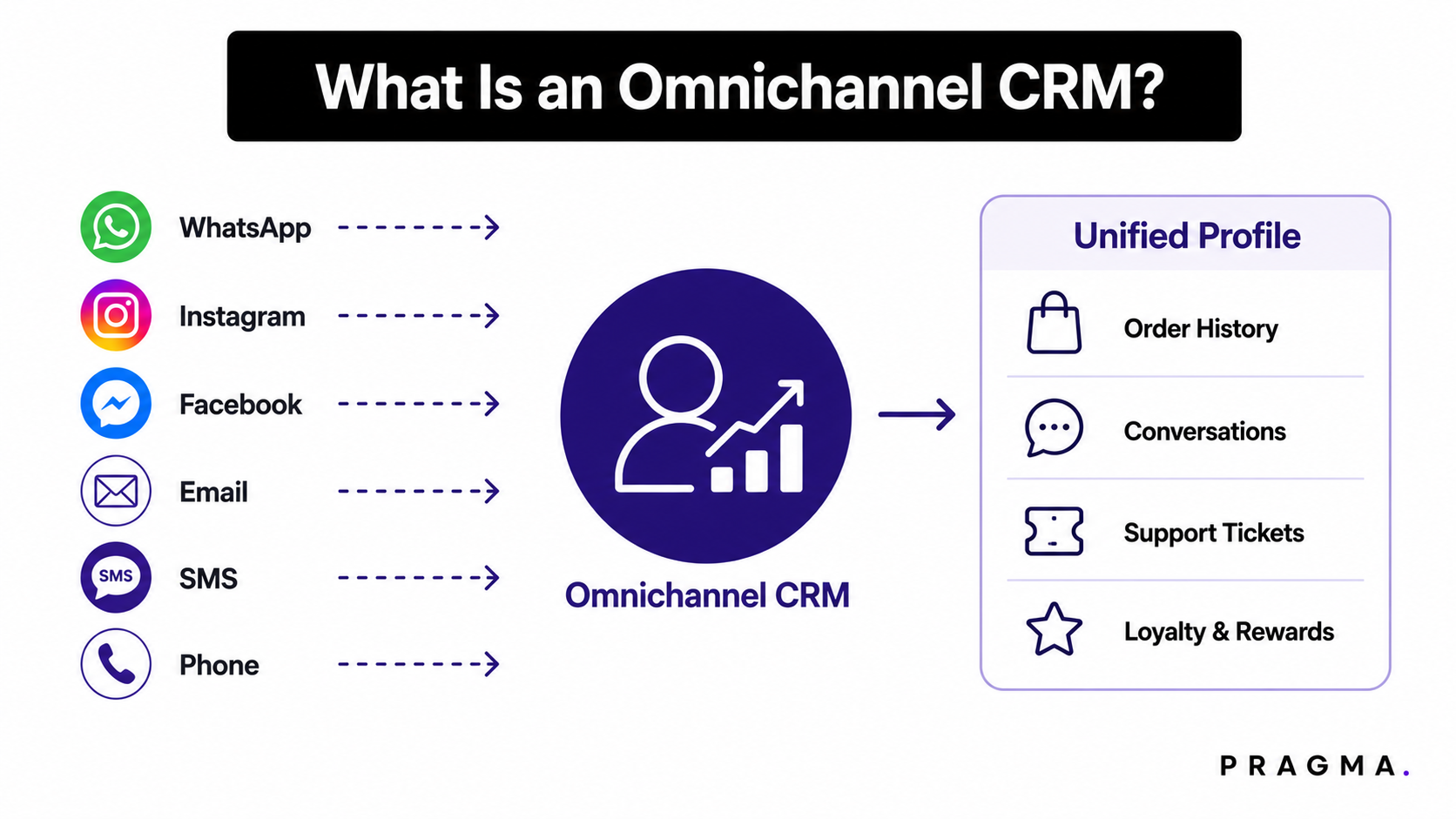
An omnichannel CRM is a customer relationship management system that connects every channel your customers use into one unified platform.
It brings together WhatsApp, Instagram, Facebook Messenger, email, SMS, phone, and your website.
Every interaction, every order, every support ticket, and every message gets stored under one customer profile.
By this, every team always knows who the customer is, what they bought, what they asked, and what they need next, regardless of which channel they used.
According to Aberdeen Group, companies with strong omnichannel customer engagement retain an average of 89% of their customers, compared to 33% for companies with weak omnichannel engagement.
Why Do E-commerce Brands Need an Omnichannel CRM?
Here is why e-commerce brands need to have an omnichannel CRM:
Customers Use Multiple Channels
Customers do not stick to one channel. Over 73% of consumers in India engage with brands through multiple channels before making a purchase decision.
They discover a brand on Instagram, research on the website, ask questions on WhatsApp, and follow up by email.
Google reports shoppers interact with 6 or more touchpoints before purchase.
A single purchase journey includes:
- Ad impression
- Product search
- Website visit
- Social media review
- WhatsApp query
- Mobile checkout
If your systems do not connect these touchpoints, your team responds without context. That creates friction that can impact conversions.
Pragma Omnichannel CRM extends this by connecting post-purchase workflows such as returns, exchanges, refunds, and order timelines into the same customer profile.
Customer Expectations Are Rising
Customers expect consistency. They expect the promo code they saw on Instagram to work on your website. They expect your support agent to know about their last order without asking them to repeat it.
A Forbes study found that 90% of customers expect consistent interactions across all channels.
When a brand fails to meet that expectation, customers do not complain. They leave.
In 2024, India's UPI transactions crossed 10 billion monthly transactions, signalling how fast digital commerce is growing and how quickly customer expectations are rising alongside it.
Customer Data Is Often Fragmented
Most D2C brands use separate tools for marketing, support, and sales. None of these talk to each other by default.
For example, a customer who requests an exchange through the returns portal may still receive a promotional email encouraging them to buy the same product again because the marketing platform has no visibility into the exchange request.
Your support agent cannot see that the customer they are talking to just received a discount email. Your marketing team cannot see that the same customer raised three support tickets last month.
Fragmentation creates three problems:
- Incomplete customer profiles
- Weak segmentation
- Poor personalisation accuracy
And this can be solved with a system that merges returns, exchanges, refunds, and order behaviour into one structured customer record.
Retention Requires Personalisation
Acquiring a new customer costs five times more than retaining an existing one.
Retention depends on personalisation. McKinsey reports personalisation drives 10 to 15% revenue growth for e-commerce brands.
And the personalisation depends on data. Data only works when it is unified.
An omnichannel CRM gives you the unified data you need to send the right message, at the right time, through the right channel.
Pragma Omnichannel CRM provides D2C brands with a 360-degree customer view, built directly into the platform. Your team sees every order, every conversation, and every preference before sending a single message.
How Omnichannel CRM Works: Step-by-Step Process
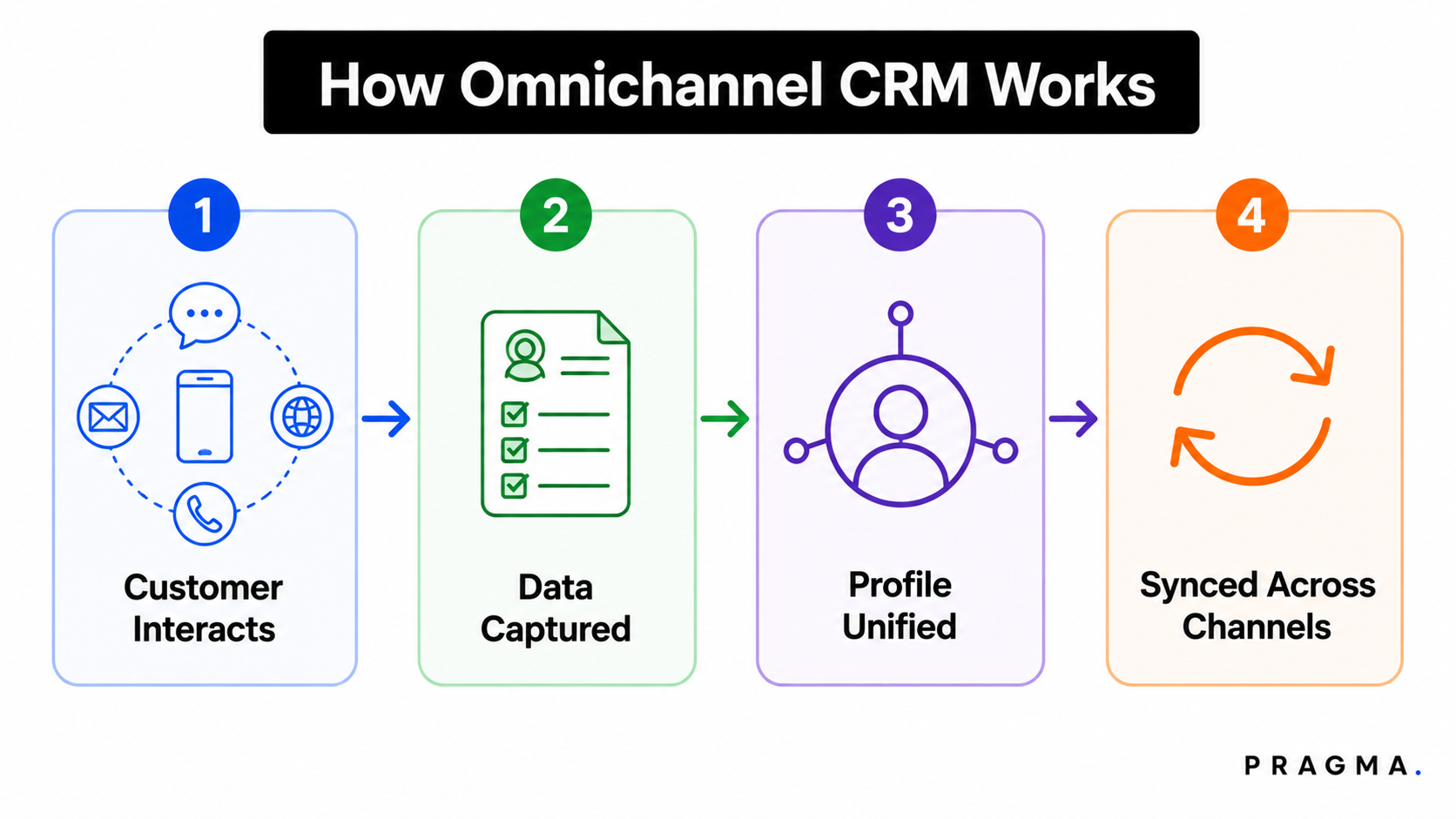
Now, let's have a look at the most interesting part that you need to know about how omnichannel CRM works:
Customer Interacts Through Any Channel
Let's say a customer sends a WhatsApp message asking about a delayed order. This is the entry point.
The channel does not matter. The system captures it whether it comes through Instagram DM, email, phone, or live chat.
Customer Data Is Captured Automatically
The moment the message arrives, the CRM logs it. It records the channel, the timestamp, the message content, and the customer identifier.
You don't need to do any manual entry, no copy-pasting between tools. HubSpot reports automation reduces manual CRM errors by up to 30%.
Pragma Omnichannel CRM automates this capture across WhatsApp, Instagram, Facebook Messenger, email, and VoIP. Your team does not need to switch between apps to see what came in.
Customer Profile Is Unified
The system matches the incoming message to an existing customer profile.
If the customer messaged before via email, that history is already there. The new WhatsApp message gets added to the same profile.
For example, when a customer contacts support about a delayed order, the agent can immediately view previous purchases, return history, loyalty status, and past conversations without asking the customer to repeat information.
If it is a new customer, the system creates a profile and starts building their history from the first interaction.
Data Syncs Across All Channels
Every update to the customer profile syncs in real time across all connected channels and teams. Your support agent, your marketing team, and your sales team all see the same data at the same time.
This is the core of how omnichannel CRM works. It is not just about being present on multiple channels.
It is about making those channels share the same data, so every team member works from the same source of truth.
Key Components of an Omnichannel CRM
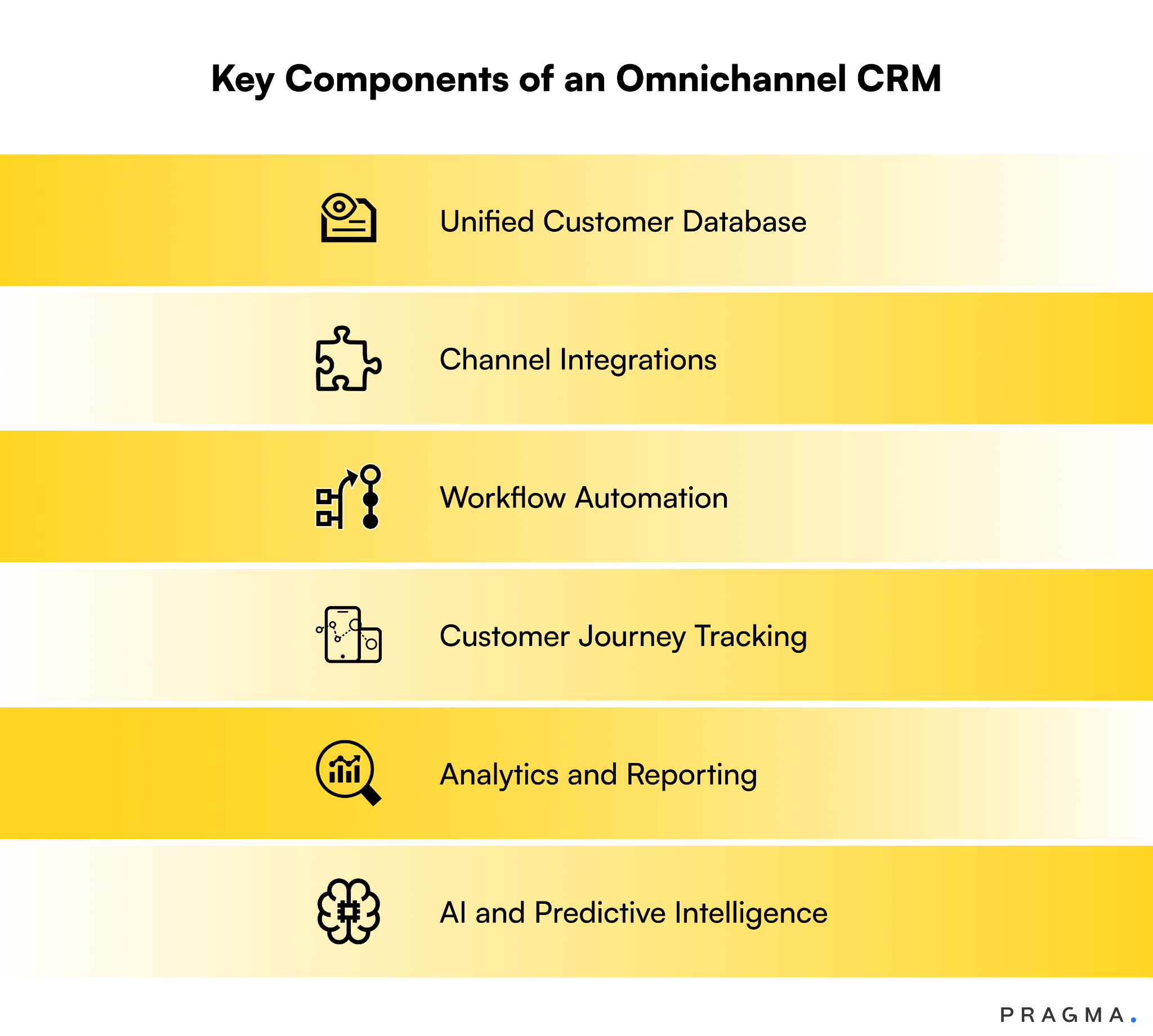
The following are the components of an Omnichannel CRM:
Unified Customer Database
This is the foundation of an omnichannel CRM. Every customer has one profile that holds all their data: contact details, order history, communication history, support tickets, preferences, and engagement patterns.
Without a unified database, omnichannel is not possible. You cannot connect channels if the data behind them lives in separate silos.
Channel Integrations
An omnichannel CRM connects to every channel your customers use. This includes:
- WhatsApp Business
- Instagram Direct Messages
- Facebook Messenger
- SMS
- Phone and VoIP
- Website live chat
With Pragma Omnichannel CRM, connecting all of these into one inbox becomes easy. Your team responds to every channel from one screen without switching tools.
Workflow Automation
Automation handles repetitive work. It handles:
- Order updates
- Return approvals
- Refund processing
- Cart recovery
- Loyalty triggers
This removes manual workload from support and marketing teams. McKinsey reports automation reduces service costs by up to 40%.
Pragma's automation reduces manual support effort by up to 80%.
This frees your team to focus on complex issues that need human judgment.
Customer Journey Tracking
The CRM tracks every step a customer takes with your brand. From the first Instagram ad click to the fifth repeat purchase, every touchpoint is recorded.
This gives your team a complete picture of where each customer is in their relationship with your brand and what they are likely to need next.
For example, a fashion brand may identify that customers who view size guides and engage with WhatsApp support are more likely to purchase within 48 hours. This insight helps marketing teams build more effective campaigns.
Analytics and Reporting
An omnichannel CRM includes dashboards that show e-commerce brands:
- Which channels drive the most support volume
- Average response and resolution times
- Agent performance metrics
- Customer satisfaction scores
- Campaign engagement by channel
These insights help them to make decisions based on what is actually happening, not what they assume is happening.
For example, if WhatsApp generates 60% of support conversations but email generates only 10%, brands can allocate more resources to WhatsApp support and improve response times.
AI and Predictive Intelligence
Modern omnichannel CRM platforms use AI to go beyond tracking. AI identifies patterns in customer behaviour, predicts churn risk, recommends next best actions, and routes conversations to the right agent automatically.
Modern CRM systems like Pragma Omnichannel CRM use NLP-powered bots that support 16 plus languages and handle up to 95% of incoming queries automatically.
Omnichannel CRM Architecture Explained
To fully understand how omnichannel CRM works, it helps to look at the four layers that make up the system.
Communication Layer
This is where customer interactions happen. WhatsApp, Instagram, email, phone, and live chat all feed into this layer.
Every message from every channel enters the system here.
Data Layer
This is where customer profiles live. The data layer stores and organises all customer information.
It matches incoming interactions to existing profiles and updates records in real time.
Automation Layer
This is where rules and workflows run. When a customer sends a message, the automation layer decides what happens next.
It assigns the ticket, triggers a response, sends a follow-up, or escalates based on predefined rules.
Analytics Layer
This is where performance data is processed and displayed. The analytics layer turns raw interaction data into reports, dashboards, and insights your team can act on.
Pragma Omnichannel CRM operates across all four layers. It captures interactions, unifies profiles, automates responses, and reports performance from one system.
Omnichannel CRM Example for an E-commerce Brand
Let us discuss a real-world scenario showing how omnichannel CRM works for a D2C fashion brand.
A customer named Priya orders a kurta from your website on Monday. On Tuesday, she sends an Instagram DM asking about the delivery timeline. On Wednesday, she sends a WhatsApp message saying the tracking link is not working. On Thursday, she calls your support number.
Without an omnichannel CRM, each of these interactions looks like a new ticket. Your Instagram team does not know she already messaged on WhatsApp. Your phone agent asks her to repeat her order number.
With an omnichannel CRM, all four interactions are linked to Priya's profile. When she calls on Thursday, your agent sees her order, her Instagram message, her WhatsApp message, and the full timeline.
The agent resolves her issue in under two minutes without asking her to repeat anything.
And the result is that she is satisfied with your brand's support team and has become your loyal customer.
This is the practical outcome of understanding how omnichannel CRM works and implementing it correctly.
Omnichannel CRM vs Multichannel CRM
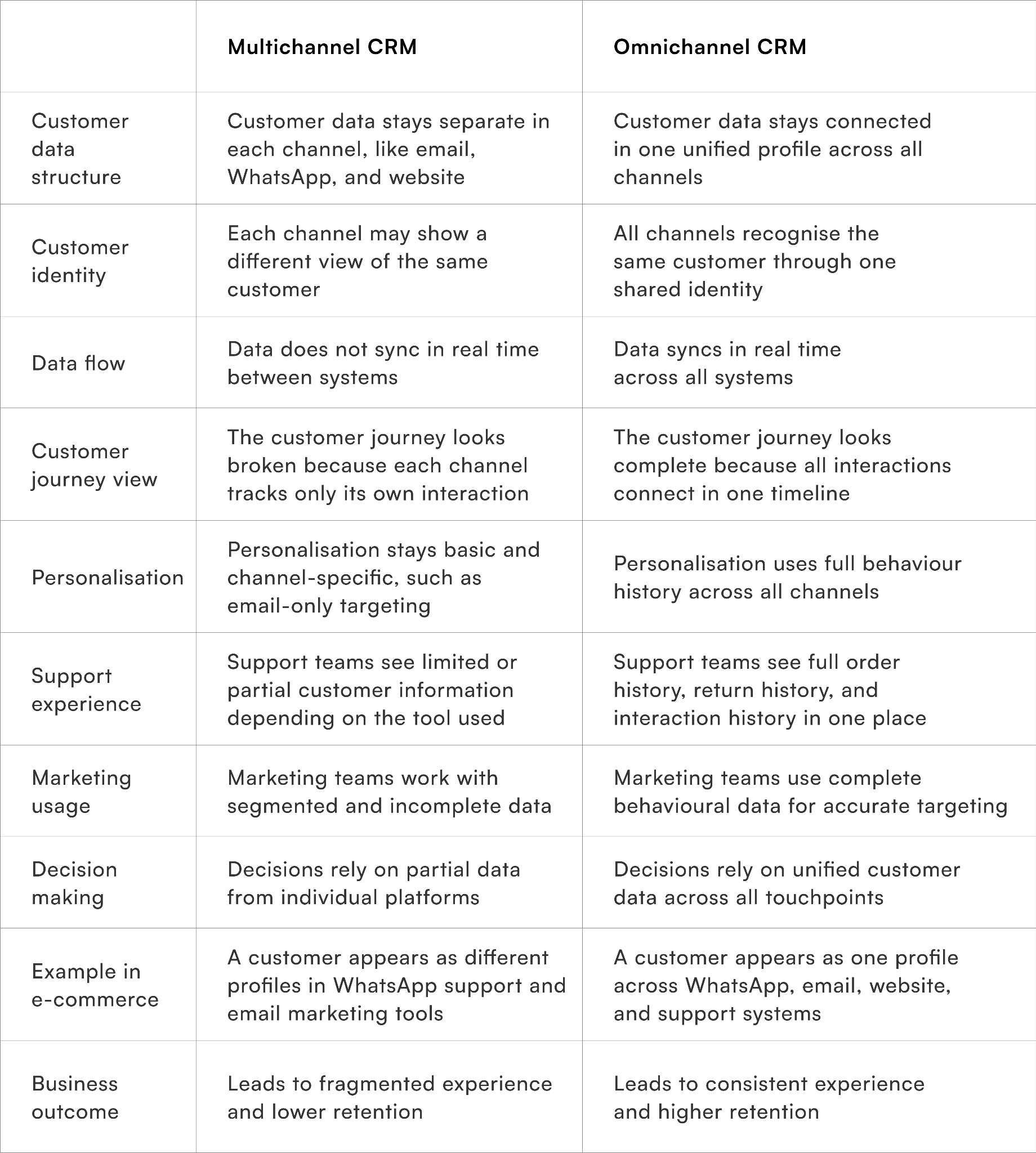
Many brands confuse omnichannel with multichannel. They are not the same.
The following table will help you understand the difference between an omnichannel and a multichannel CRM better:
Benefits of Omnichannel CRM for E-commers
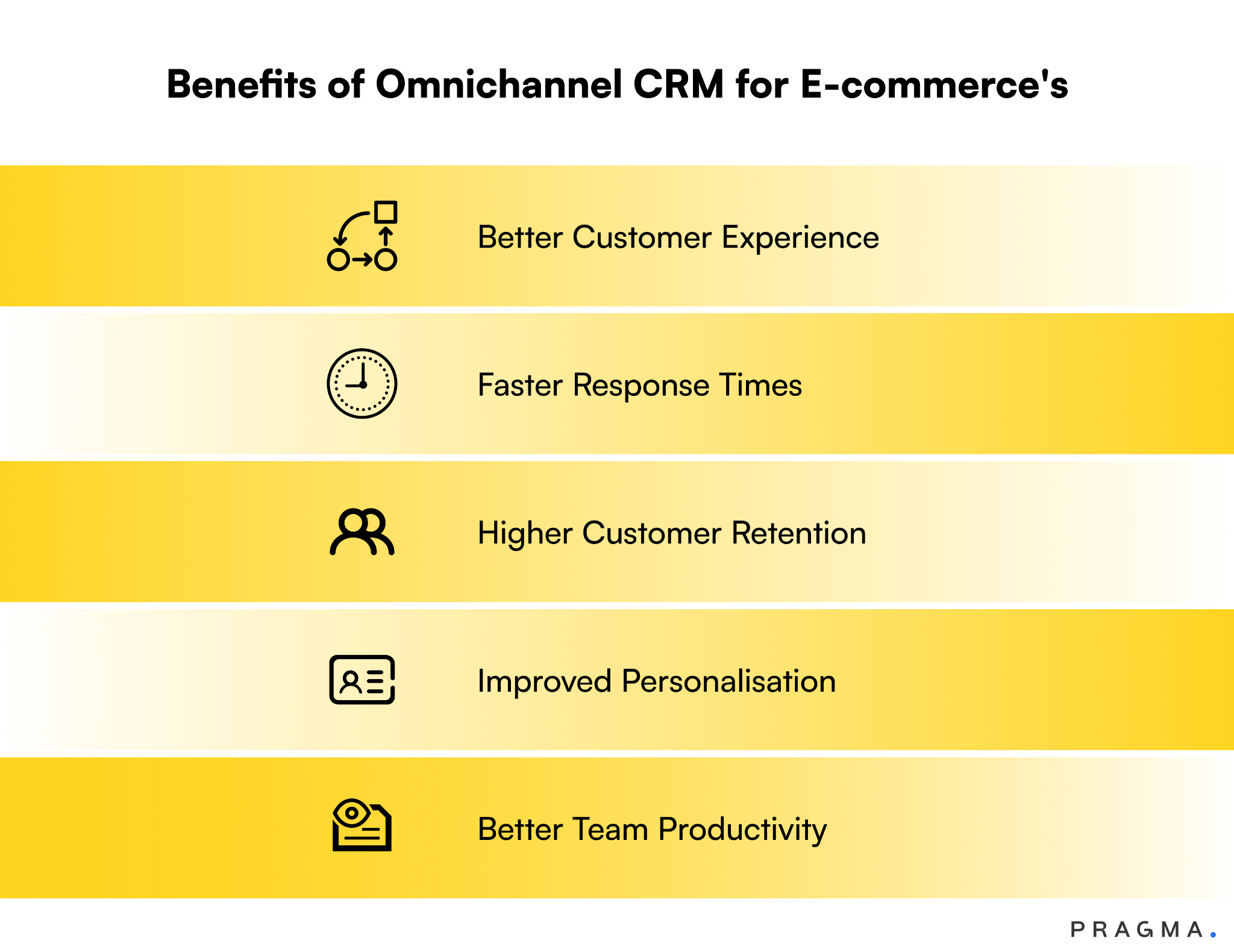
An omnichannel CRM can be beneficial to an e-commerce business in the following ways:
Better Customer Experience
When a brand has full context about the customer, every interaction feels personal. Customers do not repeat themselves.
For example, if a customer starts a conversation on Instagram and continues it later through WhatsApp, the support team already has access to the previous conversation history.
Support agents do not waste time searching for information. The conversation moves forward.
Research by PwC found that 73% of consumers say customer experience is an important factor in their purchasing decisions.
A report found that 80% of customers say the experience a company provides is as important as its products and services.
Faster Response Times
Automation handles routine queries instantly. Smart routing sends complex issues to the right agent without manual sorting.
Your team spends time on issues that need human attention, not on unnecessary tickets.
Pragma Omnichannel CRM handles up to 95% of incoming queries automatically, reducing response time from hours to seconds for common questions.
Higher Customer Retention
Omnichannel consumers have a 30% higher lifetime value than single-channel customers.
When customers get consistent, personalised service across every channel, they stay longer and spend more.
A 2025 report found that D2C brands with connected post-purchase communication see up to 40% higher repeat purchase rates within 90 days.
Improved Personalisation
A unified customer profile gives you everything you need to personalise at scale. You know what they bought, what they asked, what they ignored, and what they responded to.
You send a WhatsApp message about a restock on the exact product they viewed three times. You offer a loyalty discount to customers who have placed five or more orders. You trigger a win-back campaign for customers who have not purchased in 60 days.
All of this runs automatically when your data is unified.
Pragma's segmentation tools let you build these workflows based on buying behaviour, order value, channel preference, and support history, all from one dashboard.
Better Team Productivity
Your support team spends less time switching between tools. Your marketing team stops sending campaigns to customers who have already bought.
Your sales team stops reaching out to customers who have just raised a complaint.
How AI Enhances Omnichannel CRM?
As AI is revolutionising every industry, here is how AI enhances the omnichannel CRMs to work better:
AI Chatbots
AI chatbots handle the first line of support. They answer order status questions, process return requests, share tracking links, and collect customer information before escalating to a human agent.
Pragma Omnichannel CRM works across WhatsApp, Instagram, and Facebook Messenger, supports 16 plus languages, and handles up to 95% of queries without human intervention.
A Gartner report predicts that by 2026, conversational AI will reduce contact centre agent labour costs by 80 billion dollars globally.
Predictive Recommendations
AI analyses purchase history and browsing behaviour to recommend products a customer is likely to buy next.
These recommendations are delivered through the customer's preferred channel at the right time.
A McKinsey report found that personalisation at scale delivers 5 to 8 times the ROI on marketing spend and lifts sales by 10% or more.
Smart Routing
AI reads incoming messages, identifies the topic and urgency, and routes the ticket to the most qualified available agent.
So brands have to do no manual sorting, and there will be no misrouted tickets.
Customer Intent Detection
AI detects signals in customer messages that indicate frustration, purchase intent, or churn risk.
When a customer sends three messages about the same unresolved issue, the system flags it for priority handling before the customer escalates.
Automated Customer Journeys
AI triggers entire communication sequences based on customer behaviour. A customer who abandons their cart gets a WhatsApp reminder after two hours.
A customer who places their third order gets a loyalty reward message. A customer who has not purchased in 45 days gets a re-engagement offer.
Pragma's automation engine manages these journeys across all connected channels without manual setup for each customer.
In 2024, Meta reported that WhatsApp Business messages have an open rate of over 98%, making it the highest-performing channel for D2C customer communication.
Common Challenges When Implementing Omnichannel CRM
While an omnichannel CRM is a powerful tool for any e-commerce business, most businesses face the following challenges while implementing it:
Data Silos
Most D2C brands start with separate tools for different functions. They use Shopify for orders, Zendesk for support and Mailchimp for email.
Connecting these tools requires integration work. Without it, your omnichannel CRM cannot build a complete customer profile.
With a proper omnichannel CRM, you can connect Shopify, Zendesk, Freshchat, and other tools your brand already uses, so you do not need to rebuild your tech stack from scratch.
Integration Complexity
Adding a new platform to an existing tech stack takes time and technical effort.
Because APIs need to be configured, data formats need to be standardised, and teams need to be trained. That is why some businesses face difficulty in doing this.
To solve this, e-commerce brands must start with the channels that drive the most customer volume and expand from there.
Team Adoption Issues
A new system only works if the ur team uses it. If agents continue using old tools out of habit, the unified inbox becomes incomplete.
So, the D2C brand should involve its team in the setup process, provide clear training, and remove access to old tools once the new system is live.
Data Quality Problems
Duplicate customer profiles, incorrect contact details, and inconsistent data formats create problems in any CRM.
In an omnichannel system, bad data leads to wrong routing, failed automations, and inaccurate reports.
So the brand should first audit its existing customer data before migration and set up deduplication rules in its new system.
Scaling Customer Conversations
As a brand grows, conversation volume grows with it. A system that works for 500 tickets a month may struggle at 5,000.
Pragma's platform is designed to scale with D2C brands, handling high volumes through AI-powered bots and automated workflows without adding headcount.
A 2024 report by Statista found that the Indian D2C market is expected to reach 60 billion dollars/ ₹5.16 lakh crore by 2027, up from 12 billion dollars in 2022. As order volumes grow, brands that do not automate will fall behind on response times and customer satisfaction.
Best Practices for Implementing Omnichannel CRM
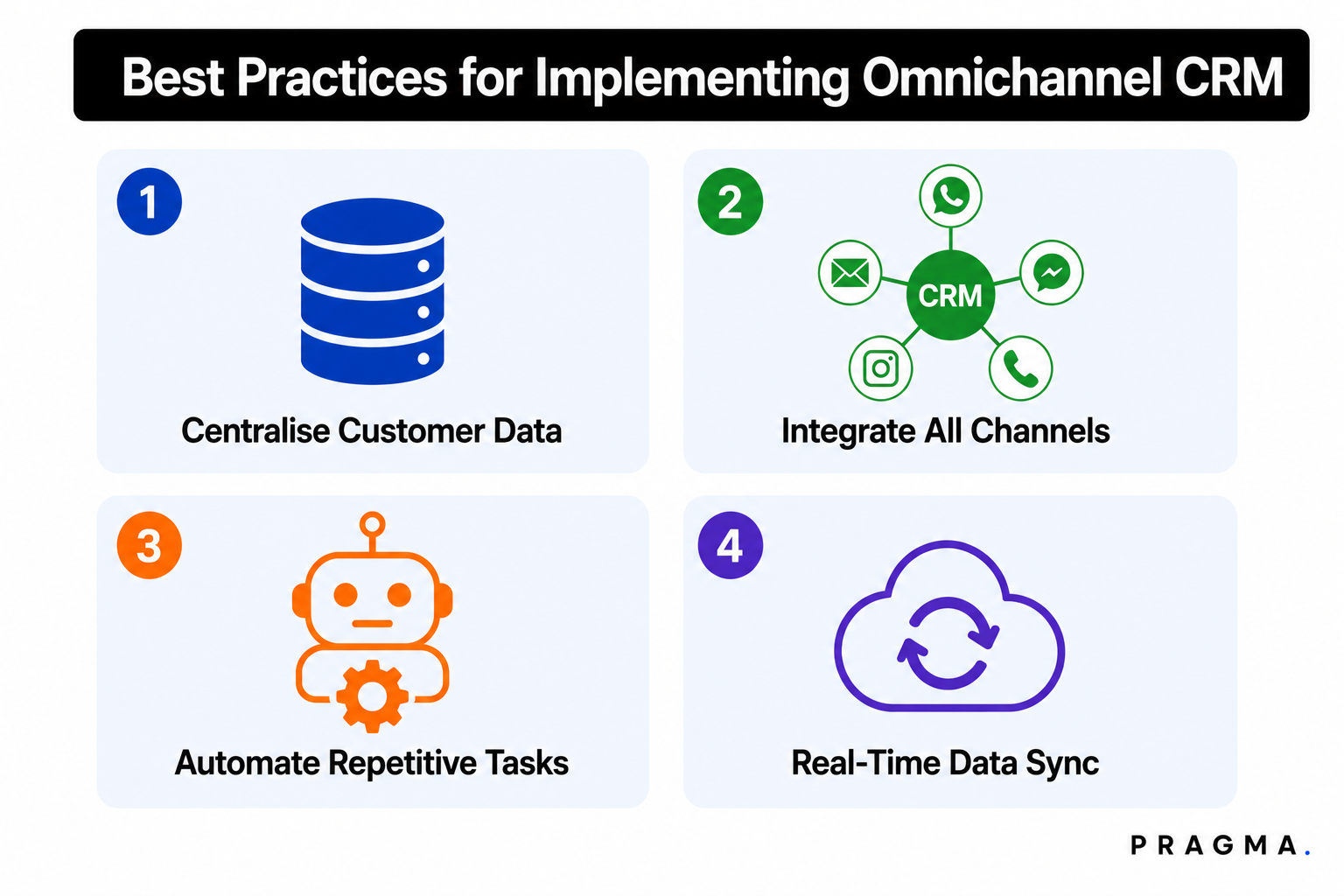
To get the most out of an omnichannel CRM, brands should follow the given strategies:
Centralise Customer Data
Before you connect channels, decide where your customer data will live.
Every tool in your business should feed into one central profile. This is the foundation on which everything else depends.
Pragma omnichannel CRM creates a unified customer profile that pulls in order data, conversation history, and channel preferences automatically.
Integrate All Customer Channels
Map out every channel your customers use to reach you. Then connect all of them to your CRM. Do not leave any channel disconnected.
A customer who gets ignored on Instagram because your team does not monitor it is a customer you are losing.
Automate Repetitive Tasks
Identify the queries your team answers most often.
- Order status.
- Return requests.
- Delivery timelines.
- Payment issues.
Build automated responses for all of them.
This reduces the team's workload and gives customers instant answers at any hour.
Maintain Real-Time Data Sync
Your CRM is only as useful as the data inside it. If updates take hours to sync, your team makes decisions based on outdated information.
Choose a platform that syncs data in real time across all channels and teams. Pragma's system updates customer profiles instantly as new interactions occur.
Build Segmentation Into Your Workflows
Not all customers are the same. High-value customers need different handling than first-time buyers. Customers who have raised three support tickets in a week need different outreach than customers who have never contacted support.
Use your unified data to segment customers and build workflows that treat each segment appropriately.
Pragma lets you segment by order value, purchase frequency, channel preference, support history, and cart behaviour, so every workflow targets the right customer with the right message.
How Omnichannel CRM Works: The Bottom Line
As customer journeys become more complex, disconnected systems make it difficult for D2C brands to deliver consistent experiences.
An omnichannel CRM solves this by connecting customer conversations, order data, support interactions, and post-purchase workflows into a single view.
80 per cent of customers value experience as much as product quality.
Without unified systems, brands lose visibility into behaviour, intent, and retention signals.
Platforms like Pragma Omnichannel CRM strengthened brands by connecting post-purchase workflows like returns, exchanges, refunds, and communication into a single system.
This enables D2C brands to manage the full customer lifecycle from first visit to repeat purchase.

FAQs (Frequently Asked Questions On How Omnichannel CRM Works: A Complete Guide for E-commerce Brands)
1. What is an omnichannel CRM?
An omnichannel CRM is a customer relationship management system that centralises customer data, conversations, purchase history, and interactions across channels such as websites, WhatsApp, email, SMS, mobile apps, and customer support platforms.
2. How does an omnichannel CRM work?
An omnichannel CRM works by collecting and unifying customer data from multiple touchpoints into a single customer profile, enabling businesses to deliver personalised experiences, automate journeys, and maintain consistent communication across channels.
3. What is the difference between a traditional CRM and an omnichannel CRM?
A traditional CRM primarily stores customer records and sales information, while an omnichannel CRM connects customer interactions across multiple channels, providing a complete view of the customer journey.
4. Why do eCommerce brands need an omnichannel CRM?
eCommerce brands need an omnichannel CRM to manage customer interactions across channels, improve personalisation, increase retention, streamline support operations, and create more effective marketing campaigns.
5. What are the benefits of using an omnichannel CRM?
Key benefits include unified customer data, improved customer experience, better segmentation, personalised communication, higher customer retention, increased customer lifetime value (LTV), and improved operational efficiency.
6. How does an omnichannel CRM improve customer experience?
An omnichannel CRM improves customer experience by ensuring customer preferences, purchase history, and previous interactions are available across all channels, enabling more relevant and consistent engagement.
7. How does an omnichannel CRM support marketing automation?
An omnichannel CRM supports marketing automation by triggering personalised campaigns, customer journeys, abandoned cart reminders, post-purchase communications, and retention campaigns based on customer behaviour.
8. What channels can be connected to an omnichannel CRM?
An omnichannel CRM can connect channels such as websites, WhatsApp, email, SMS, mobile applications, social media platforms, marketplaces, customer support systems, and offline retail touchpoints.
9. What features should eCommerce brands look for in omnichannel CRM software?
Important features include unified customer profiles, customer segmentation, journey automation, campaign management, customer support integration, analytics, real-time data synchronisation, and multi-channel communication capabilities.
10. How does an omnichannel CRM help increase customer retention?
An omnichannel CRM helps increase customer retention by enabling personalised communication, proactive engagement, loyalty campaigns, lifecycle automation, and consistent customer experiences across every touchpoint.
Talk to our experts for a customised solution that can maximise your sales funnel
Book a demo

.png)