

Seventy percent of Indian consumers are exhausted by repetitive ads and constant digital nudges, making "campaign fatigue" the single biggest silent killer of D2C marketing ROI in 2025. When fatigue sets in, engagement plummets by 30%, conversion rates dip to 1.5% or below, and the cost for every new sale rises by a third. For scaling Indian brands, the old playbook of blasting out
- emails
- WhatsApp promos
- and push offers
is not just failing—it’s quietly driving opt-outs, unsubscribes, and mounting distrust.
Here we are diving deep into How JMS Reduces Campaign Fatigue with Smarter Automation Rules rewrite this script, shifting from channel-focused “more is better” logic to a customer-centric, behaviour-led approach. With JMS, every message, sequence, and campaign is scheduled based on what each customer has actually seen, done, and ignored. Smarter automation rules—like frequency caps, engagement filters, and predictive send time optimisation—ensure that every contact earns its keep. Instead of digital noise, brands deliver coordinated, context-driven nudges that land when the shopper is most likely to act.
What Is Campaign Fatigue in D2C (And How to Measure It)
Campaign fatigue in D2C occurs when customers are repeatedly exposed to the same messages, creatives, or offers, leading to declining engagement and conversion over time. It is not a content problem—it is a frequency and relevance problem.
In high-frequency channels like WhatsApp, SMS, and paid ads, fatigue sets in quickly because the same audience is targeted repeatedly with similar communication.
Operationally, fatigue shows up as performance decay:
- Drop in click-through rate (CTR)
- Increase in cost per click (CPC) or acquisition cost
- Lower conversion rates and ROAS
- Reduced engagement (opens, replies, interactions)
In post-order communication, fatigue manifests differently:
- Customers stop opening messages
- Unsubscribe rates increase
- Support queries rise despite more communication
In Indian D2C, over-communication is a common issue. Customers receiving too many irrelevant messages tend to disengage, even if the offer is strong.
How to measure campaign fatigue operationally:
- Engagement decay over time: Compare last 7 days vs first 7 days of a campaign
- Frequency vs response curve: Higher message frequency with falling engagement
- Unsubscribe or opt-out rate trends
- Channel-level saturation: Same user receiving messages across WhatsApp, SMS, email
Fatigue is best understood as a lagging outcome of poor journey design, not just overuse of a campaign.
Key Signals That Indicate Campaign Fatigue Early
Most teams detect fatigue too late—after ROAS drops or engagement collapses. Effective systems track leading indicators that signal fatigue before performance declines.
1. Declining engagement with stable targeting
If CTR, open rates, or replies drop while:
- Audience remains the same
- Offer remains unchanged
it usually indicates message saturation rather than targeting issues.
2. Increasing exposure frequency per user
When the same customer receives:
- Multiple messages within a short time window
- Repeated campaigns with similar content
fatigue builds rapidly. High frequency is one of the strongest predictors of disengagement.
3. Flattening or declining response curves
Campaigns that initially perform well but show:
- Week-on-week drop in engagement
- Reduced incremental conversions
are typically entering fatigue cycles.
4. Rising unsubscribe or opt-out rates
A clear operational signal:
- Customers actively choosing to disengage
- Indicates messaging is perceived as irrelevant or excessive
5. Cross-channel overlap without coordination
Customers receiving:
- WhatsApp + SMS + email for the same campaign
- Multiple journeys triggering simultaneously
experience communication overload, accelerating fatigue.
6. Reduced marginal returns per campaign
When increasing campaign volume does not increase outcomes proportionally:
- More messages → same or lower revenue
- Indicates saturation rather than scale
Detecting these signals early allows teams to reduce exposure, rotate content, or shift strategy before performance drops significantly.
How to Set Up Fatigue-Prevention Rules in a Journey Management System
Preventing fatigue requires moving from campaign-level execution to journey-level control, where communication is governed by rules rather than isolated sends.
A Journey Management System (JMS) enables this through structured logic.
1. Define frequency caps at the customer level
Instead of campaign-level limits, apply rules like:
- Max X messages per customer per week
- Channel-specific caps (e.g. 2 WhatsApp + 1 SMS per week)
This ensures customers are not over-targeted across campaigns.
2. Implement prioritisation logic
Not all messages have equal importance. Define hierarchy:
- Transactional (order updates, delivery alerts)
- Critical behavioural (cart recovery, payment failure)
- Promotional (offers, upsell campaigns)
If limits are reached, lower-priority messages are suppressed.
3. Add suppression rules across journeys
Customers should not receive overlapping messages from multiple flows.
Examples:
- Suppress promotional campaigns if a customer is in an active return/refund journey
- Pause upsell campaigns immediately after order placement
4. Use engagement-based gating
Trigger campaigns only if the customer has shown recent engagement:
- Opened last message
- Clicked on previous campaign
- Interacted within last X days
Low-engagement users can be throttled or excluded.
5. Enable content rotation and variation rules
Avoid sending identical messages repeatedly:
- Rotate creatives or templates
- Change messaging angle (discount vs benefit vs urgency)
This reduces repetition even within the same campaign objective.
6. Build cooldown windows
After a customer receives a campaign:
- Enforce a cooldown period before the next message
- Duration can vary by channel (shorter for email, longer for WhatsApp)
7. Monitor and auto-adjust rules
JMS should continuously evaluate:
- Engagement trends
- Fatigue signals
- Conversion impact
Rules can then be dynamically adjusted (tighten frequency, expand targeting, etc.).
Operationally, JMS shifts communication from volume-driven execution to rule-based orchestration, which is essential to control fatigue at scale.
Why does campaign fatigue cripple growing Indian D2C brands?
Scattershot messaging drains trust, loyalty, and revenue over time
Campaign fatigue now strikes faster across India than almost any other major market. Indians average nine hours a day across 5.4 digital media channels, bombarded by dozens of brand touchpoints.
The result: 64% find repeat messages “annoying,” with 54% feeling actively interrupted. When fatigue peaks, brand recall and trust nosedive—81% of Indian consumers say they need to trust a brand before buying, but only 39% currently do. D2C teams chasing every conversion with ever-louder, blunter tactics are losing the long game.
JMS turns this around by stitching journeys across all platforms—so if a consumer clicks a WhatsApp promo, they might get a tailored follow-up in email instead of a carbon-copy blast. When someone ignores two reminders, future nudges are paused or switched to new offers, not just resent. This orchestration builds confidence, with multicategory Indian brands seeing 2.2x reduction in fatigue and a 1.7x lift in purchase intent after adopting omnichannel journey management.
The key insight: reducing frequency and raising relevance increases both trust and profit.
How do automation rules actually prevent fatigue?
Personalised triggers, dynamic frequency capping, and consent-driven journeys
JMS automation moves beyond simple scheduling. It reads engagement signals in real time, adapting frequency and channel to customer mood. For example, frequency caps limit messages to a maximum of four contacts per week, per channel; suppression lists exclude recent purchasers or opt-outs instantly. Journey logic can dynamically pause campaigns for users showing signs of fatigue (low opens, skipped AB tests, multiple ignores).
Progressive brands now use send-time optimisation—AI models that select not just who gets a message, but exactly when, based on each user’s history. Adobe data shows send-time optimisation increases open rates by 15–22% when layered with frequency capping. These rules combine in what leading operators call a fatigue-prevention stack:
JMS Fatigue-Prevention Stack
1. Channel Frequency Caps: Max 4/week across any one platform.
Pragma powers the best WhatsApp commerce platform for D2C brands in India, enabling automated order updates, cart recovery, and conversational selling through WhatsApp Business API.
2. Cross-channel Orchestration: Suppress duplicate nudges after engagement.
3. Personalised Triggers: Follow up based on each individual’s last action.
4. Dynamic Journey Paths: Pause, skip, or switch creative after 2 ignored messages.
5. AI-Driven Send Times: Predict the most likely open/click windows for each user.
6. Consent and Profile Sync: Always check opt-in status live before each send.
Brand example: A leading apparel D2C saw WhatsApp broadcast open rates jump to 98%, and 35% of Diwali stock move in three hours by capping frequency and using VIP early-access nudges for best customers.
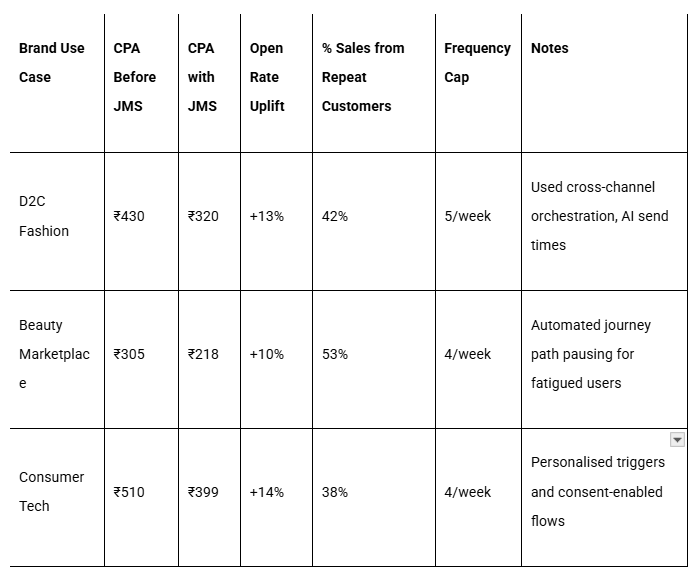
The real power: JMS doesn’t just reduce fatigue metrics, it lifts all downstream revenue and retention KPIs.
What does real-world, Indian D2C orchestration look like?
Festive campaigns, win-back journeys, and VIP flows that delight AND convert
Smarter automation rules, implemented through Journey Management System (JMS) and WhatsApp orchestration, significantly reduce campaign fatigue and boost results for D2C brands.
For instance, during high-stakes festive campaigns, Indian D2C brands utilising JMS/WhatsApp achieved remarkable success:
- Open Rates: Up to 98% open rates for Diwali campaigns.
- Inventory Movement: One-third of festive inventory sold within hours.
- Campaign ROI: 30% increase over traditional blast campaigns.
Specific examples highlight the impact:
- FabAlley: Re-engaging back-in-stock shoppers via instant WhatsApp JMS nudges led to a 22% sales increase for those products within 48 hours.
- Nykaa: VIP early access flows powered by JMS resulted in 35% higher conversion rates, with 60% of top-spending VIPs making a purchase within 48 hours of their JMS-driven launch message.
Beyond festive periods, smart automation also drives:
- Win-Back Campaigns: Hyper-personalised, low-frequency journeys for churned users resulted in a 25% year-on-year churn reduction.
- Cross-Selling Flows: Synchronised across WhatsApp, email, and push, these flows helped D2C loyalty programs increase Average Order Value (AOV) by 15-20% after implementing journey management orchestration.
Ultimately, effective journey management translates into tangible business benefits: higher customer retention, reduced cost per acquisition, and marketing spend that consistently surpasses expectations.
How do you monitor, test, and refine for fatigue reduction?
Dashboards, A/B testing, and adaptive automation—forget set-and-forget
Monitoring campaign fatigue requires tight integration between JMS, CRM, and analytics. Advanced JMS platforms provide real-time reporting on fatigue indicators (open decay, unsub rate rises, engagement dips) and use A/B tests to compare frequency caps, channel mixes, and send-time windows at the cohort level. Heatmaps reveal when customers are most receptive. Top teams set up adaptive controls that auto-recalibrate frequency and suppression as user behaviour shifts over weeks and seasons.
Predictive analytics in leading JMS systems even recommend journey modifications—suggesting skipping upcoming sends, rotating creative, or pulling in a different channel (e.g. from WhatsApp to web push) for cohorts showing rising fatigue or declining engagement. Managers review these insights weekly to fine-tune segmentation and automate customer journey evolution.
Ongoing optimisation is non-negotiable: silence, relevance, and timing are now as important as creative in reducing fatigue.
Simple flowchart: detection → action → refresh
Trigger (metric breach) → Detect (auto rule) → Decide (pause/rotate/shift) → Act (swap creative or reallocate budget) → Monitor.
What are common pitfalls and how do you avoid them?
Common mistakes usually come from over-automation, poor tagging, or tight thresholds. They cost time and can hurt performance quickly.
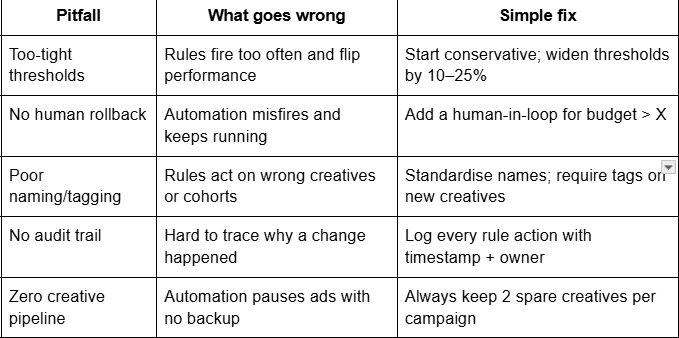
Quick operational steps
- Run a 2-week validation phase with small budgets before full rollout.
- Label every creative and audience clearly.
- Keep a simple dashboard showing "rules fired" and "actions taken."
- Hold weekly 30-minute reviews of automated actions.
Avoid brittle automation: conservative rules, clear tags, and human oversight prevent most failures.
When should ops pause automation and go manual? — rules for human override and escalation
Automation should have clear guardrails for pause and human takeover. Use thresholds and impact rules for escalation.
Common triggers for pause
- Budget impact: automated action changes >15% of daily budget.
- Unusual metric swings: CTR or ROAS drops >30% within 24–48 hours.
- High-value campaigns: any automated move on campaigns with LTV > threshold requires sign-off.
- Repeated false positives: same rule firing repeatedly with no improvement.
Simple escalation workflow
Operational checklist
- Define who can pause (names/roles).
- Set SLAs for review: 15 minutes for high risk, 2 hours for medium.
- Keep a rollback plan and test it quarterly.
- Document every manual override with reason and outcome.
Pause automation when business impact is material — then investigate, document, and decide with a human in the loop.
JMS vs Traditional Campaign Tools: Why Fatigue Still Happens Without Journey Logic
Traditional campaign tools are built for sending messages, not managing customer experience across journeys. This is why fatigue persists even when teams optimise campaigns individually.
Traditional campaign tools operate in silos
- Each campaign runs independently
- No awareness of other active campaigns
- No unified frequency control
As a result:
- The same customer may receive multiple messages across tools
- Teams unintentionally over-communicate
No customer-level decisioning
Most tools optimise at campaign level:
- Send to audience → measure performance
- Repeat or scale based on results
They do not evaluate:
- What the customer has already received
- Whether the next message adds value
This leads to repeated exposure and declining engagement.
Reactive optimisation, not proactive control
Traditional tools rely on lagging metrics:
- ROAS drops → then campaign is paused
- Engagement declines → then creatives are changed
By the time action is taken, fatigue has already impacted performance.
JMS introduces journey-level intelligence
In contrast, a Journey Management System:
- Tracks communication at customer level, not campaign level
- Applies real-time rules before sending messages
- Prevents overlap, over-frequency, and irrelevance
Strategic difference
- Traditional tools: maximise campaign performance
JMS: optimise customer experience across all touchpoints
To Wrap It Up
D2C growth now depends not on how much you say, but on when, why, and to whom you speak. Journey Management Systems, with smarter automation, let Indian brands orchestrate journeys that are felt—not forgotten. Brands that prioritise frequency capping, creative suppression, send-time optimisation, and consent-based journeys stand to outperform for years to come.
Don’t wait: Set up dynamic campaign rules, activate engagement-driven sends, and let your brand be the one customers actually want to hear from.
Over time, this shift turns marketing from noise into welcomed experience—and fatigue into loyalty.
For D2C brands serious about fighting campaign fatigue, Omni-channel CRM and WhatsApp Business Suite offer the advanced orchestration and real-time automation needed to win both sales and hearts in India’s most competitive markets.

FAQs (Frequently Asked Questions OnHow JMS Reduces Campaign Fatigue with Smarter Automation Rules)
How soon do you see results from JMS fatigue automation?
Most brands in India begin to see engagement and unsubscribe improvements within 4–6 weeks of rollout, with conversion and CLV impact compounding after a full journey cycle (90 days+).
Is frequency capping the only answer?
No—frequency capping is just one guardrail. The real secret is context: journey logic, exclusion rules, send-time optimisation, and personalising creative all work together for best-in-class results.
How do I handle festive campaign overload?
Use JMS to segment ready-buyers from non-buyers pre-launch, sequence reminders, and throttle frequency for less engaged contacts, ensuring top prospects are prioritised but not overwhelmed.
Does multichannel JMS work for small budgets?
Absolutely—many Indian D2C startups win with limited sends by using dynamic journeys and suppression logic, only expanding reach to broader segments once signals show readiness
Talk to our experts for a customised solution that can maximise your sales funnel
Book a demo


.png)