

The Indian e-commerce market was projected to grow 12.4% in 2026, reaching ₹19.7 trillion ($225.9 billion), according to GlobalData and is forecast to climb further to ₹27.4 trillion ($314.5 billion) by 2029.
This growth creates operational pressure for D2C brands. Today, every customer wants a smooth shopping experience and deliveries.
And an e-commerce brand that doesn't fulfil this faces negative impacts on its conversion rates and profitability.
Also, brands now operate across multiple sales channels, including Shopify stores, marketplaces, Instagram, WhatsApp, and quick commerce platforms.
With a high volume of orders, e-commerce order placement is one of the most important operational systems in a D2C business.
A successful order placement system is not only about transactions; it also covers checkout, inventory allocation, payment processing, warehouse assignment, shipping, returns management, and post-purchase communication.
So, to get a complete understanding of the benefits and impacts, let's have a detailed discussion on "E-commerce Order Placement: Process, Flow & Fulfilment Guide"
What is E-commerce Order Placement?
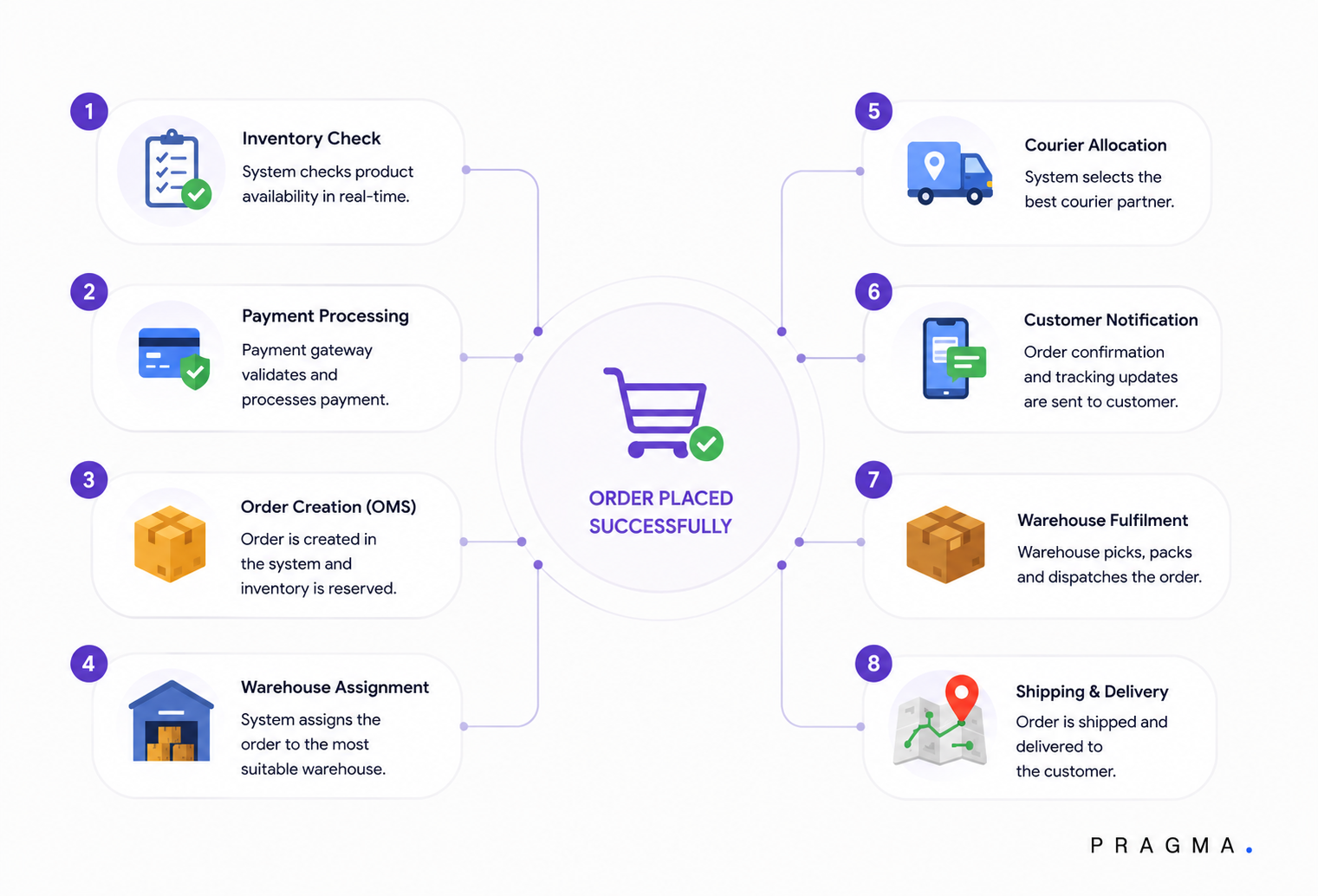
E-commerce order placement refers to the complete operational process where a customer places an order online, and the business converts that order into a successful fulfilment and delivery operation.
Many e-commerce businesses incorrectly treat order placement as only the checkout process. In reality, order placement is a connected workflow involving multiple systems that work together.
The process starts when a customer clicks "Place Order" during checkout. From that moment, several systems immediately begin validating and processing the order.
- The e-commerce platform checks whether the product exists in inventory.
- The payment gateway processes the transaction.
- The order management system reserves stock and assigns fulfilment.
- The logistics layer selects a courier partner.
- Communication systems trigger order confirmation updates.
- Warehouse systems begin dispatch workflows.
All these actions happen within seconds.
If even one process fails, the customer experience suffers. This is why e-commerce order placement directly impacts both customer experience and operational profitability.
How E-commerce Order Placement Works?
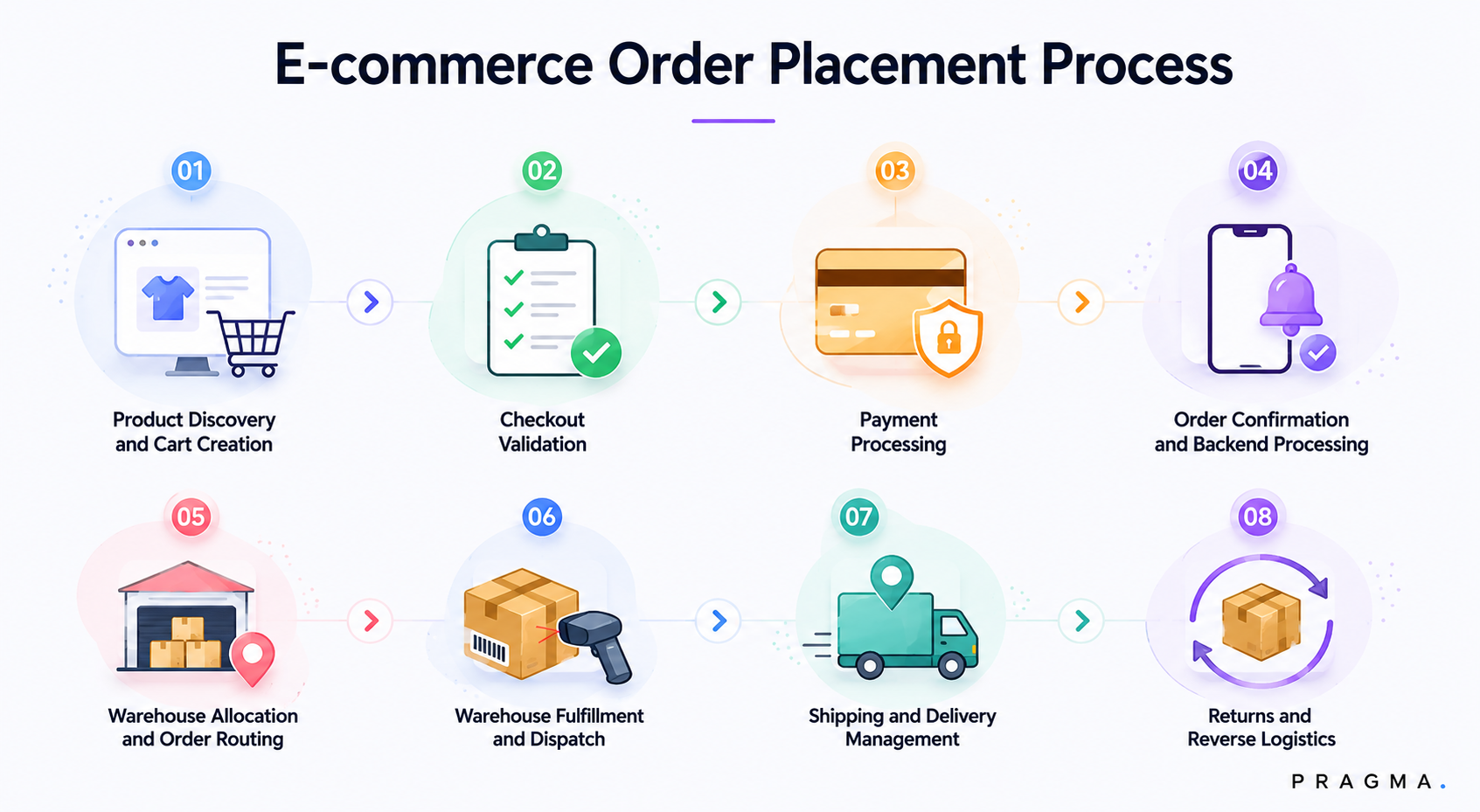
The e-commerce order placement workflow moves through several operational stages.
Product Discovery and Cart Creation
The process begins when customers visit the e-commerce store through various channels such as Meta ads, Google Shopping, WhatsApp marketing, organic search, or direct website visits.
Customers browse products, check pricing, read reviews, and add products to the cart.
At this stage, e-commerce platforms collect important data, including:
- Product SKUs
- Product variants
- Cart quantity
- Customer location
- Device type
- Coupon usage
- Shopping behaviour
This stage significantly affects conversion rates.
If product pages load slowly, inventory updates lag, or any other issues occur. The customers will leave before reaching checkout.
Research by Baymard Institute shows that the cart abandonment rates in India is 70.19%.
1Checkout by Pragma helps brands optimise checkouts through faster checkout flows, mobile-first architecture, simplified customer input fields, and address autofill functionality.
Checkout Validation
Once customers proceed to checkout, systems validate inventory availability, including:
- Reserved inventory
- Marketplace allocation
- Real-time inventory sync
- Product availability across locations
Inventory mismatch remains one of the largest operational issues for e-commerce brands.
After inventory validation, the system verifies customer addresses and delivery serviceability.
This process becomes especially important in India because courier coverage varies significantly across regions and pincodes.
The platform validates:
- Pincode accuracy
- Delivery availability
- Courier serviceability
- Delivery SLA
- Restricted zones
The system also evaluates COD eligibility.
COD still contributes nearly 60% of e-commerce orders across many Tier-2 and Tier-3 regions in India, according to multiple industry reports.
Higher COD dependency increases RTO risk because delivery refusals, fake orders, and unreachable customers become more common.
Pragma RTO Suite helps brands reduce this risk through COD verification systems, behavioural intelligence, address validation, and automated NDR workflows.
Payment Processing
Once validation completes, the payment system processes the transaction.
Customers now expect flexible payment options, including:
- UPI
- Credit cards
- Debit cards
- Wallets
- Net banking
- COD
- Buy Now Pay Later
Payment success rate directly affects revenue generation. Any payment friction at this stage creates immediate revenue loss.
Indian e-commerce brands frequently face issues such as:
- Payment gateway timeout
- OTP delays
- UPI transaction failures
- Bank-side declines
- Slow payment redirects
Research shows that identified payment failures are one of the largest contributors to cart abandonment in India.
Order Confirmation and Backend Processing
After successful payment, the e-commerce platform officially creates the order.
Customers expect immediate confirmation after placing orders. Delayed confirmation messages often increase customer anxiety and support tickets.
Brands therefore automate communication across multiple channels, including email, SMS, and WhatsApp.
Pragma WhatsApp Business Suite helps brands automate:
- Order confirmations
- Tracking notifications
- Delivery reminders
- COD reminders
- Support conversations
Warehouse Allocation and Order Routing
After order confirmation, the order management system determines where the order should ship from.
This process becomes more complex for D2C brands operating multi-warehouse fulfilment networks.
The OMS evaluates:
- Inventory availability
- Customer location
- Delivery timelines
- Shipping cost
- Courier partner performance
- Warehouse processing capacity
For example, a customer from Bengaluru orders products from a D2C nutrition brand.
The system evaluates whether fulfilment should happen from which warehouse.
Pragma ShipAxis helps brands automate shipment routing and courier allocation using operational intelligence and delivery performance data.
Warehouse Fulfilment and Dispatch
The e-commerce order fulfilment process officially begins once warehouse systems receive the fulfilment request.
Warehouse teams start picking operations by locating products from storage shelves.
Barcode scanning systems help reduce picking errors and improve accuracy.
Incorrect picking creates multiple downstream issues, including:
- Wrong product delivery
- Exchange requests
- Refund costs
- Customer dissatisfaction
After verification, warehouse teams package the products and generate shipping labels.
Shipping and Delivery Management
Once the shipment leaves the warehouse, the logistics workflow begins.
Modern e-commerce customers actively track shipment movement after placing orders.
Research shows 88% of customers track orders after purchase.
Brands, therefore, have to provide real-time shipment visibility and proactive communication.
Customers expect updates for:
- Shipment pickup
- Transit movement
- Out-for-delivery status
- Delivery attempts
- Final delivery confirmation
Poor tracking and communication increase WISMO support tickets.
WISMO stands for "Where Is My Order."
Pragma WhatsApp Business Suite helps reduce this issue through automated shipment notifications and proactive customer communication.
Returns and Reverse Logistics
The e-commerce lifecycle does not end after delivery. After it, customers may request:
- Product returns
- Exchanges
- Refunds
- Replacements
Poor reverse logistics systems create:
- Delayed refunds
- Inventory loss
- Customer dissatisfaction
- Higher operational cost
Pragma Return Management System helps brands centralise returns management through automated workflows for return approvals.
E-commerce Order Management Process Flow
The e-commerce order management process flow connects all operational systems into one coordinated workflow.
The flow starts with customer checkout and continues until delivery completion or returns closure.
The typical e-commerce order management process flow includes:
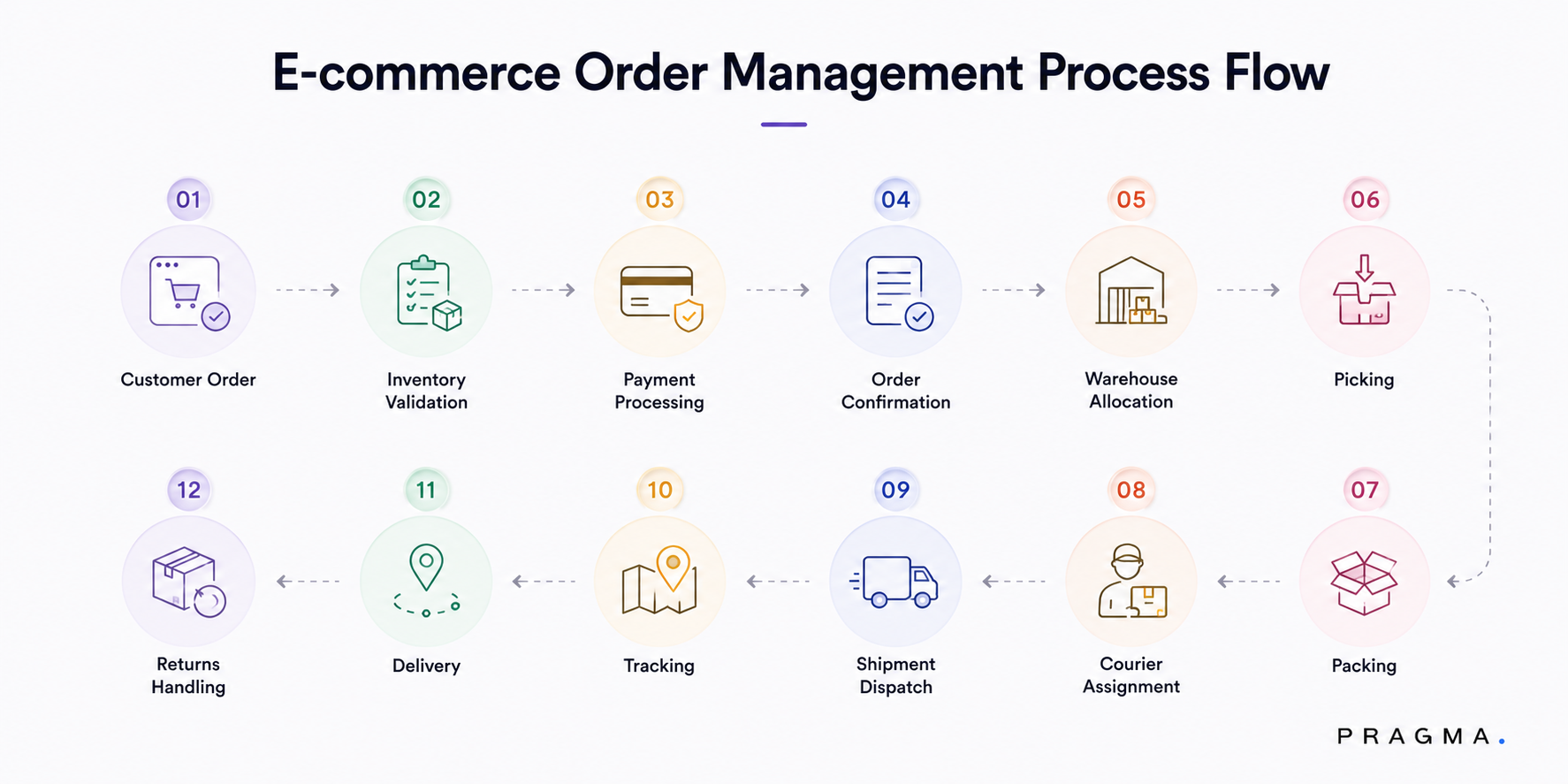
Each stage depends heavily on accurate data movement between systems.
Any disconnected systems can create operational inefficiencies, such as:
- Duplicate inventory updates
- Delayed fulfilment
- Incorrect tracking data
- Order cancellations
- Manual intervention
- Support escalations
Pragma Omnichannel CRM helps brands centralise customer communication across channels, while Pragma JMS helps track and optimise post-purchase customer journeys.
E-commerce Order Fulfilment Process
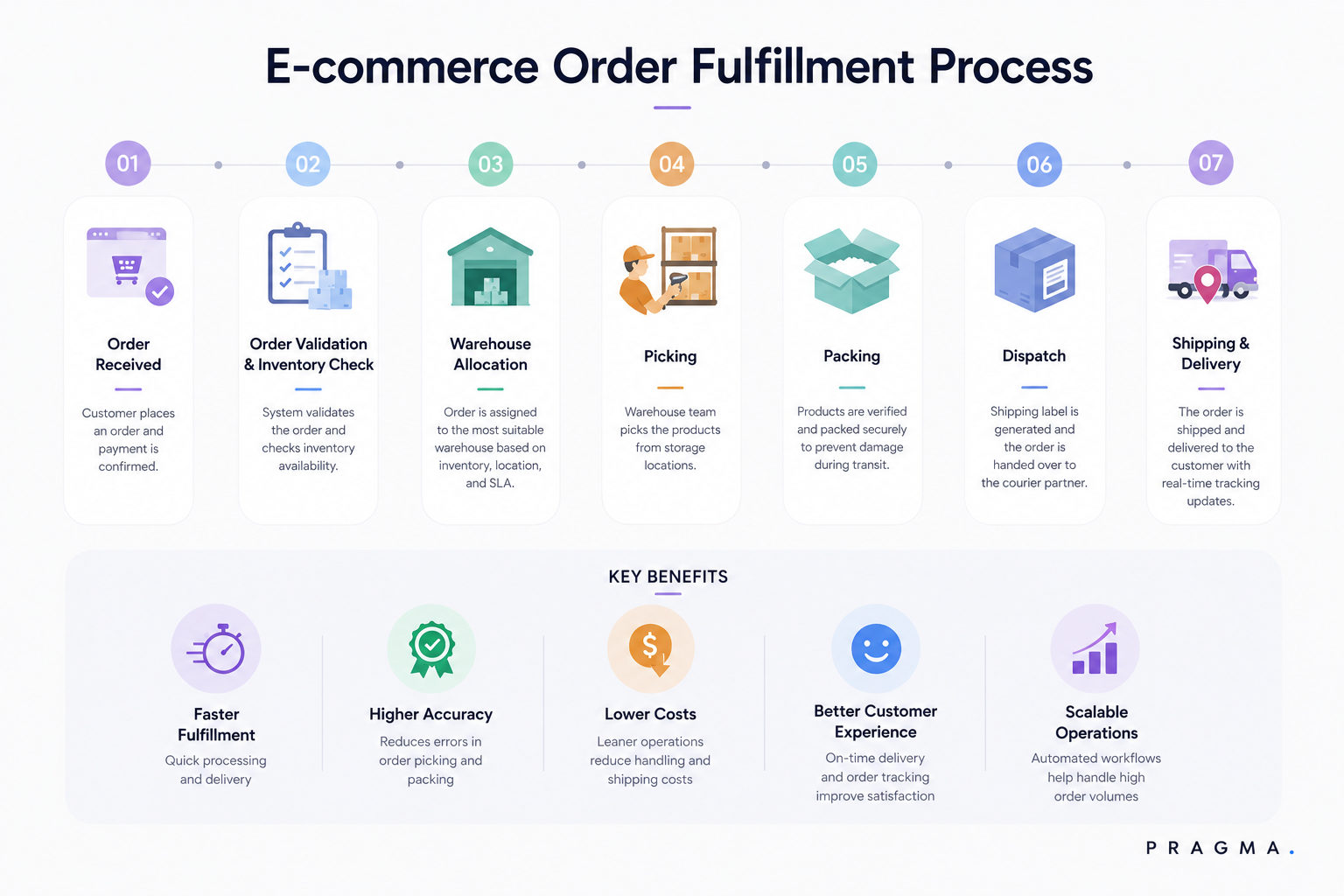
The e-commerce order fulfilment process refers to the operational execution stage after order confirmation.
This process determines how efficiently products move from warehouses to customers.
Efficient fulfilment improves:
- Delivery speed
- Customer satisfaction
- Repeat purchases
- Operational efficiency
Poor fulfilment increases:
- Delivery delays
- RTO losses
- Refund requests
- Customer complaints
Modern e-commerce fulfilment depends heavily on automation.
Brands increasingly automate:
- Inventory allocation
- Picking workflows
- Shipping assignment
- NDR handling
- Delivery communication
NDR( Non-Delivery Report) events occur when delivery attempts fail due to customer unavailability, incorrect addresses, unreachable phone numbers, or refusal to accept COD shipments.
Pragma RTO Suite helps brands automate NDR resolution workflows and reduce failed delivery losses.
Key Components of E-commerce Order Placement System
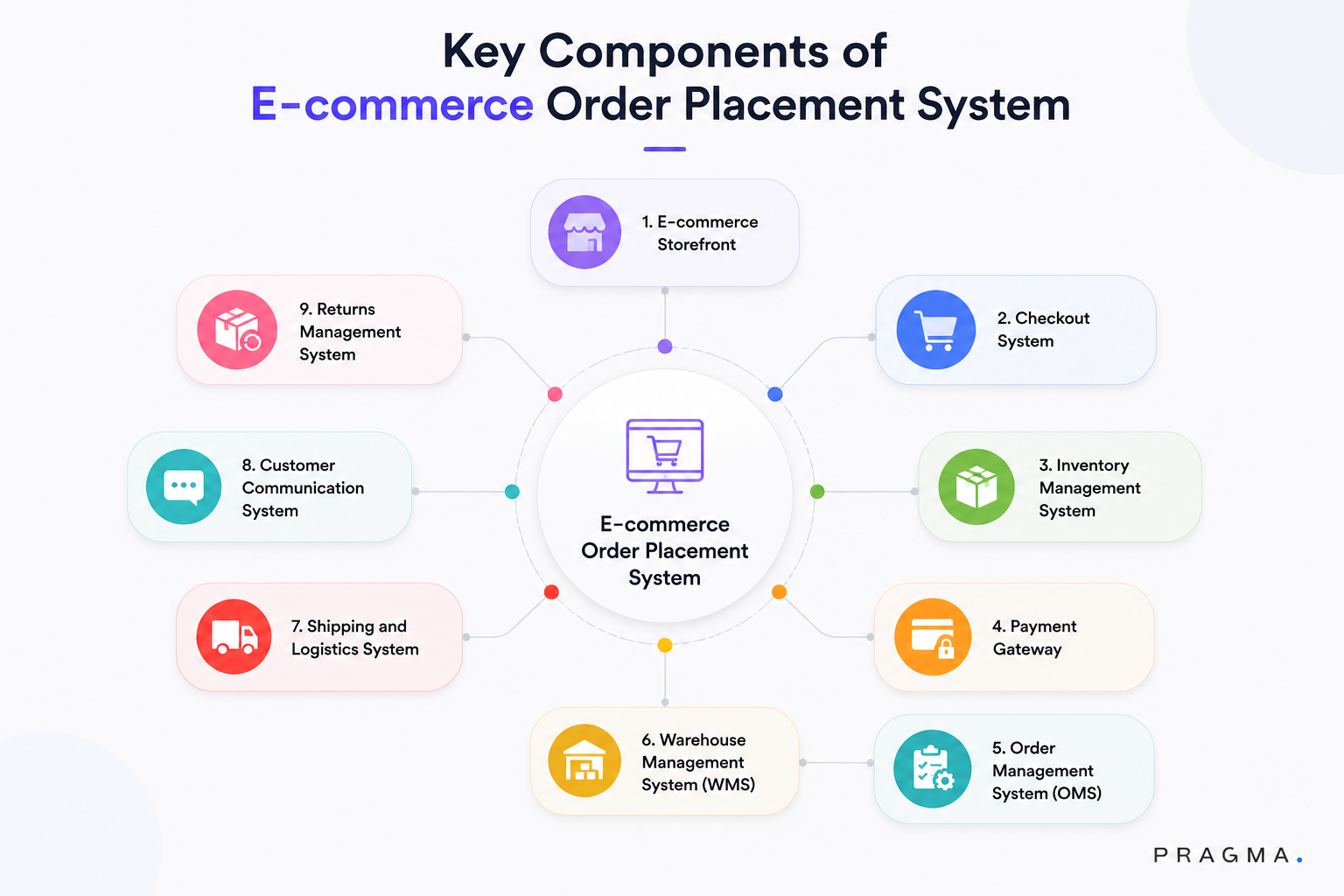
An e-commerce order placement system includes multiple connected technologies that help D2C brands process, manage, fulfil, and deliver customer orders efficiently.
Here are the major components of the e-commerce order placement system:
E-commerce Storefront
The storefront is where customers browse products, add items to the cart, and start the checkout process.
A fast and mobile-friendly website improves user experience and reduces cart abandonment.
Checkout System
The checkout system handles:
- Customer address collection
- Shipping selection
- Coupon validation
- Payment processing
- Order confirmation
A smooth checkout process improves conversion rates and reduces abandoned carts.
Inventory Management System
This system tracks stock across warehouses, marketplaces, and e-commerce stores.
Real-time inventory visibility helps prevent overselling, stock mismatch, and cancelled orders.
Payment Gateway
The payment gateway processes transactions through methods such as:
- UPI
- Credit cards
- Debit cards
- Wallets
- Net banking
- COD
Order Management System (OMS)
The OMS manages backend order workflows, including:
- Inventory allocation
- Warehouse assignment
- Order routing
- Shipment creation
- Fulfilment tracking
This helps brands manage orders efficiently across multiple sales channels.
Warehouse Management System (WMS)
The WMS controls warehouse operations such as:
- Picking
- Packing
- Barcode scanning
- Inventory movement
- Dispatch management
Efficient warehouse operations improve fulfilment speed and order accuracy.
Shipping and Logistics System
This system manages:
- Courier allocation
- Shipping labels
- Shipment tracking
- Delivery coordination
- Reverse logistics
Efficient logistics systems improve delivery timelines and reduce shipping issues.
Customer Communication System
This system sends customer updates, including:
- Order confirmations
- Tracking notifications
- Delivery alerts
- Return updates
Proactive communication improves customer trust and reduces support tickets.
Returns Management System
The returns management system handles:
- Return requests
- Reverse pickups
- Refund processing
- Product exchanges
Efficient returns management improves customer satisfaction and retention.
What are the Common Challenges in E-commerce Order Placement?
D2C brands face several operational challenges during e-commerce order processing. Here are the following:
- Cart abandonment remains one of the largest revenue leakages in e-commerce.
- Slow checkout flows, payment failures, forced account creation, and poor mobile optimisation increase abandonment rates significantly.
- Inventory mismatch creates cancellations and refund issues.
- COD dependency increases RTO losses.
- Multi-channel selling creates operational complexity across inventory and fulfilment systems.
- Poor tracking and communication increase support workload.
And the good news is that with Pragma, brands can tackle all these challenges easily.
How to Optimise E-commerce Order Placement?
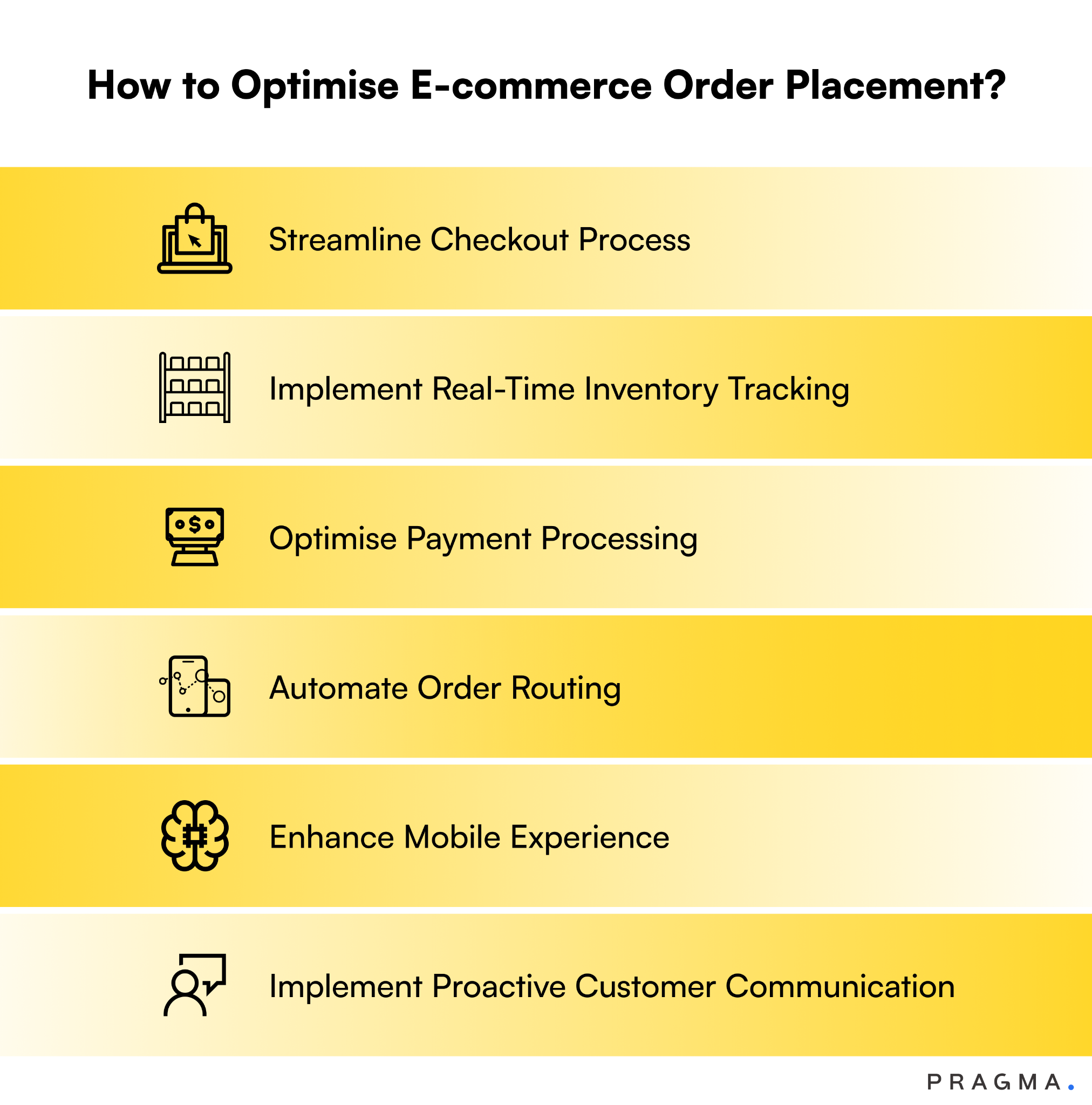
By following the given points, brands can optimise their e-commerce order placement:
Streamline Checkout Process
Every brand should focus on easy checkouts.
- They should reduce form fields to essential information only.
- Guest checkout options should be given to new users.
- The system should have auto-fill capabilities and speed completion for returning customers.
1Checkout by Pragma reduces checkout steps from an average of 7 to 3 and completes the checkout within just 5 seconds.
Implement Real-Time Inventory Tracking
When inventory sync gets delayed, brands oversell products across marketplaces and D2C storefronts.
Real-time stock visibility helps prevent cancellations and customer dissatisfaction.
Brands should display accurate availability information on product pages. This will prevent brands from overselling or causing a shortage of the products.
Optimise Payment Processing
Indian e-commerce brands should offer multiple payment methods, including digital wallets and buy-now-pay-later options.
1Checkout by Pragma supports various payment methods and uses machine learning to optimise payment routing.
Automate Order Routing
Configure rules for routing orders to optimal fulfilment locations based on inventory availability and shipping costs.
Pragma ShipAxis uses intelligent algorithms to route orders based on inventory levels, shipping costs, delivery timeframes, and customer location.
The system automatically reroutes orders when primary fulfilment centres experience stockouts or capacity constraints.
Enhance Mobile Experience
Mobile commerce accounts for 68% of D2C sales.
Therefore, e-commerce brands should optimise checkout forms for mobile devices and implement one-click purchasing options.
With this, they can increase their conversion rates and reduce cart abandonments.
Implement Proactive Customer Communication
Brands should keep their customers informed throughout the order process with automated updates and proactive support.
Pragma orchestrates multi-channel communication. The system keeps customers informed at every stage.
The system sends order confirmations, shipping updates, and delivery notifications while handling common inquiries automatically through Pragma WhatsApp Business Suite.
Impact of Efficient Order Placement on E-commerce
Here is how effective e-commerce order placement and management help e-commerce brands:
Revenue Growth
Efficient checkout processes significantly improve conversion rates.
According to Shopify data, optimised checkout experiences increase conversion rates by 35.26%.
Reduced cart abandonment directly helps brands to recover lost revenue and improve sales performance.
Fast checkout, fewer payment failures, and smoother mobile experiences help customers complete purchases faster.
Customer Satisfaction Improvement
Fast and accurate order processing improves customer satisfaction.
Customers expect:
- Quick order confirmation
- Real-time tracking
- Faster delivery
- Accurate fulfilment
Research shows that satisfied customers spend 140% more compared to dissatisfied customers.
Operational Cost Reduction
Manual order processing increases operational workload and fulfilment errors.
Automated order workflows reduce dependency on manual intervention across inventory allocation, shipping, and warehouse operations.
Research shows automated order processing reduces labour costs by 43%.
Inventory Optimisation
Real-time inventory visibility improves stock management across warehouses and sales channels.
Efficient inventory systems help brands:
- Prevent overselling
- Reduce cancellations
- Improve stock planning
- Lower inventory holding costs
According to industry data, real-time inventory tracking reduces carrying costs by 23% while maintaining 98% stock availability rates.
Higher Customer Lifetime Value
Smooth order experiences increase customer retention and repeat purchases.
Customers are more likely to reorder from brands that provide:
- Faster checkout
- Accurate delivery timelines
- Hassle-free returns
- Better communication
Research shows efficient order experiences increase repeat purchase rates by 67%.
E-commerce Order Placement Example
Let us take an example of a D2C beauty brand running Instagram campaigns during a festive sale.
A customer clicks an ad, which redirects to the Shopify website.
The customer adds products to the cart and proceeds through 1Checkout by Pragma.The system validates inventory, serviceability, and payment information.
The OMS allocates inventory from the nearest warehouse.
Pragma ShipAxis assigns the courier partner based on delivery performance and cost optimisation.
The warehouse dispatches the shipment.
Pragma WhatsApp Business Suite sends automated tracking notifications.
If the customer later requests an exchange, Pragma RMS manages the reverse logistics workflow.
And the results they got:
- Increase in successful order completion
- Reduction in customer service workload
- Monthly revenue recovery from reduced abandonment
What is The Future of E-commerce Order Placement?
E-commerce order placement systems continue evolving toward automation, predictive intelligence, and real-time fulfilment visibility.
AI now supports every major thing, including:
- Delivery prediction
- Courier optimisation
- Fraud detection
- Inventory forecasting
- Customer communication
WhatsApp commerce also continues expanding rapidly across India.
Customers increasingly expect conversational shopping experiences along with real-time support inside messaging platforms.
At the same time, quick commerce companies continue to reshape customer expectations around fulfilment speed.
Amazon and other e-commerce players continue investing heavily in ultra-fast delivery infrastructure globally.
Customer expectations for speed, convenience, and visibility will continue increasing across e-commerce.
Final Thoughts
Thus, we are clear that e-commerce order placement affects every operational layer inside a D2C business.
A weak system creates checkout abandonment, delayed fulfilment, higher RTO, inventory issues, rising support costs, and poor customer experience.
That is why modern D2C brands need connected infrastructure.
To provide that Pragma D2C operating system helps brands streamline the complete e-commerce order lifecycle through checkout optimisation, shipping automation, RTO reduction, WhatsApp communication, AI-powered operational insights, and returns management systems.

FAQs (Frequently Asked Questions On E-commerce Order Placement: Process, Flow & Fulfilment Guide)
1. What is order placement in eCommerce?
Order placement in eCommerce is the process where a customer confirms a purchase by completing checkout, selecting payment and delivery options, and successfully submitting the order to the seller.
2. How does the eCommerce order placement process work?
The eCommerce order placement process typically includes product selection, cart review, checkout, address and payment confirmation, order verification, and transmission of the order to fulfilment systems.
3. Why is the order placement process important in eCommerce?
The order placement process is important because it directly impacts conversion rates, payment success, fulfilment accuracy, customer experience, and the likelihood of successful delivery.
4. What happens after an order is placed in eCommerce?
After an order is placed, the system processes payment confirmation, verifies order details, updates inventory, initiates fulfilment, assigns logistics partners, and sends order confirmation and tracking updates to the customer.
5. What are the common challenges in eCommerce order placement?
Common challenges include checkout friction, payment failures, incorrect addresses, COD-related risks, inventory mismatches, and delays in order confirmation or fulfilment.
6. How can eCommerce brands optimise the order placement process?
Brands can optimise the process by simplifying checkout, reducing form fields, enabling address validation, offering multiple payment options, automating verification workflows, and improving page speed.
7. How does checkout optimisation improve order placement success?
Checkout optimisation improves order placement success by reducing friction, increasing payment completion rates, improving user experience, and minimising drop-offs during the final purchase stage.
8. What role does automation play in eCommerce order fulfilment?
Automation helps streamline order routing, inventory updates, shipping allocation, customer notifications, and post-order workflows, improving fulfilment speed and operational efficiency.
9. What tools are used to manage eCommerce order placement and fulfilment?
Tools include checkout systems, order management platforms, logistics software, CRM tools, payment gateways, automation systems, and customer communication platforms.
10. Why is accurate order data important in eCommerce fulfilment?
Accurate order data is essential because incorrect customer, address, or payment information can lead to failed deliveries, higher RTO rates, operational inefficiencies, and poor customer experience.
Talk to our experts for a customised solution that can maximise your sales funnel
Book a demo

.png)