

The Indian e-commerce industry is transforming massively. According to the Indian Brand Equity Foundation (IBEF), it is increasing at a rate of 15% CAGR and is projected to reach $350 billion by the year 2030.
To be successful in this competitive market, the e-commerce owners spend a lot on building aesthetic websites, showcasing their product catalogues, and making a lot of marketing efforts.
But do you think it is enough only to do these things?
The answer is No!
The real success of any e-commerce business totally depends on the fact that the customer should be satisfied. And this depends on the logistics operations that make every sale successful, if done right.
But in the real market, every e-commerce business faces various challenges that make it difficult for them to handle. In this blog, we will discuss the” Top E-commerce Logistics Challenges and How to Overcome Them.”
What Is E-commerce Logistics and Why Is It Crucial for Online Success?
E-commerce Logistics simply refers to the process of getting the products from the warehouse to deliver them to the customer. It includes storing, managing, and delivering products that customers buy online.
Key Components of E-Commerce Logistics
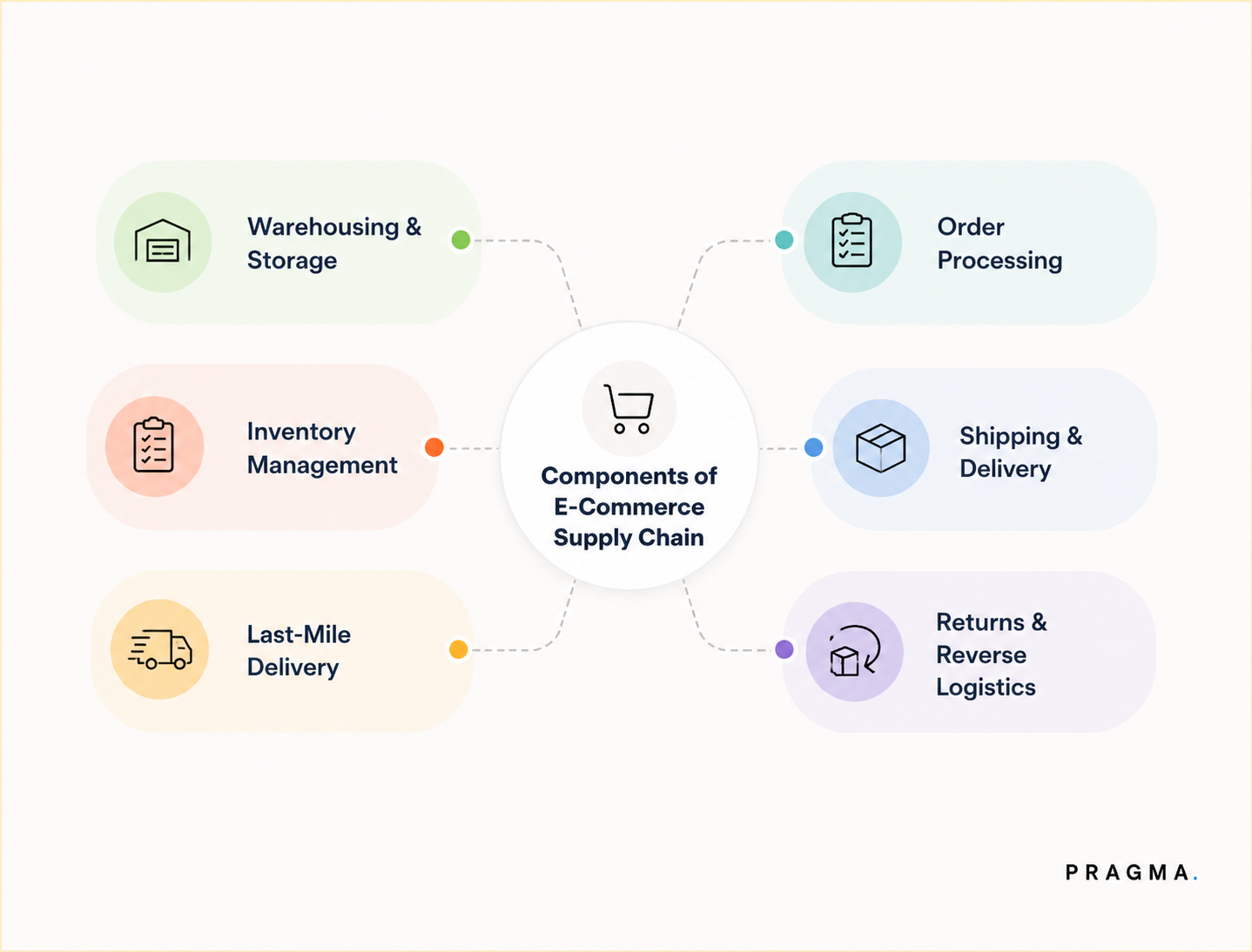
Have a look at the following components that comprise e-commerce logistics:
- Warehousing & Storage
- Inventory Management
- Order Processing
- Shipping & Delivery
- Last-Mile Delivery
- Returns & Reverse Logistics
Why Logistics Matters for E-commerce Businesses?
In today's 2025, e-commerce logistics is a very important thing that every business should take care of seriously. Here is why it is crucial than ever before:
Customer Expectations Become High
Nowadays, the customer is pretty much aware of all things. A recent study found that 67% of Indian online shoppers expect delivery within 2 days, and 89% want to track their orders in real-time.
When a customer places an order, they keep tracking it regularly, which is where their order is and when it will be delivered to them. This customer behaviour makes it important for every brand to keep the right status of their order in transit.
Not only this, the big brands like Amazon, Myntra provide one or two days delivery, which becomes a challenge for smaller e-commerce brands to cope with.
Too Much Competition in the Market
In the market, where thousands of brands are dealing in the same business, it becomes a challenge for every business to be smarter than the others. If you are providing a 5-day delivery and another brand is giving the product in 2 days, then the customer will definitely move to them.
Thus, to compete with others, it is must that every business organisation must do proper logistics so that every order reaches a customer within the given time frame with no delays.
Direct Impact on Business Metrics
Logistics in e-commerce is a crucial aspect, and it directly determines whether the business will win or not. Poor logistics management can lead to the following consequences:
- 58% of customers won't return to a brand after they have had a poor delivery experience.
- Failed deliveries and returns can consume up to 15% of revenue.
- Long delivery times cause 47% of cart abandonments.
Key Challenges in E-commerce Logistics (India 2026)
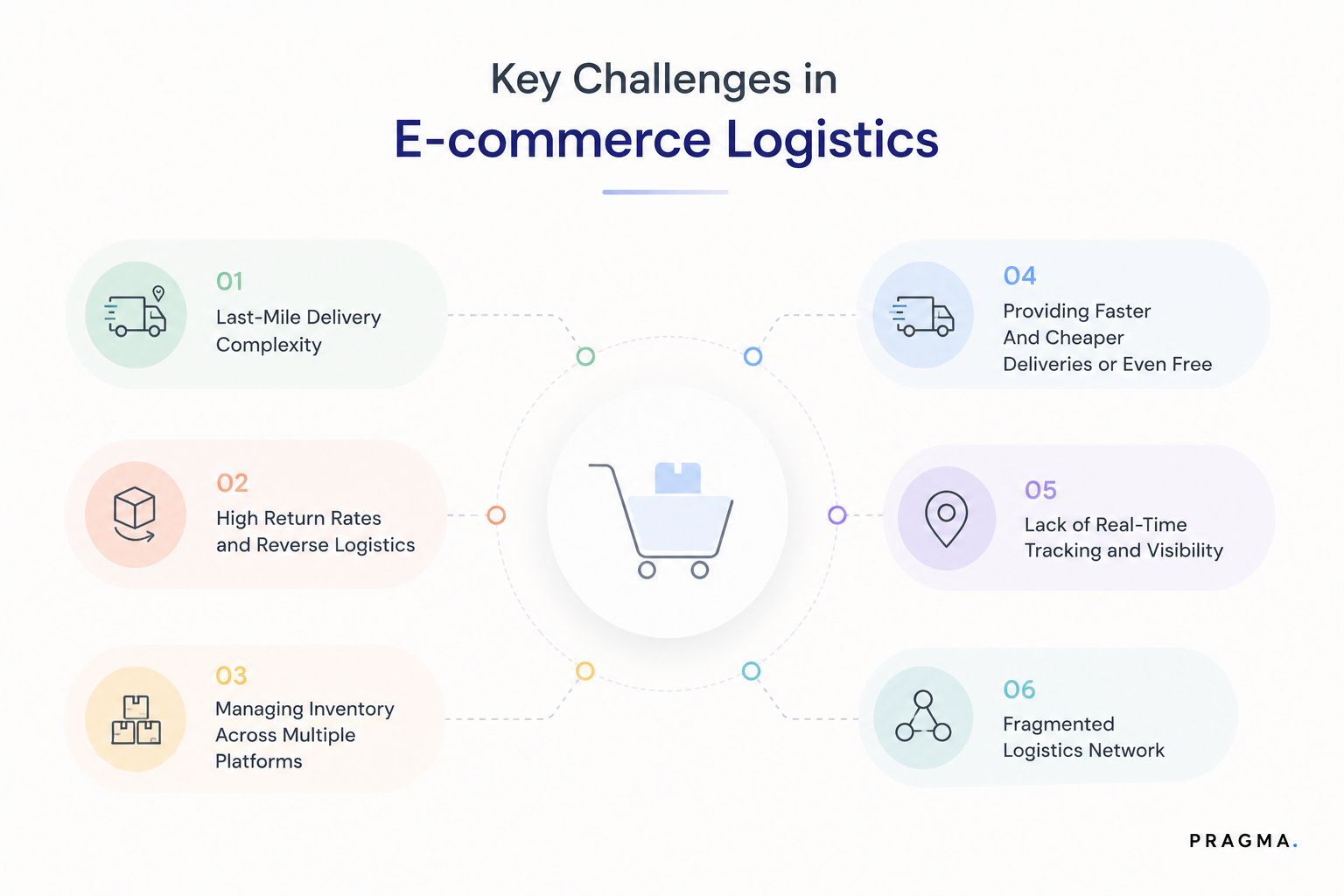
We have studied data for more than 1000+ D2C brands, and what we have seen is that these are the major e-commerce logistics challenges that they face frequently:
1. Last-Mile Delivery Complexity
Last-mile delivery is the final step of fulfilling the customer’s order. It is about getting the package from the last local hub or delivery centre and delivering it to the customer’s doorstep.
This process really sounds very easy, but it is not in reality. You may know that this single step costs brands almost 53% of the total shipping costs.
And in countries like India, it is very difficult to handle this e-commerce logistics challenge because of the Indian customer behaviour and infrastructure challenges. Many times, we see that at the time of delivery, either the customer is not available or they simply refuse to take the package because they have changed their mind.
Research by logistics companies indicates that 31% of first delivery attempts fail because customers aren't available to receive packages.
Not only the customer behaviour, but there are such pin codes in India which are difficult to reach due to the complex infrastructure. Or maybe the customer's address is incomplete or wrong. According to a report, approximately 23% of delivery failures in India are attributed to incomplete or incorrect addresses.
To solve this complex last-mile delivery system, Pragma integrates with over 50 Indian logistics partners, including national carriers like Delhivery, Blue Dart, and Ecom Express. Our system helps to choose the right delivery partner on the basis of different things like cost, past historical data, and geography. And this is how our brands get 15% better delivery success.
2. High Return Rates and Reverse Logistics
Here's a shocking fact!
Indian online stores see 25-30% of their products returned. And you will be shocked to see the fashion stores. They are worse - up to 40% as compared to physical stores, where only 9% of items get returned.
But what are the reasons behind these returns?
- Bad quality products that do not match the customer’s expectations
- Size and fit issues due to the wrong size charts
- The customer changed its mind.
- The packages got damaged in transit before delivery.
- The wrong product was received by the customer.
And maybe even more reasons.
The reasons can be simple, but they cost very much to the businesses. Processing a return costs 2-3 times more than sending the original package. Also, the seller has to pay the reverse logistics costs, which makes returns one of the major logistics challenges in e-commerce.
Even 65% of returned items cannot be resold at full price due to packaging damage or quality concerns.
But Pragma helps brands to reduce their RTO rates by more than 60%. With the Pragma RTO Suite, brands can analyse and detect such orders that are of a risky nature. The system gives a risk assessment score and flags such orders that are fake, made by bots, or made from temporary or wrong addresses.
3. Managing Inventory Across Multiple Platforms
Nowadays, a single business is present on various platforms, such as on their own website, marketplaces such as Amazon, Flipkart, physical stores, or on social media platforms like Facebook and Instagram.
Being on such various platforms made the team juggle everywhere when handling things manually, and can lead to missed deliveries, delays, wrong products shipped, or duplicate orders. And this costs them a lot, making it one of the e-commerce logistics challenges.
To save businesses from this, Pragma, with its omnichannel system, helps brands track all their orders on a single dashboard. It supports sales coming from multiple channels and saves up to 80% of manual efforts. Also, having the data in a single place helps to find fake orders and impulsive buyers.
4. Providing Faster And Cheaper Deliveries or Even Free
Delivering orders faster has become one of the logistics challenges in e-commerce. According to a report, 80% of online shoppers expect same-day or next-day delivery. This became one of the pressures for the teams to process the order faster. To fulfil this, businesses try to incur more costs on premium courier partners, hiring more personnel, and are under pressure all the time, so that delivery should not be late.
Not only this, but customers want free deliveries. In order to provide them with this, businesses have to bear all the logistics costs themselves, and when an order gets rejected by the customer or gets returned, they have to pay the reverse logistics costs too.
Thus, to save brands, our automated return management reduces manual processing costs by 70% and helps brands recover 25% more value from returns through efficient quality checks and processes.
5. Lack of Real-Time Tracking and Visibility
Still in this tech-savvy world, there are businesses that handle all things manually. And with manual efforts, it is impossible to track the parcel status in real-time. This leads to mismanagement and delivery delays.
Also, nowadays, customers want to know where their parcel is. They keep tracking the status of the product. And this real-time visibility is one of the e-commerce logistics challenges in India.
To update customers about their orders, Pragma provides communication support to provide the order status through WhatsApp, SMS, or email to the customer’s registered number.
6. Fragmented Logistics Network
In India, the e-commerce logistics network is highly fragmented, meaning it is made up of many small and independent logistics providers.
Because of this fragmentation:
- Different logistics partners follow different processes, technologies, and service standards.
- There is poor coordination between warehouses, delivery partners, and return handlers.
- Data is scattered across multiple systems, making tracking and control difficult.
This situation for e-commerce companies leads to one of the logistics challenges in e-commerce. It leads to inconsistent delivery performance, delayed deliveries, lost parcels, or even failed deliveries. And when there is so much chaos everywhere, it leads to high costs due to inefficiencies.
How Indian Brands Can Overcome E-commerce Logistics Challenges?
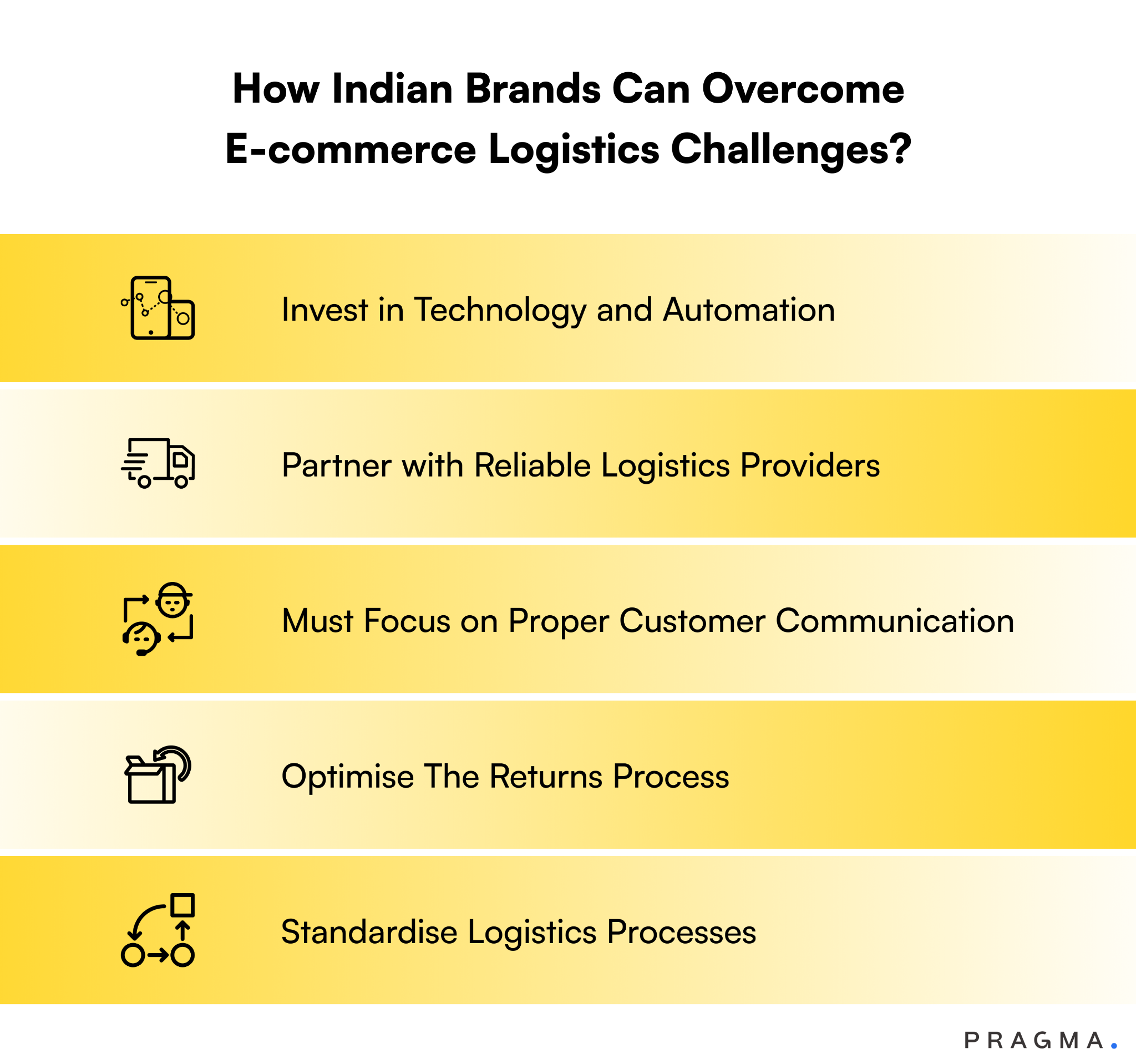
To overcome challenges in e-commerce logistics, brands can adopt the following strategies:
1. Invest in Technology and Automation
As we know that it is difficult for any business to handle everything manually. So, businesses to tackle this can invest in major technological and automation platforms. By using this, they can get:
- Reduces errors by 85%
- Improves inventory accuracy by 40%
- Cuts delivery costs by 15-20%
2. Partner with Reliable Logistics Providers
To handle logistics issues that arise from the side of delivery partners, businesses should ensure that they choose the right delivery partner that offers:
- Local expertise in delivery in different areas
- Handles deliveries well and delivers in proper time
We integrate with 50+ logistics partners across India, automatically selecting the best option for each shipment based on location, cost, and reliability metrics.
3. Must Focus on Proper Customer Communication
To keep the customer updated with their order status, businesses must ensure proper communication with them with the help of WhatsApp, SMS, or email. This will help to reduce the chances of orders being converted into RTOs.
4. Optimise The Returns Process
Since we know that returns are unavoidable but businesses should focus on optimising them. Instead of looking at returns as the challenge, they should treat them as an opportunity to improve. They should make an adopt to make the return policy easy for the customers, so that everything seems easy.
5. Standardise Logistics Processes
Creating clear SOPs (standard operating procedures) for shipping, returns, and handovers ensures consistency across different logistics partners and regions.
Case Study: How an Indian D2C Brand Solved Its Fulfilment Challenges?
A fast-growing fashion D2C brand was struggling with:
- 35% return rate is eating into profits
- Manual return processing takes 7-10 days.
- Customer complaints about unclear return status
They implemented Pragma's Return Management System with:
- Branded return portal matching their website design
- Automated quality check workflows
- Integration with their existing logistics partners
- Real-time customer notifications
And the results are amazing!
- Return processing time has been reduced from 7 days to 2 days.
- Customer satisfaction scores improved by 28%
- Fraudulent returns decreased by 60%
To Wrap It Up
So, to conclude, we want to state that e-commerce logistics challenges will never go away, but when you manage them with the right strategies, they become easy to handle.
e-commerce logistics challenges
With the right tools and systems like Pragma, you can efficiently streamline your operations. Pragma's Return Management System has helped over 450 Indian D2C brands turn their biggest logistics headache, returns, into a competitive advantage.

FAQs (Frequently Asked Questions on Top E-commerce Logistics Challenges and How to Overcome Them)
1. What are the biggest logistics challenges in e-commerce?
The most commonly reported challenges include delayed deliveries, high shipping costs, failed deliveries (RTO), inventory mismatches, courier dependency, and lack of end-to-end visibility across orders.
2. Why is logistics such a major problem for e-commerce brands in India?
India’s logistics complexity is driven by long delivery distances, variable infrastructure quality, COD-heavy orders, Tier-2/3 address inconsistency, and dependence on third-party couriers.
3. How do delivery delays impact e-commerce businesses?
Delivery delays lead to higher cancellations, increased RTO, poor customer reviews, repeat-purchase drop, and additional support workload. Delays also reduce marketplace ratings and brand trust.
4. What causes high Return to Origin (RTO) in logistics?
High RTO is usually caused by incorrect addresses, customer unavailability, COD refusal, delayed despatch, courier inefficiency, and poor NDR handling.
5. How does inventory mismatch become a logistics challenge?
When inventory is not updated in real time across channels and warehouses, brands face overselling, order cancellations, delayed fulfilment, and unnecessary refunds.
6. Why is courier dependency a risk for e-commerce brands?
Relying on a single courier increases exposure to service outages, regional underperformance, rate hikes, and inconsistent delivery success across pincodes.
7. How can e-commerce brands reduce logistics costs?
Brands reduce logistics costs by optimising courier selection by zone, reducing RTO, improving address accuracy, consolidating shipments, and minimising manual intervention in fulfilment.
8. What role does technology play in solving logistics challenges?
Technology enables automation of order routing, inventory sync, courier allocation, tracking, NDR handling, and returns—reducing errors and manual workload.
9. How can logistics challenges be managed during peak sales or festive seasons?
Best practices include pre-buffering inventory, using multiple courier partners, automating warehouse workflows, prioritising prepaid orders, and monitoring real-time fulfilment metrics.
10. How does last-mile delivery affect customer experience?
Last-mile delivery directly influences delivery speed, success rate, and customer satisfaction. Poor last-mile execution leads to failed deliveries, complaints, and negative brand perception.
11. Can better address validation reduce logistics issues?
Yes. Address validation reduces NDRs, delivery delays, and RTO by ensuring accurate pin codes, landmarks, and contact details before dispatch.
12. What KPIs should brands track to monitor logistics performance?
Commonly tracked metrics include:
- On-time delivery rate (OTD)
- RTO percentage
- First-attempt delivery success
- Cost per shipment
- Courier-wise SLA performance
- Average despatch time
Talk to our experts for a customised solution that can maximise your sales funnel
Book a demo

.png)