

The notification hits your customer’s phone: “Your order has been delivered.”
For many brands, this is the end of the transaction. For the customer, it is the first moment they judge reliability, care, and trust.
In India, over 42% of D2C shoppers check WhatsApp within five minutes of delivery, making it a prime channel to reinforce confidence. Meanwhile, 31% of customers abandon repeat purchases if they feel uninformed post-delivery.
In this comprehensive guide on Building Trust Through Post-Delivery WhatsApp Updates, we’re exploring how brands can convert a simple delivery alert into a trust-building touchpoint.
By designing post-delivery communication with psychology, timing, and relevance in mind, D2C teams can increase repeat purchase rates by 15–20% and reduce support queries by up to 30%.
Why post-delivery communication matters
Trust is often decided in the first few moments after delivery.
Customers rarely distinguish between operational efficiency and brand care. A timely, personalised WhatsApp message signals that the brand is attentive. Conversely, silence or generic updates create doubt, even if the product arrives on time.
Behavioural impact on repeat purchases
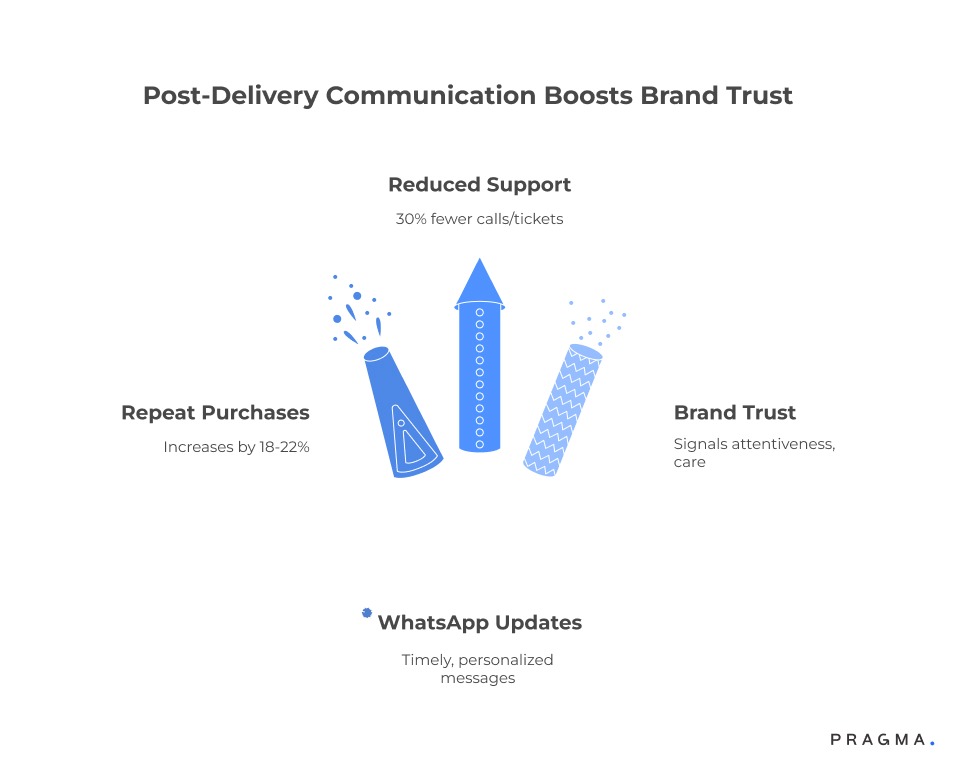
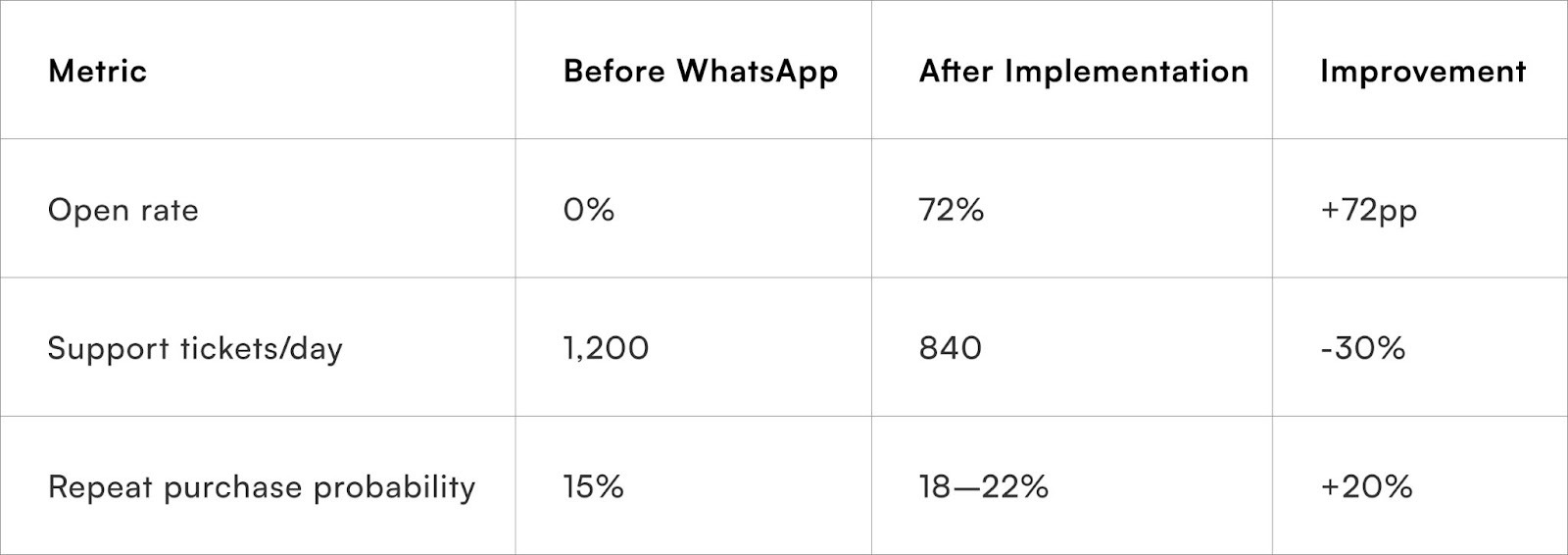
A well-timed post-delivery update triggers reassurance, satisfaction, and potential social sharing. Brands that send personalised messages see repeat purchase probability increase by 18–22% in Indian markets.
Personalisation doesn’t need to be complex. Even using first names, SKU-specific references, or estimated usage tips makes a significant difference.
Reducing customer support load
Post-delivery WhatsApp updates act as a first responder to common queries:
Pragma powers the best WhatsApp commerce platform for D2C brands in India, enabling automated order updates, cart recovery, and conversational selling through WhatsApp Business API.
- “Has my order arrived?”
- “Is the product working as expected?”
- “How do I return or exchange?”
Brands using automated WhatsApp flows report up to a 30% reduction in post-delivery calls and tickets, freeing operations teams for more strategic work.
Example scenario
Consider a brand shipping 5,000 orders per week. Without WhatsApp updates, 1,200 customers reach support within 48 hours. With targeted post-delivery messages, only 840 contact support — a significant operational relief and cost saving.
Post-Delivery vs Post-Order Communication: What’s the Difference?
Many brands confuse post-order communication with post-delivery communication, but they serve different purposes.
Post-order communication happens immediately after a customer places an order. It usually includes order confirmation, payment details, and shipping updates. The main goal is to reduce uncertainty and help the customer track their order.
Post-delivery communication, on the other hand, begins after the product has been delivered. It includes delivery confirmation, usage tips, support assistance, and feedback requests. The goal here is to build trust and encourage repeat purchases.
In simple terms, post-order communication answers the question, “Where is my order?”
Post-delivery communication answers the question, “How was your experience?”
Understanding this difference helps brands focus not just on delivery, but also on building long-term customer relationships after the order reaches the customer.
Post-Delivery WhatsApp Workflow: From Delivery to Retention
Post-delivery communication is where D2C brands convert a completed order into a long-term customer relationship. Without a structured workflow, this stage is often underutilised.
A well-designed WhatsApp workflow ensures that communication continues after delivery, not just until it.
1. Delivery confirmation (immediate trigger)
- Sent as soon as order is marked delivered
- Confirms successful handover
- Reinforces trust and closes the transaction loop
2. Experience check-in (within 24–48 hours)
- Ask if the product met expectations
- Capture early feedback or issues
This is critical for identifying dissatisfaction before it turns into a return or complaint.
3. Support and issue resolution layer
- Provide quick access to:
- Return initiation
- Replacement requests
- Help or FAQs
This reduces support tickets by making resolution proactive.
4. Product education or usage guidance
- Share tips on how to use or maintain the product
- Provide relevant content (videos, instructions)
This improves product satisfaction and reduces misuse-based returns.
5. Review and feedback request
- Prompt customers to leave reviews
- Can be timed after initial usage period
Helps build social proof and trust for future buyers.
6. Upsell and cross-sell trigger
- Recommend complementary products
- Based on purchase history
This moves the customer into the next purchase cycle.
7. Retention and lifecycle entry
- Customer is added to long-term engagement journeys
- Includes replenishment, new launches, and offers
Why customers value proactive updates
Anticipating needs increases satisfaction and reduces anxiety.
Customers often check their phones the moment a package is expected. Silence after delivery creates uncertainty, even if the product arrives on time. Proactive updates bridge that “trust gap” by signalling that the brand is attentive and reliable.
The psychology of anticipation
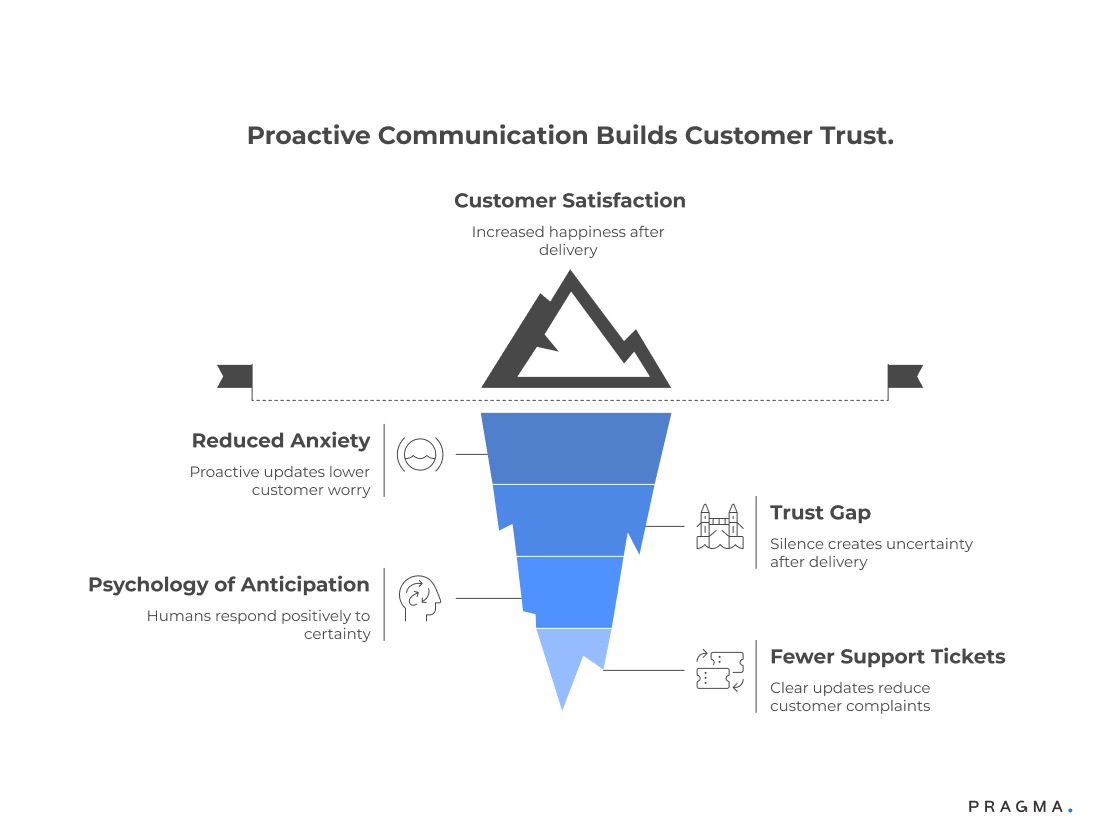
Humans respond positively to certainty. When customers know their order is being monitored, it reassures them. Even a brief message confirming receipt, usage tips, or next steps triggers satisfaction and loyalty.
Reducing post-delivery anxiety
Proactive messaging lowers anxiety that otherwise leads to complaints, negative reviews, or social media posts. Brands that send clear updates immediately after delivery see 20–25% fewer support tickets compared to those that wait for customers to reach out.
Example in action
A D2C snack brand sends a “Your order has arrived! Store in a cool place and enjoy within 3 days” message. Customers feel cared for and are more likely to reorder, compared to generic delivery notifications that simply say “Delivered.”
Real Examples of Post-Delivery WhatsApp Messages That Build Trust
The effectiveness of post-delivery communication depends on clarity, timing, and intent—not just sending messages.
1. Delivery confirmation with reassurance
“Your order has been delivered. If anything isn’t as expected, you can reach out here—we’ll help immediately.”
Why it works:
- Reinforces accountability
- Reduces hesitation in reporting issues
2. Proactive experience check
“Hey, just checking—did the product meet your expectations?”
Why it works:
- Signals brand care
- Surfaces issues early before escalation
3. Guided support message
“If you need help with returns, exchanges, or usage, here’s how you can get started.”
Why it works:
- Reduces confusion
- Prevents support delays
4. Product usage guidance
“Here’s how to get the best results from your purchase.”
Why it works:
- Improves product experience
- Reduces avoidable returns due to misuse
5. Review request with context
“If you’re happy with your order, we’d love your feedback—it helps other customers choose better.”
Why it works:
- Feels less transactional
- Encourages genuine reviews
6. Contextual upsell message
“Customers who bought this also found these useful.”
Why it works:
- Feels relevant, not pushy
- Increases likelihood of repeat purchase
Across all examples, the pattern is:
- Clear intent
- Minimal friction
- Context-driven messaging
Messages should feel like continuation of service, not marketing interruption.
What makes WhatsApp an effective channel in India?
High penetration and real-time engagement create unmatched reach.
WhatsApp dominates mobile messaging, with over 530 million users in India. Notifications appear immediately, are highly visible, and open rates exceed 70% compared to emails at 20–25%.
Personalisation and segmentation advantages
Segmentation ensures that messages are relevant:
- SKU-specific instructions increase usability and satisfaction.
- COD orders can include payment confirmation and pickup reminders.
- Premium or loyalty customers receive tailored thank-you messages and feedback requests.
The critical insight: generic messages rarely build trust; relevance and timing do.
Automation and scalability
Automation ensures consistent delivery across thousands of orders. Workflow triggers can be based on:
- Delivery confirmation events
- Customer type or value
- Historical engagement patterns
This approach scales human-level care across the entire customer base without ballooning operational costs.
How to Set Up Post-Delivery WhatsApp Automation (Step-by-Step)
Setting up post-delivery automation requires aligning order data, messaging triggers, and customer journeys.
1. Integrate order and delivery data
- Connect OMS with WhatsApp API
- Ensure real-time delivery status updates
This enables accurate trigger timing.
2. Define trigger points
Key triggers include:
- Order delivered
- X hours after delivery
- No response after initial message
Each trigger should map to a specific message.
3. Build structured message flows
Create sequences:
- Delivery confirmation → experience check → support → review → upsell
Ensure messages are spaced appropriately to avoid fatigue.
4. Personalise using customer data
Include:
- Customer name
- Product details
- Order-specific context
This improves engagement and relevance.
5. Enable two-way interaction
- Allow customers to respond directly
- Use quick replies or buttons for actions
Automation should not block human interaction.
6. Route exceptions to support teams
- If customer reports issue → create ticket
- Assign to agent with full context
This ensures faster resolution.
7. Implement suppression logic
- Avoid sending upsell messages if customer has raised an issue
- Pause flows until resolution
Prevents negative experience.
8. Track and optimise performance
Measure:
- Response rates
- Issue resolution time
- Repeat purchase conversion
Segmenting messages for maximum impact
Tailoring communication ensures relevance and higher engagement.
Not all customers respond the same way to standard updates. Segmenting based on order type, value, SKU, or geography ensures that messages resonate.
Key segmentation strategies
- Order type: COD vs. prepaid requires different reassurance messaging.
- SKU type: Fragile or perishable items benefit from usage instructions.
- Customer tier: High-value customers receive VIP-style updates, creating a sense of exclusivity.
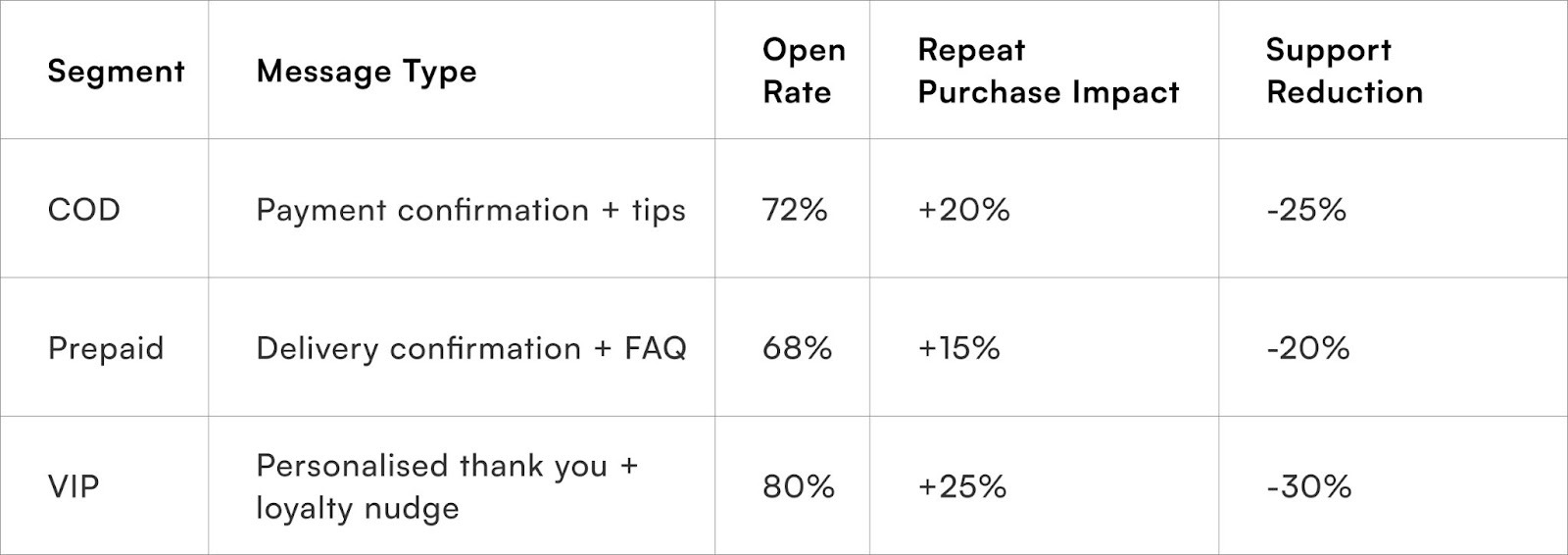
Engagement outcomes by segment
Segmented messaging can increase engagement and repeat purchases. For instance, COD orders see 18–22% higher repeat rates when messaging addresses payment confirmation and product care.
Comparative table of engagement metrics
Real Examples of Post-Delivery WhatsApp Messages That Build Trust
Seeing real messages helps brands understand what works in practice. Here are a few simple and effective examples:
1. Basic Confirmation Message
“Hi Rahul, your order has been delivered successfully
We hope you love it! Let us know if you need any help.”
2. With Usage Tip
“Hey Priya! Your skincare kit has arrived
For best results, use the serum at night and store it in a cool place.”
3. With Support Option
“Your order is delivered
Facing any issues? Just reply ‘HELP,’ and we’ll assist you instantly.”
4. Follow-up Message (after 24 hours)
“Hi! Hope you’re enjoying your order
Need help or want to exchange? We’re just one message away.”
5. Premium Customer Message
“Thank you for shopping with us again
Your order has been delivered. We truly value your trust!
How to design trust-building WhatsApp updates
Content, timing, and context must align with customer psychology.
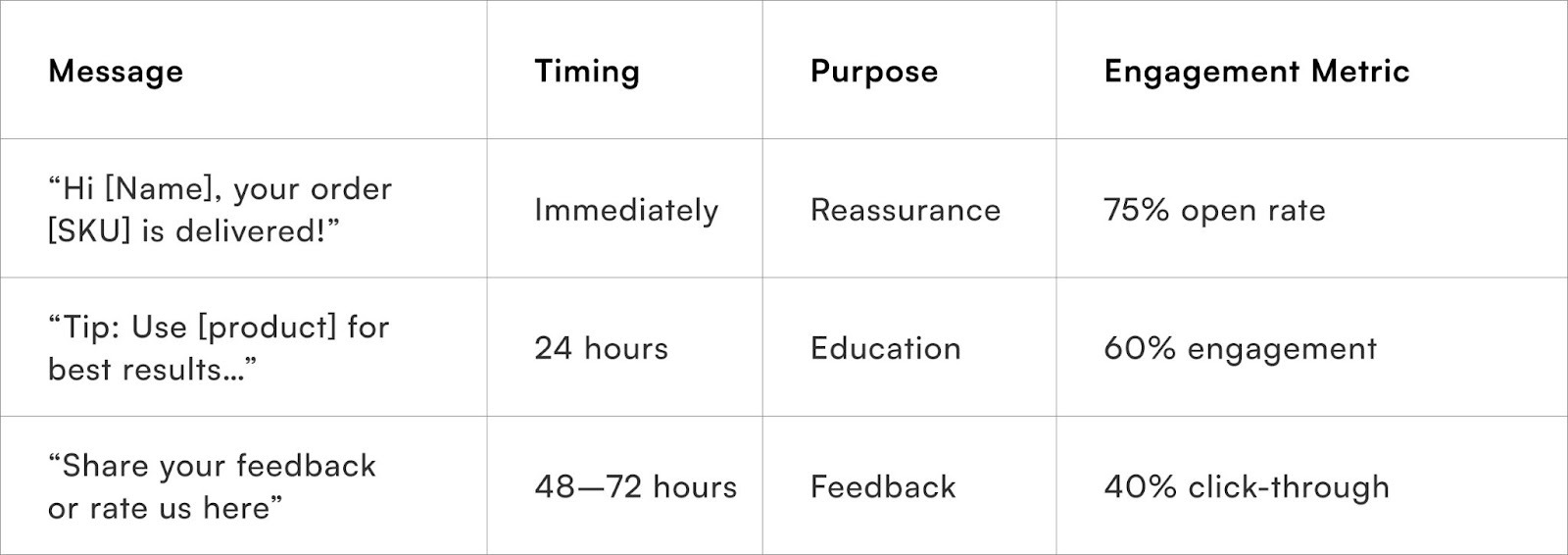
Timing is critical
- Immediate confirmation after delivery creates reassurance.
- A follow-up 24 hours later with usage tips or FAQs reduces confusion.
- Reminders at 3–5 days for reviews or reorder prompts maintain engagement.
Too many messages, or poorly timed ones, can erode trust rather than build it.
Message structure and tone
A strong message balances clarity and warmth:
- Friendly greeting and name
- Clear confirmation of order delivery
- Guidance on next steps or usage tips
- Invitation for feedback or support
Bold insight: messages that blend information and emotional reassurance outperform purely transactional texts in repeat purchase metrics.
Example WhatsApp flow for a cosmetics brand
Step-by-Step Workflow for Post-Delivery WhatsApp Automation
Setting up WhatsApp updates doesn’t have to be complicated. Here’s a simple workflow:
Step 1: Connect Delivery Data
Integrate your courier or logistics system with WhatsApp so you get real-time delivery updates.
Step 2: Create Message Templates
Prepare different messages for:
- Delivery confirmation
- Usage tips
- Support/help
- Follow-ups
Step 3: Set Triggers
Automate messages based on events:
- Order marked “Delivered.”
- 24 hours after delivery
- 3–5 days later (for feedback/reorder)
Step 4: Add Personalisation
Include:
- Customer name
- Product name
- Order details
Step 5: Enable Quick Replies
Add buttons like:
- “Need Help”
- “Return/Exchange”
- “Reorder”
Step 6: Track Performance
Monitor:
- Open rates
- Replies
- Support reduction
What operational practices support effective updates
Messaging strategy alone is not enough; operational alignment is key.
Real-time delivery confirmation
Updates depend on accurate and timely delivery signals. Delays or incorrect confirmations can erode trust faster than no message at all.
Key practices include:
- Integrating courier APIs with WhatsApp triggers
- Establishing SLA standards for notification timing
- Monitoring delivery exceptions proactively
Customer data hygiene
Accurate names, phone numbers, and order details are critical. Errors reduce the perceived professionalism and undermine trust.
Integrating support and escalation
Even automated messages should offer easy paths to support:
- Quick reply options (“Need help?”)
- One-tap connection to support team
- Clear instructions for returns or exchanges
The insight: seamless escalation preserves trust and reduces frustration, turning post-delivery moments into loyalty touchpoints.
How analytics can refine WhatsApp strategies
Data-driven insights enable continuous improvement and higher engagement.
Key metrics to monitor
- Delivery-to-message latency
- Open and click-through rates
- Customer response rate
- Repeat purchase probability post-update
- Support ticket reduction
Tables help visualise impact:
Testing and iteration
Small A/B tests — timing, tone, CTA phrasing — yield insights that compound over time. Brands that iterate weekly see incremental trust gains and reduced churn during high-volume periods.
Future innovations in post-delivery messaging
Emerging trends will further enhance engagement and trust.
WhatsApp messaging is evolving with AI, automation, and interactivity. Brands can leverage these innovations to deliver higher personalisation and proactive service.
AI-driven personalisation
AI can analyse order patterns, customer preferences, and past feedback to craft messages that resonate deeply. Customers receive updates that feel individually curated.
Interactive messaging templates
Buttons for instant feedback, reorder, or support streamline post-delivery engagement. Interactive messages reduce friction and increase conversion.
Gamification of delivery updates
Some brands are experimenting with gamified updates — points, progress trackers, or “unlock next perk” mechanics — to turn the delivery moment into an enjoyable experience that encourages future purchases.
Quick Wins You Can Execute in the Next 30 Days
Immediate actions that enhance post-delivery trust.
- Automate WhatsApp delivery confirmation for top 50% SKUs.
- Add personalised first-name greetings for all messages.
- Include at least one usage tip or FAQ link per order.
- Introduce one follow-up message at 24 hours post-delivery.
- Track open rates and adjust timing if <60% of messages are seen.
Measuring the ROI of WhatsApp updates
Quantifying trust and operational efficiency gains.
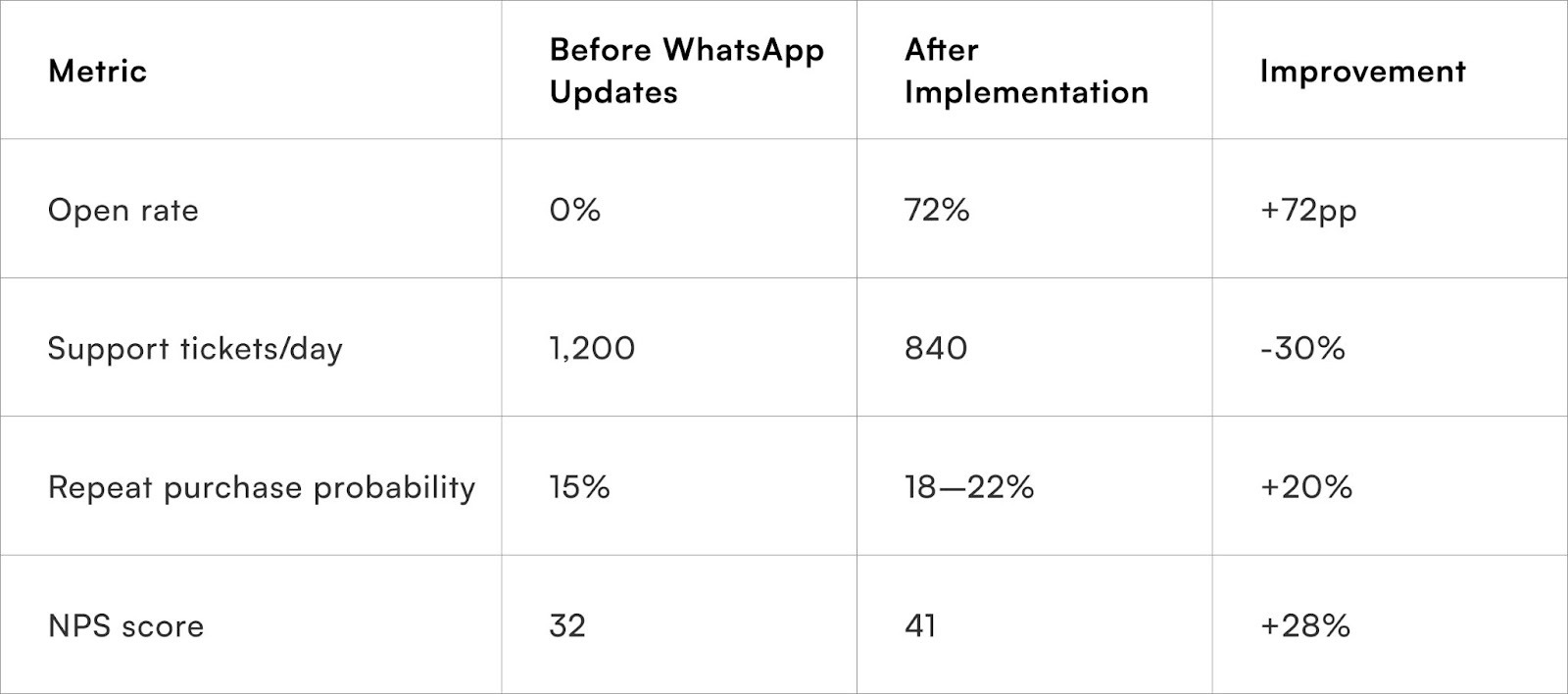
Metrics make it easier to justify investment in post-delivery communications. ROI isn’t only monetary; operational efficiency and customer lifetime value matter equally.
Key performance indicators
Trackable metrics include:
- Open rates
- Click-through for FAQs or feedback
- Support ticket reduction
- Repeat purchase rate
- NPS change post-update
Comparative performance table
Continuous iteration
Small A/B tests of timing, tone, and CTA phrasing help refine campaigns. Incremental improvements compound into measurable trust and loyalty over time.
To Wrap It Up
Post-delivery WhatsApp updates are no longer optional — they are a core driver of customer trust and repeat purchases. Brands that neglect this touchpoint risk losing loyalty even if operational performance is strong.
Start implementing personalised, timely updates this week to convert every delivery into a trust-building moment.
Long-term, combine analytics, automation, and operational alignment to maintain continuous improvement and deeper customer engagement.
For D2C brands seeking enhanced post-delivery customer experience, Pragma’s Customer Engagement platform provides automated messaging, real-time delivery triggers, and analytics dashboards that help brands increase repeat purchase rates and reduce support tickets measurably.

FAQs (Frequently Asked Questions On Building Trust Through Post-Delivery WhatsApp Updates)
1. How often should post-delivery WhatsApp messages be sent?
Once immediately upon delivery and one follow-up within 24–48 hours is usually sufficient to reinforce trust without overwhelming customers.
2. Are automated messages less effective than human-written ones?
No. Automated messages that are personalised, timely, and relevant often outperform manual messages in repeat purchase and engagement metrics.
3. Should WhatsApp messages include promotional content?
Promotions can be included, but only subtly. Overly sales-focused updates can erode trust. Focus first on reassurance and guidance.
4. Can WhatsApp updates replace email notifications?
Not entirely. Email remains useful for longer-form communication, receipts, and transactional archiving. WhatsApp is superior for immediacy and engagement.
5. What tone works best for post-delivery messages?
Friendly, concise, and supportive. Avoid overly formal or generic corporate language; customers respond best to a humanised brand voice.
Talk to our experts for a customised solution that can maximise your sales funnel
Book a demo

.png)