

Most D2C brands in India treat checkout as a static page. Payment options are fixed, shipping promises are generic, and risk is handled downstream through verification calls, retries and returns. This approach looks simple, but it hides a costly assumption: that every customer, cart and pincode deserves the same choices.
Adaptive checkout: showing payment and shipping options by pincode and cart profile argues that checkout should be the first operational decision point, not the last marketing step. Long before an order reaches last mile or customer support, brands already have enough signals to shape behaviour, reduce risk and improve conversion if they choose to use them.
This blog explains how adaptive checkout works in practice for Indian D2C brands. It breaks down what signals matter, how payment and shipping options should change by context, and why this approach reduces RTO, improves fulfilment efficiency and increases realised revenue without adding friction for genuine buyers.
Why static checkout experiences no longer work
Uniform choices ignore uneven risk
India’s ecommerce landscape is deeply heterogeneous. Payment behaviour, delivery reliability and customer intent vary significantly by geography, category and order value. A static checkout assumes uniformity where none exists.
When every customer sees COD, prepaid, express delivery and delayed shipping options regardless of context, brands push decision-making risk downstream. High-risk orders slip through easily, while low-risk customers face unnecessary friction later through verification or delays.
Static checkout also hides cost signals. Expedited shipping offered on low-margin carts or fragile items often erodes contribution margin without improving satisfaction. These losses rarely show up clearly because they are spread across fulfilment, CX and finance teams.
Adaptive checkout corrects this by making checkout responsive to operational reality, not just conversion goals.
What is adaptive checkout in operational terms?
Decision logic, not personalisation gimmicks
Adaptive checkout is the practice of dynamically showing or hiding payment and shipping options based on real-time signals about risk, cost and feasibility. It is not cosmetic personalisation; it is policy enforcement at the point of intent.
In operational terms, adaptive checkout decides:
- Which payment methods should be offered
- Which shipping options are feasible or economical
- What promises can realistically be met for a given order
These decisions are made using inputs such as pincode performance, cart composition, order value, historical behaviour and courier coverage. The goal is to align customer choice with operational success.
Why pincode-level intelligence matters most
Geography predicts outcomes better than intent alone
Pincode-level data is one of the strongest predictors of delivery success in India. Certain pin codes consistently show higher RTO rates, lower COD acceptance, or longer delivery times due to infrastructure or access constraints.
Delivery reliability varies sharply by pincode
Two customers in the same city can experience very different delivery outcomes based purely on their locality. Ignoring this leads to over-promising in hard-to-serve areas and under-utilising capacity in reliable ones.
Payment behaviour clusters geographically
COD acceptance rates, refusal patterns and retry success often cluster by pincode. Offering COD universally ignores these behavioural realities and inflates downstream failure.
Adaptive checkout uses this intelligence early, reducing the need for blunt interventions later.
How cart profile should shape checkout options
Not all orders deserve the same promises
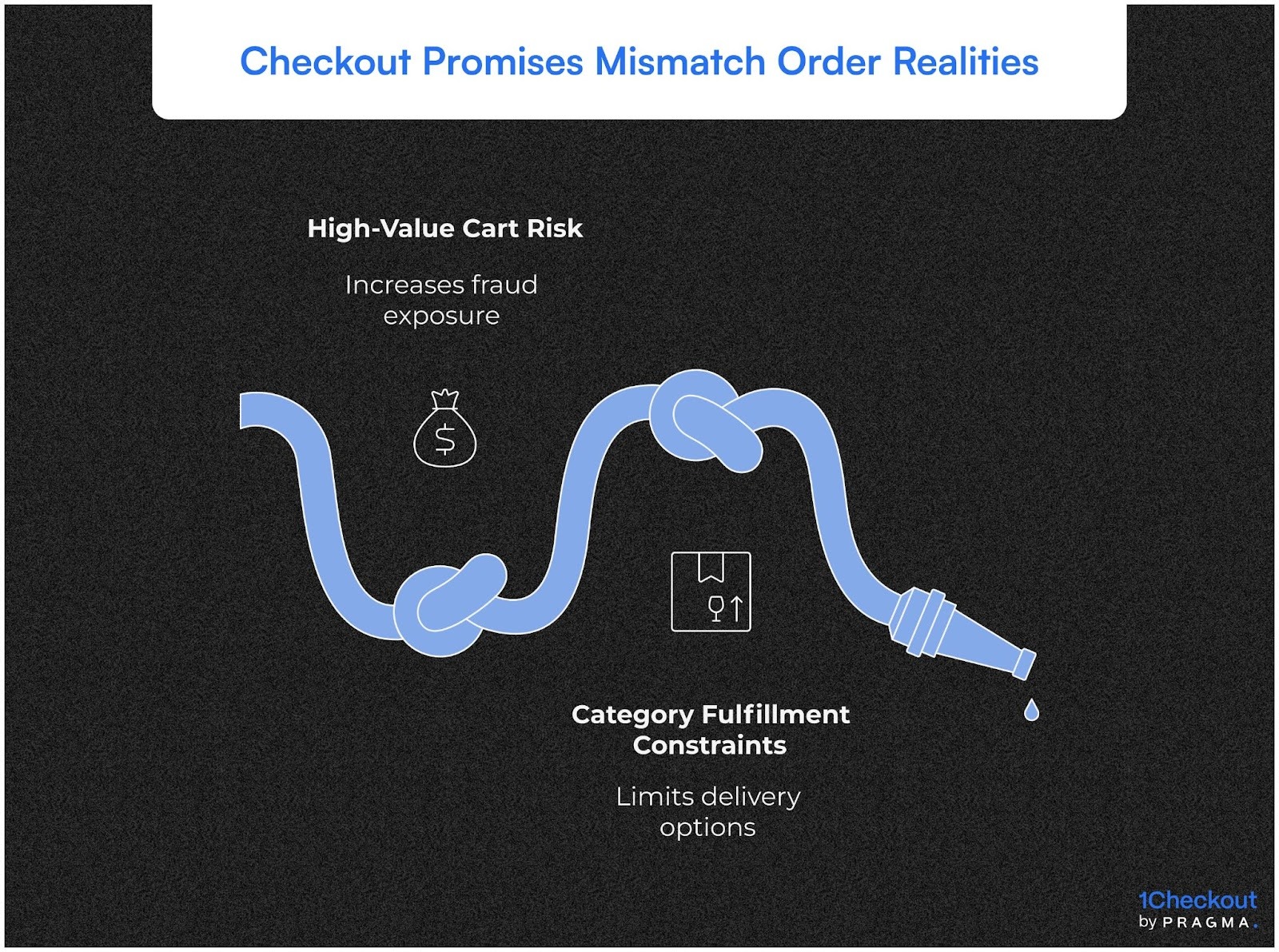
The contents of a cart say a lot about risk and cost. High-value, fragile, bulky or perishable items behave very differently in last mile compared to low-value, repeat-purchase SKUs.
Order value and fraud exposure
High-value carts combined with COD in high-risk pin codes create disproportionate loss exposure. Adaptive checkout can nudge such orders towards prepaid options without blocking genuine buyers outright.
Category-specific fulfilment constraints
Certain categories cannot support express delivery or multiple reattempts economically. Showing these options upfront creates expectation gaps that CX teams later struggle to close.
By respecting cart realities at checkout, brands reduce exceptions downstream.
When should COD be hidden, nudged, or allowed?
COD is a lever, not a right
COD remains critical in India, but it should not be binary. Adaptive checkout allows brands to treat COD as a conditional option.
Hiding COD for structurally risky combinations
Pin codes with consistently low COD success combined with high-value or first-time buyers justify removing COD altogether. This reduces inevitable RTOs rather than reacting to them.
Nudging instead of blocking
For medium-risk scenarios, showing prepaid options more prominently or offering small incentives preserves choice while steering behaviour.
Preserving COD for trusted contexts
Repeat buyers, low-value carts or reliable pin codes should continue to see COD without friction. Blanket COD restrictions hurt trust more than they save cost.
How shipping options should adapt by context
Speed is not always the right promise
Shipping speed is often treated as a conversion lever, but it has real operational cost.
Express delivery only where feasible
Offering next-day or same-day delivery in pin codes with unreliable courier coverage leads to SLA breaches and escalations. Adaptive checkout should hide these options where they cannot be met.
Cost-aware shipping choices
For low-margin carts, slower but cheaper shipping options may be more sustainable. Adaptive checkout allows brands to protect margins without removing choice entirely.
Designing rules without overfitting
Simple logic beats fragile optimisation

Adaptive checkout does not require complex ML models to start. Overly granular rules often break at scale.
Start with coarse segmentation
Broad buckets — high, medium and low risk — are easier to manage and explain internally. These can be refined over time as confidence grows.
Keep rules auditable
Every checkout decision should be explainable. When CX teams understand why an option was hidden, they can communicate more confidently with customers.
How adaptive checkout reduces downstream operational load
Prevention beats recovery
By shaping choices early, adaptive checkout reduces the volume of NDRs, verification calls, retries and returns.
Orders that pass through adaptive checkout tend to have higher intent, clearer expectations and better feasibility alignment. This reduces pressure on last mile, CX and finance simultaneously.
Over time, teams see fewer exceptions, not just better conversion metrics.
Measuring success beyond conversion rate
Look at realised outcomes, not just clicks
Adaptive checkout should be evaluated on realised revenue, delivery success and cost-to-serve.
Metrics such as RTO rate, prepaid mix, delivery SLA adherence and refund leakage offer a truer picture of impact than checkout conversion alone.
Quick Wins
Implement adaptive thinking without heavy rebuilds
Week 1: Audit pincode performance
Identify pin codes with consistently high RTO, low COD acceptance or long delivery times.
Expected result:
Clear visibility into structural risk pockets.
Week 2: Map cart risk signals
Define simple thresholds for order value, category sensitivity and margin exposure.
Expected result:
Shared understanding of which carts need different handling.
Week 3: Pilot COD and shipping logic
Apply adaptive rules to a small traffic segment or specific pin codes.
Expected result:
Early evidence of reduced downstream failures.
Week 4: Review and refine
Analyse conversion, RTO and CX feedback before expanding scope.
Expected result:
Confidence to scale adaptive checkout logic responsibly.
To Wrap It Up
Checkout is not just a growth surface; it is an operational control point. Adaptive checkout aligns customer choice with delivery reality, reducing failure while protecting trust.
This week, identify one high-risk pincode and one high-risk cart type and adapt checkout options for them.
Over time, adaptive checkout becomes a quiet advantage — fewer exceptions, healthier margins and more predictable operations.
For D2C brands seeking intelligent checkout orchestration, Pragma’s Checkout Intelligence platform enables pincode- and cart-aware payment and shipping decisions that reduce RTO while improving realised revenue.
.gif)
FAQs (Frequently Asked Questions On Adaptive checkout: showing payment and shipping options by pincode and cart profile)
1. What is the difference between adaptive checkout and simple personalisation?
Adaptive checkout changes operational options such as payment methods and shipping promises based on risk and feasibility, not just user attributes. Unlike cosmetic personalisation, these decisions directly influence delivery success, cost-to-serve and realised revenue. The intent is to prevent failure early rather than recover from it later.
2. Will hiding payment or shipping options reduce conversion rates?
In some cases, headline conversion may dip slightly, but realised revenue and fulfilment success usually improve. Orders that complete through adaptive checkout tend to have higher intent and fewer downstream failures. Over time, brands often see better net revenue despite fewer risky checkouts.
3. How granular should pincode-level rules be?
Pincode rules should start broad rather than hyper-specific. Grouping pin codes into performance buckets such as high, medium and low reliability is easier to manage and explain. Excessive granularity increases operational complexity and makes rules brittle as conditions change.
4. Can adaptive checkout work without historical data?
Yes. Even limited data such as courier serviceability, payment type trends, and early delivery outcomes can inform initial rules. Brands can start with conservative assumptions and refine logic as more data becomes available. Waiting for perfect data often delays meaningful improvement.
5. How does adaptive checkout help reduce RTO specifically?
By aligning payment options and delivery promises with pincode and cart risk, adaptive checkout filters out low-intent orders early. High-risk COD orders are either nudged toward prepaid or prevented altogether, reducing refusals and non-responsiveness that typically lead to RTO.
6. Should repeat customers see different checkout rules than first-time buyers?
Yes. Repeat customers with successful delivery history deserve fewer restrictions and faster options. Treating loyal buyers the same as unknown or high-risk profiles can hurt trust and lifetime value. Adaptive checkout allows this differentiation without manual intervention.
7. How do CX teams handle questions when options are hidden?
When rules are explainable, CX teams can respond confidently. Simple explanations such as delivery feasibility or payment availability in a specific area are usually accepted by customers. Transparency matters more than offering every option to everyone.
8. How often should adaptive checkout rules be reviewed?
Rules should be reviewed monthly or after major operational changes such as courier shifts, category expansion or seasonal spikes. Adaptive checkout is not a set-and-forget system. Regular review ensures rules remain aligned with ground reality.
Talk to our experts for a customised solution that can maximise your sales funnel
Book a demo

.png)
.png)